ENG
ENG Japanese
  French
  German
  Korean
Implantable Defibrillators Market: Market Size by Segment, Region, Share Analysis, Regulatory Framework, Reimbursement Dynamics, Intervention Trends, and Outlook to 2032
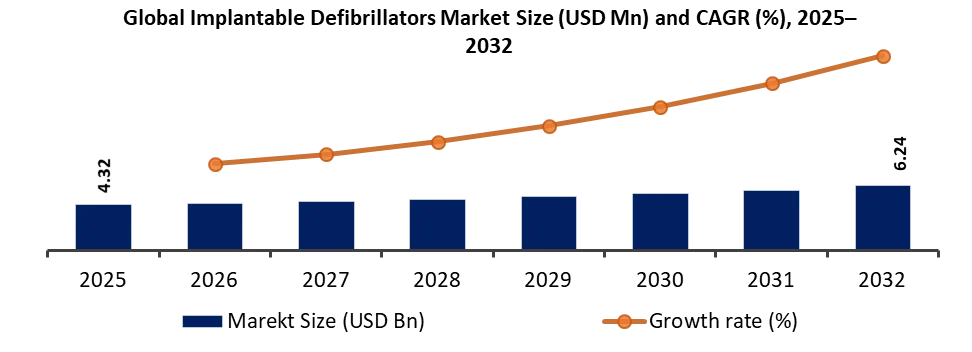
Global Implantable Defibrillators market was valued at USD 4.32 billion in 2025 and is projected to grow at a CAGR of 5.40% from 2026 to 2032, reaching USD 6.24 billion by 2032.
The implantable defibrillators market is expected to grow steadily during the forecast period. Growth is driven by the rapidly growing geriatric population and the increasing incidence of sudden cardiac arrest (SCA) globally.
The adoption of implantable cardioverter defibrillators (ICDs) in patients with nonischemic cardiomyopathy has demonstrated a mortality risk reduction of 23%, creating new opportunities for implantable defibrillators market players. Alongside traditional transvenous systems, the market is witnessing a notable shift toward subcutaneous implantable cardioverter defibrillators (S-ICDs) and next-generation extravascular ICD (EV-ICD) platforms, which eliminate the need for leads placed inside the heart or vasculature. The S-ICD segment is projected to grow at a CAGR of 6.18% during the forecast period outpacing the overall market driven by rising clinician preference for lead-complication-free therapy and expanding eligibility criteria for younger and lower-risk patients. This technology transition is reshaping competitive dynamics across the implantable defibrillators market, with major players including Medtronic, Boston Scientific, and Abbott accelerating investments in extravascular and subcutaneous device platforms.
To get more Insights: Request Free Sample Report
Implantable Defibrillators Market Key Highlights
- North America Implantable Defibrillators Market size was valued at USD 1.74 billion in 2025.
- Adults segment accounted for 58.88% market share in 2025, supported by higher incidence of heart failure and arrhythmias in the adult demographic.
- The Implantable Defibrillators industry in the U.S. is expected to grow rate of 5.12% significantly over the forecast period (2026-2032).
- S-ICD Product is expected to grow at a CAGR of 6.18% during forecast Period (2026-2032) in Implantable Defibrillators Market.
- Asia Pacific Implantable Defibrillators Market Size to Hit USD 1.51 Billion By 2032.
Clinical Necessity Meets Long-Term Device Economics:
The Implantable Defibrillators Market is driven by strong clinical necessity and long-term device economics. Implantable defibrillators are widely prescribed for patients with structural heart disease, ischemic and non-ischemic cardiomyopathy, heart failure with reduced ejection fraction, and inherited arrhythmia syndromes —patient cohorts that are expanding globally owing to:
- Improved diagnostic rates for arrhythmogenic disorders
- Increasing diabetes prevalence
- Aging populations
- Rising survival from acute cardiac events
Demand for implantable defibrillators (ICDs) is clinically locked in, as high-risk patients need lifelong sudden cardiac arrest (SCA) prevention. As a result, battery longevity, replacement cycles, and remote monitoring capabilities are as economically critical as initial implantation volumes. Device replacement intervals of 5–7 years, along with risks related to lead failure, infection, and inappropriate shocks, continue to shape procurement decisions and total cost-of-care considerations.
Diabetes Prevalence and Its Impact on the Implantable Defibrillators Market:
The Implantable Defibrillators Market is expected to benefit from the increasing global prevalence of diabetes and pre-diabetes, which significantly elevates the risk of cardiovascular complications and sudden cardiac death. Diabetes contributes to progressive damage of the heart and vascular system, increasing the incidence of arrhythmias and myocardial dysfunction. Implantable cardioverter defibrillators (ICDs) play a critical role in managing high-risk diabetic patients by reducing arrhythmic mortality and overall death rates.
|
Indicator (2025) |
Statistical Data |
Relevance to Implantable Defibrillators Market |
|
Global people living with diabetes (20–79 years) |
~589 million |
Expands the high-risk population for sudden cardiac arrest (SCA) and arrhythmias |
|
Undiagnosed diabetes cases |
~250 million adults |
Delayed diagnosis increases risk of advanced cardiac complications |
|
Diabetes cases in low- & middle-income countries |
~81% of total cases |
Drives long-term ICD adoption potential in Asia-Pacific, Latin America, MEA |
|
Cardiovascular disease as leading cause of death in diabetics |
~50% of diabetes-related deaths |
Supports clinical justification for ICD implantation |
|
Impact of diabetes on cardiac risk |
2–4× higher risk of arrhythmias & heart failure |
Increases eligibility for implantable defibrillator therapy |
|
ICD effectiveness in high-risk cardiomyopathy (incl. diabetics) |
~23% mortality risk reduction (multi-year) |
Strengthens payer and clinician confidence in ICD utilization |
|
Forecast diabetes trajectory |
~853 million by 2050 |
Sustains long-term growth outlook for the Implantable Defibrillators Market |
Demand Is Rising, but Adoption Is Uneven:
Implantable defibrillator penetration varies significantly across regions due to various structural and healthcare system constraints, including:
- High device and procedure costs (USD 25,000–50,000 per implant)
- Reimbursement variability across public and private healthcare systems
- Shortage of trained electrophysiologists in emerging markets
- Infrastructure gaps for implantation, follow-up, and remote monitoring
As a result, North America and Europe dominate installed base and replacement-driven revenues, while Asia Pacific represents the fastest-growing opportunity, driven by improving access, cost-optimized device offerings, and growing cardiac care infrastructure.
Implantable Defibrillators Market – DROCT-Based Strategic Outlook
|
Dimension |
Market Impact |
|
Drivers |
Rising sudden cardiac arrest incidence, aging population, higher cardiovascular disease burden |
|
Restraints |
High device and implantation costs, reimbursement variability |
|
Opportunities |
Subcutaneous ICDs, extended battery life, remote patient monitoring |
|
Challenges |
Shortage of trained electrophysiologists, infrastructure gaps |
|
Trends |
Shift toward leadless systems, MRI-conditional and connected ICDs |
Implantable Defibrillators Market Segment Analysis
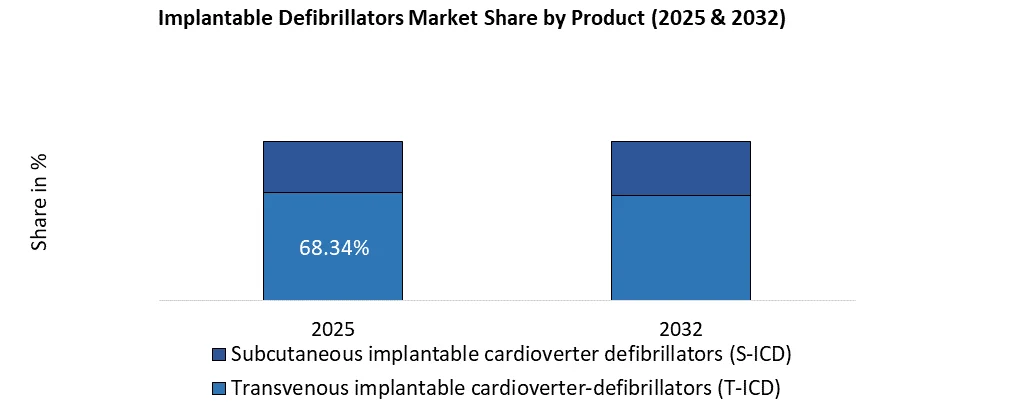
By Product, the Transvenous implantable cardioverter-defibrillators (T-ICD) segment dominated the Implantable Defibrillators market and accounted for a market share of nearly 68.34% in 2025. Despite procedural risks and costs associated with transvenous implantation, T-ICDs remain the dominant choice due to their comprehensive therapeutic capabilities — including cardiac resynchronization therapy (CRT), permanent pacing, and anti-tachycardia pacing — making them the preferred option for patients with ventricular tachycardia (VT) and ventricular fibrillation (VF).
By End User, Hospitals & Cardiac Centers segment held the 74.12% share of the global Implantable Defibrillators market in 2025. Hospitals provide immediate access to cardiac surgery, intensive care units (ICUs), and complication response, which is critical in managing procedural risks such as lead dislodgement, infection, or inappropriate shocks.

By Patient Type (Adults vs. Pediatrics), adults represent the overwhelmingly dominant patient cohort in 2025, accounting for the vast majority of ICD implantations globally, as ICD therapy is primarily indicated for adult patients with structural heart disease, heart failure, and arrhythmia syndromes. Pediatric ICD implantation, while clinically significant, remains a smaller subset driven by inherited arrhythmia syndromes and congenital heart disease.
Implantable Defibrillators Market Regional Analysis
North America held the largest share of 40.32% in 2025. The United States dominates, backed by strong reimbursement and high ICD implantation rates. Canada grows steadily supported by universal healthcare coverage and rising cardiovascular awareness. Mexico is an emerging market driven by improving hospital infrastructure and expanding reimbursement frameworks.

Asia-Pacific Implantable Defibrillators Market expected to grow highest CAGR of 6.62% during the forecast Period. The growth is fuelled by improving device availability through active distributor networks and a rapid rise in hospitals and cardiac clinics. Strong investments by leading medical device manufacturers are further strengthening regional implantable defibrillators market growth. The presence of a large, underpenetrated patient population, particularly in high-growth economies such as India, China, Japan, and South Korea are creating substantial long-term opportunities.
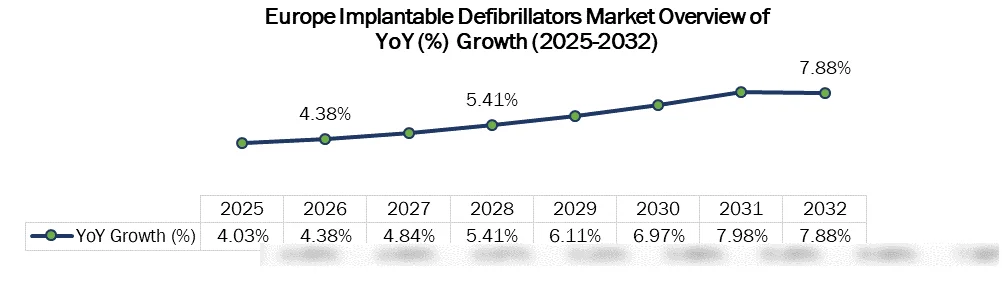
Europe held a significant share of the Implantable Defibrillators Market in 2025, supported by well-established reimbursement frameworks and strong ICD adoption across Germany, France, and the UK. South America is expected to grow at a CAGR of 4.03% during 2026–2032, driven by improving cardiac care infrastructure in Brazil and Argentina and rising cardiovascular disease burden. The Middle East and Africa market is growing steadily, supported by increasing healthcare investments across GCC nations, though infrastructure gaps and cost constraints continue to limit broader regional penetration.
Implantable Defibrillators Market Competitive Landscape:
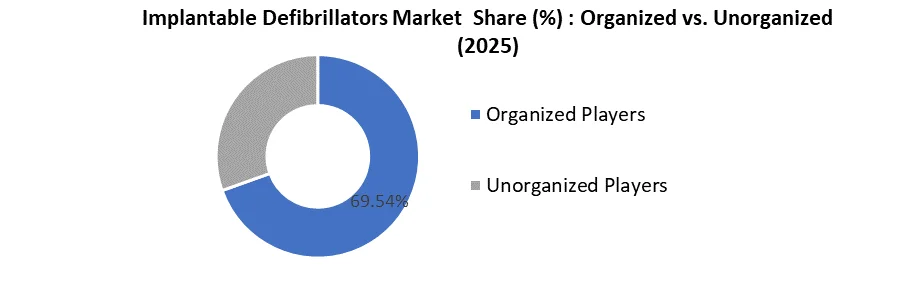
The implantable defibrillators market in 2025 is dominated by a few global leaders—Medtronic, Abbott, Boston Scientific, and Biotronik—who collectively hold the majority share. Medtronic leads with strong transvenous ICD and CRT-D portfolios, while Abbott and Boston Scientific are pushing growth in subcutaneous ICDs and remote monitoring solutions. Biotronik remains competitive in Europe with advanced telemetry integration.
Recent Developments in the Implantable Defibrillators Market:
|
Date |
Company |
Development |
Market Impact |
|
Jan-26 |
Abbott (in collaboration with AtaCor Medical) |
Announced a collaboration to advance a next-generation investigational extravascular ICD (EV-ICD) system, pairing AtaCor's investigational parasternal Atala™ EV-ICD lead with Abbott's investigational ICD system. A pivotal IDE clinical trial is planned for initiation in 2026. |
Positions Abbott as a third major EV-ICD entrant alongside Medtronic and Boston Scientific, expanding the extravascular ICD landscape and offering a lead-in-heart-free therapy option for a broader patient population. |
|
Feb-26 |
BIOTRONIK |
Launched the Acticor Sky and Rivacor Sky ICD/CRT-D device family — the world's first CE-approved devices supporting left bundle branch area pacing (LBBAP), now commercially available across European CE markets. |
Establishes BIOTRONIK as the first mover in conduction system pacing via high-voltage devices, opening a new clinical indication pathway and reinforcing the company's competitive position in the European ICD and CRT-D market. |
|
Feb-24 |
BIOTRONIK |
Announced it will exclusively supply its proprietary DX single-lead ICD models for all new single-chamber ICD implants, discontinuing traditional single-chamber ICD offerings, driven by clinical evidence of superior AF detection and lower complication risk of DX technology. |
Signals a major strategic shift in single-chamber ICD procurement, compelling electrophysiologists and hospital procurement teams to reassess device selection; strengthens BIOTRONIK's differentiation in the competitive ICD market. |
Implantable Defibrillators Market Scope
|
Implantable Defibrillators Market |
|||
|
This Report Covers |
Details |
||
|
Base Year: |
2025 |
Forecast Period: |
2026-2032 |
|
Historical Data: |
2019 to 2025 |
Market Size in 2025: |
USD 4.32 Bn |
|
Forecast Period 2025 to 2032 CAGR: |
5.40% |
Market Size in 2032: |
USD 6.24 Bn |
|
Implantable Defibrillators Market Segments Covered: |
By Product |
Transvenous implantable cardioverter-defibrillators (T-ICD) Subcutaneous implantable cardioverter defibrillators (S-ICD)
|
|
|
By Type |
Single-chamber ICDs Dual-chamber ICDs Biventricular devices |
||
|
By End User |
Hospitals & Cardiac Centers Ambulatory Surgical Centers Specialty Clinics Home-care / Remote Monitoring Programs |
||
|
|
By Patient Type |
Adults Pediatrics |
|
Implantable Defibrillators Market, by region
North America (United States, Canada and Mexico)
Europe (UK, France, Germany, Italy, Spain, Sweden, Russia and Rest of Europe)
Asia Pacific (China, South Korea, Japan, India, Australia, Indonesia, Malaysia, Vietnam, Philippines, Thailand, and Rest of APAC)
South America (Brazil, Argentina, Rest of South America)
Middle East and Africa (South Africa, GCC, Egypt, Nigeria, Rest of MEA)
Implantable Defibrillators Market key Players
- Medtronic plc
- Boston Scientific Corporation
- Abbott Laboratories (St. Jude Medical)
- BIOTRONIK SE & Co. KG
- MicroPort CRM (MicroPort Scientific)
- LivaNova PLC
- Integer Holdings Corporation
- Lepu Medical Technology Co., Ltd.
- Shree Pacetronix Ltd.
- Medico S.p.A.
- Osypka AG
- Jingjing Medical Equipment
- EBR Systems
- EBR Extravascular Solutions
- CathRx Ltd.
- Fukuda Denshi Co., Ltd.
- Nihon Kohden Corporation
- BPL Medical Technologies
- Progetti S.r.l.
- CU Medical Systems, Inc.
- Metrax GmbH
- Bexen Cardio
Frequently Asked Questions
The Implantable Defibrillators market is projected to reach USD 6.24 billion by 2032.
North America held 40.32% of the global market in 2025.
The South America market is expected to grow at a CAGR of 4.03% from 2026 to 2032
Major players in the Implantable Defibrillators market are Medtronic plc, Boston Scientific Corporation, Abbott, BIOTRONIK SE & Co. KG and others.
1. Implantable Defibrillators Market Introduction
1.1. Study Assumption and Market Definition
1.2. Scope of the Study
1.3. Executive Summary
2. Global Implantable Defibrillators Market: Competitive Landscape
2.1. SMR Competition Matrix
2.2. Key Players Benchmarking
2.2.1. Company Name
2.2.2. Headquarter
2.2.3. Product Segment
2.2.4. Revenue Details in 2025
2.2.5. Market Share (%)
2.2.6. Growth Rate (%)
2.2.7. Distribution Channel
2.2.8. Return on Investment (%)
2.2.9. Technological Capabilities
2.2.10. Geographical Presence
2.3. Market Structure
2.3.1. Market Leaders
2.3.2. Market Followers
2.3.3. Emerging Players
2.4. Mergers and Acquisitions Details
3. Implantable Defibrillators Market: Dynamics
3.1. Implantable Defibrillators Market Trends
3.2. Implantable Defibrillators Market Dynamics
3.2.1. Drivers
3.2.2. Restraints
3.2.3. Opportunities
3.2.4. Challenges
3.3. PORTER’s Five Forces Analysis
3.4. PESTLE Analysis
3.5. Regulatory Landscape by Region
3.6. Key Opinion Leader Analysis for the Global Industry
3.7. Analysis of Government Schemes and Initiatives for Industry
4. Implantable Defibrillators Market Pricing & Cost Structure Analysis (2025)
4.1. Average Pricing Trends for Implantable Defibrillators Product (2025)
4.2. Regional Pricing Analysis of Implantable Defibrillators (2025)
4.3. Pricing Strategies of Key Players in the Implantable Defibrillators Market
4.4. Pricing Drivers: Raw Material Costs, Logistics, and Compliance
4.5. OEMs are shifting toward value-based pricing focused on total cost-of-care reduction.
5. Implantable Defibrillators Market End-User & Buyer Insights
5.1. Hospitals & Cardiac Centers dominate ICD usage.
5.2. Electrophysiologists drive device selection decisions.
5.3. Total cost-of-care is a key buying criterion.
5.4. Ambulatory Surgical Centers show gradual adoption.
5.5. Emerging markets rely on distributor-led purchasing.
6. Implantable Defibrillators Market Technology & Innovation Trends
6.1. Extended battery life to lower replacement frequency and lifetime treatment costs.
6.2. Subcutaneous and extravascular ICD systems reducing lead-related complications.
6.3. MRI-conditional devices enabling safer access to diagnostic imaging.
6.4. Remote monitoring and connected ICD platforms supporting continuous patient management.
6.5. Miniaturized device designs improving patient comfort and implantation flexibility.
6.6. Advanced sensing and therapy algorithms enhancing arrhythmia detection accuracy.
6.7. Focus on total cost-of-care optimization through technology-led efficiency gains.
7. Implantable Defibrillators Market Supply Chain & Manufacturing Insights
7.1. Strict regulatory and quality compliance requirements.
7.2. Concentrated suppliers for key components.
7.3. OEM-controlled manufacturing dominance.
7.4. Long validation and approval cycles.
7.5. Supply chain exposure to component shortages.
7.6. Regional manufacturing hubs for compliance and efficiency.
8. Implantable Defibrillators Market: Global Market Size and Forecast by Segmentation (by Value in USD Million) (2025-2032)
8.1. Implantable Defibrillators Market Size and Forecast, By Product (2025-2032) (Volume Mn Units)
8.1.1. Transvenous implantable cardioverter-defibrillators (T-ICD)
8.1.2. Subcutaneous implantable cardioverter defibrillators (S-ICD)
8.2. Implantable Defibrillators Market Size and Forecast, By Type (2025-2032)
8.2.1. Single-chamber ICDs
8.2.2. Dual-chamber ICDs
8.2.3. Biventricular devices
8.3. Implantable Defibrillators Market Size and Forecast, By End User (2025-2032)
8.3.1. Hospitals & Cardiac Centers
8.3.2. Ambulatory Surgical Centers
8.3.3. Specialty Clinics
8.3.4. Home-care / Remote Monitoring Programs
8.4. Implantable Defibrillators Market Size and Forecast, By Patient Type(2025-2032)
8.4.1. Adults
8.4.2. Pediatrics
8.5. Implantable Defibrillators Market Size and Forecast, By Region (2025-2032)
8.5.1. North America
8.5.2. Europe
8.5.3. Asia Pacific
8.5.4. Middle East and Africa
8.5.5. South America
9. North America Implantable Defibrillators Market Size and Forecast by Segmentation (by Value in USD Million) (2025-2032)
9.1. North America Implantable Defibrillators Market Size and Forecast, By Product (2025-2032) (Volume Mn Units)
9.2. North America Implantable Defibrillators Market Size and Forecast, By Type (2025-2032)
9.3. North America Implantable Defibrillators Market Size and Forecast, By End User (2025-2032)
9.4. North America Implantable Defibrillators Market Size and Forecast, By Patient Type (2025-2032)
9.5. North America Implantable Defibrillators Market Size and Forecast, by Country (2025-2032)
9.5.1. United States
9.5.2. Canada
9.5.3. Mexico
10. Europe Implantable Defibrillators Market Size and Forecast by Segmentation (by Value in USD Million) (2025-2032)
10.1. Europe Implantable Defibrillators Market Size and Forecast, By Product (2025-2032) (Volume Mn Units)
10.2. Europe Implantable Defibrillators Market Size and Forecast, By Type (2025-2032)
10.3. Europe Implantable Defibrillators Market Size and Forecast, By End User (2025-2032)
10.4. Europe Implantable Defibrillators Market Size and Forecast, By Patient Type (2025-2032)
10.5. Europe Implantable Defibrillators Market Size and Forecast, by Country (2025-2032)
10.5.1. United Kingdom
10.5.1.1. United Kingdom Implantable Defibrillators Market Size and Forecast, By Product (2025-2032)
10.5.1.2. United Kingdom Implantable Defibrillators Market Size and Forecast, By Type (2025-2032)
10.5.1.3. United Kingdom Implantable Defibrillators Market Size and Forecast, By End User (2025-2032)
10.5.1.4. United Kingdom Implantable Defibrillators Market Size and Forecast, By Patient Type (2025-2032)
10.5.2. France
10.5.3. Germany
10.5.4. Italy
10.5.5. Spain
10.5.6. Sweden
10.5.7. Russia
10.5.8. Rest of Europe
11. Asia Pacific Implantable Defibrillators Market Size and Forecast by Segmentation (by Value in USD Million) (2025-2032)
11.1. Asia Pacific Implantable Defibrillators Market Size and Forecast, By Product (2025-2032) (Volume Mn Units)
11.2. Asia Pacific Implantable Defibrillators Market Size and Forecast, By Type (2025-2032)
11.3. Asia Pacific Implantable Defibrillators Market Size and Forecast, By End User (2025-2032)
11.4. Asia Pacific Implantable Defibrillators Market Size and Forecast, By Patient Type (2025-2032)
11.5. Asia Pacific Implantable Defibrillators Market Size and Forecast, by Country (2025-2032)
11.5.1. China
11.5.2. S Korea
11.5.3. Japan
11.5.4. India
11.5.5. Australia
11.5.6. Indonesia
11.5.7. Malaysia
11.5.8. Philippines
11.5.9. Thailand
11.5.10. Vietnam
11.5.11. Rest of Asia Pacific
12. Middle East and Africa Implantable Defibrillators Market Size and Forecast (by Value in USD Million) (2025-2032)
12.1. Middle East and Africa Implantable Defibrillators Market Size and Forecast, By Product (2025-2032) (Volume Mn Units)
12.2. Middle East and Africa Implantable Defibrillators Market Size and Forecast, By Type (2025-2032)
12.3. Middle East and Africa Implantable Defibrillators Market Size and Forecast, By End User (2025-2032)
12.4. Middle East and Africa Implantable Defibrillators Market Size and Forecast, By Patient Type (2025-2032)
12.5. Middle East and Africa Implantable Defibrillators Market Size and Forecast, by Country (2025-2032)
12.5.1. South Africa
12.5.2. GCC
12.5.3. Egypt
12.5.4. Nigeria
12.5.5. Rest of ME&A
13. South America Implantable Defibrillators Market Size and Forecast by Segmentation (by Value in USD Million) (2025-2032)
13.1. South America Implantable Defibrillators Market Size and Forecast, By Product (2025-2032) (Volume Mn Units)
13.2. South America Implantable Defibrillators Market Size and Forecast, By Type (2025-2032)
13.3. South America Implantable Defibrillators Market Size and Forecast, By End User (2025-2032)
13.4. South America Implantable Defibrillators Market Size and Forecast, by Patient Type (2025-2032)
13.5. South America Implantable Defibrillators Market Size and Forecast, by Country (2025-2032)
13.5.1. Brazil
13.5.2. Argentina
13.5.3. Colombia
13.5.4. Chile
13.5.5. Rest Of South America
14. Company Profile: Key Players
14.1. Medtronic plc.
14.1.1. Company Overview
14.1.2. Business Portfolio
14.1.3. Financial Overview
14.1.4. SWOT Analysis
14.1.5. Strategic Analysis
14.1.6. Recent Developments
14.2. Boston Scientific Corporation
14.3. Boston Scientific Corporation
14.4. Abbott Laboratories (St. Jude Medical)
14.5. BIOTRONIK SE & Co. KG
14.6. MicroPort CRM (MicroPort Scientific)
14.7. LivaNova PLC
14.8. Integer Holdings Corporation
14.9. Lepu Medical Technology Co., Ltd.
14.10. Shree Pacetronix Ltd.
14.11. Medico S.p.A.
14.12. Osypka AG
14.13. Jingjing Medical Equipment
14.14. EBR Systems
14.15. EBR Extravascular Solutions
14.16. CathRx Ltd.
14.17. Fukuda Denshi Co., Ltd.
14.18. Nihon Kohden Corporation
14.19. BPL Medical Technologies
14.20. Progetti S.r.l.
14.21. CU Medical Systems, Inc.
14.22. Metrax GmbH
14.23. Bexen Cardio
Others
15. Implantable Defibrillators Market Key Findings
16. Implantable Defibrillators Market Analyst Recommendations
17. Implantable Defibrillators Market: Research Methodology