ENG
ENG Japanese
  French
  German
  Korean
Asia Pacific Mustard Market Growth Driven by Rising Food Demand
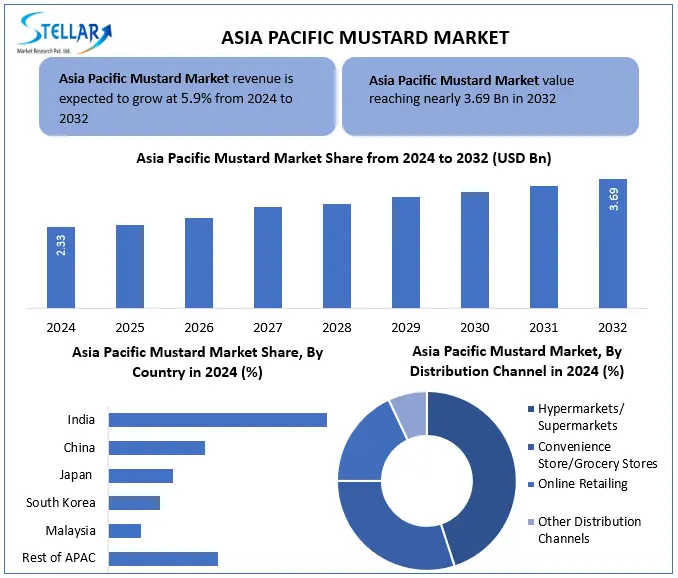
Asia Pacific Mustard Market is valued at USD 2.33 Bn in 2024 and is expected to reach USD 3.69 Bn by 2032, growing at a CAGR of 6.2%, driven by health and condiment demand.
Asia Pacific Mustard Market Overview:
Mustard is a condiment made from the seeds of mustard plants, mixed with water, vinegar, or other liquids. It has a sharp, tangy flavour and is used in cooking, dressings, and sauces. Common varieties include yellow, Dijon, and whole grain mustard.
The Asia Pacific mustard market is experiencing steady growth, driven by increasing demand for condiments, spices, and processed foods. Mustard, used in various forms such as seeds, powder, paste, and oil, is a staple in many regional cuisines, particularly in India, China, and Japan. India dominates the market due to its extensive use of mustard seeds in cooking and traditional Ayurvedic medicine, while China and Japan contribute significantly due to the popularity of mustard-based sauces in their culinary practices. The rising trend of fast food and ready-to-eat meals further boosts demand, as mustard is a key ingredient in dressings, dips, and marinades.
Recent innovations in the Asia Pacific mustard market include flavoured and functional mustard variants, such as honey-infused and probiotic-rich options, alongside eco-friendly packaging solutions. Brands are also adopting blockchain for traceability and promoting cold-pressed mustard oil for its health benefits. Additionally, ready-to-use mustard pastes and sauces tailored to regional cuisines are gaining popularity.
To get more Insights: Request Free Sample Report
Asia Pacific Mustard Market Dynamics:
Expansion of the Food Industry boosts the Asia Pacific Mustard Market Growth
The expansion of the food industry, especially fast-food chains, restaurants and the growth of packaged food areas, is a major driver for the mustard market. As consumer feature increases the demand for food items and ready-to-eat food, a popular spice for mustard, burgers, sandwiches and dressing, the experience increases consumption. Fast-food giants and food items service providers continuously include mustard-based sauce in their menu, which further help to boost mustard market. Also, increase in processed foods packed and processed, including sauces and dips, ensures stable demand for mustard as a taste. This trend is expected to continue because the global food industry continues to develop and diversify.
Recently, Taco Bell introduced Crispy Chicken Nuggets. These nuggets are paired with three dipping sauces, including the Jalapeño Honey Mustard Sauce, highlighting the increasing demand for mustard-based condiments in quick-service restaurants.
Strict Food Safety Laws Challenge Asia Pacific Mustard Market Growth
Strict food safety laws across Asia Pacific region are posing challenges to growth of mustard market. Regulations enforced by authorities like India's FSSAI mandate stringent compliance in labelling, safety, and organic certification, increasing operational costs for a producer. Varying standards across countries complicate trade, and heightened consumer vigilance regarding food quality necessitates rigorous testing and traceability measures, further straining resources for mustard manufacturers.
In September 2024, a significant food safety incident occurred when unreported mustard seeds were detected in certain Asian snacks, prompting a recall to protect consumers with mustard allergies. This event highlights the critical importance of accurate allergen labelling and the challenges faced by the mustard market in adhering to stringent food safety regulations.
Organic & Non-GMO Mustard Products are an Opportunity for the Asia Pacific Mustard Market
Consumers' growing towards health-conscious and durable food options offers an important opportunity for organic and non-GMO mustard products. As an increase in awareness about chemical-free farming and clean label material, the demand for organic mustard seeds, oil and spices is increasing. Food manufacturers can appeal to the environment-conscious and welfare-centred consumers by offering this trend-certified organic and non-GMO mustard variants. Additionally, retailers and e-commerce platforms are expanding their organic product categories, providing better access. This segment not only enhances the reliability of the brand but also allows premium pricing in the mustard market, driving profits.
Asia Pacific Mustard Market Segment Analysis:
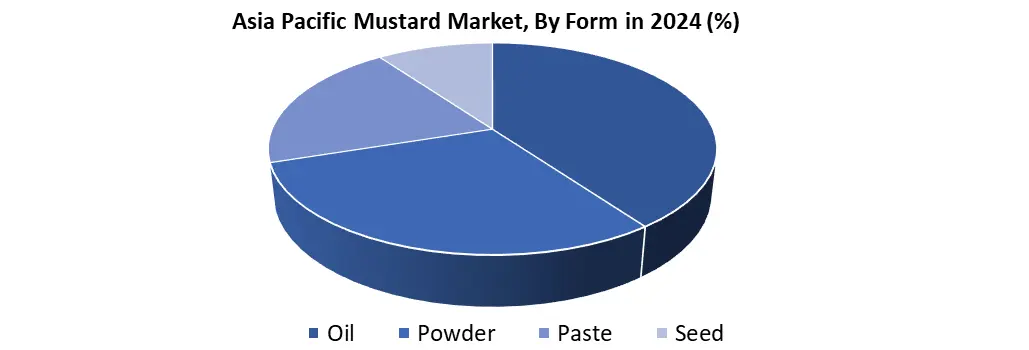
Based on Form, the mustard market is segmented into seed, powder, oil and paste. Mustard oil segment is a dominates the global mustard market by its extensive use in cooking, especially in South Asian countries like India, Bangladesh, and Nepal, where it is a staple cooking oil. Its high smoke point, strong flavour, and also perceived health benefits contribute to its popularity. Mustard powder holds the second-largest share, driven by demand in food processing, spice blends, and Western culinary applications. Paste and seeds, while significant, have smaller market shares, as they are primarily used in condiments, pickling, and the speciality dishes rather than everyday consumption.
Based on Distribution Channel, Mustard market is segmented into a online retailing, hypermarkets/ supermarkets, convenience stores/grocery stores and other distribution channels. Hypermarkets/Supermarkets dominate the Asia Pacific mustard market distribution channels, holding approximately 40% market share. This leadership stems from their widespread retail networks, consumer preference for one-stop shopping, and strong partnerships with major mustard brands. These large-format stores offer greater product visibility, promotional opportunities, and quality assurance that attract both urban and semi-urban consumers, making them the preferred distribution channel for packaged mustard products across the region.
Asia Pacific Mustard Market Country Insight:
India Leads Asia Pacific Mustard Market as Production Demand and Export Powerhouse
The Asia Pacific mustard market is dominated by India due to its massive domestic consumption and production. India is world's second largest mustard producer, with 8 to 10 million metric tons annually to their favourable agroclimatic conditions in states like Rajasthan, Uttar Pradesh, and Haryana. Mustard is a staple in Indian cuisine, accounting for 90% of local demand, while its export of mustard oil and seeds strengthens its dominance. Also, government support through subsidies and rising demand for a organic and non-GMO mustard products further solidify India's lead. China follows as the second-largest market but remains a distant competitor due to lower per capita consumption.
Asia Pacific Mustard Market Competitive Landscape:
The Asia Pacific mustard market is led by major players like Mother Dairy, Adani Wilmar and others. These companies dominate with strong distribution networks and popular mustard oil brands, capturing over 40% of the branded market share. Meanwhile, China and Bangladesh compete with local processors, though India remains unmatched in export volume, shipping 500,000+ tons annually. Private labels and regional cooperatives also thrive, especially in rural markets, while increasing demand for organic and cold-pressed variants is driving new entrants. The market remains price-sensitive, with competition intensifying over quality, pricing, and sustainability claims.
Recent Development in the Asia Pacific Mustard Market
Recently, Adani Wilmar launched a new "Fortune Kachi Ghani Mustard Oil" with enhanced packaging and purity claims, targeting health-conscious consumers. Meanwhile, ITC Ltd. expanded its "Sunfeast Farmlite" brand to include cold-pressed mustard oil, capitalising on the organic food trend in India.
|
Asia Pacific Mustard Market Scope |
|
|
Market Size in 2023 |
USD 2.33 Bn. |
|
Market Size in 2030 |
USD 3.69 Bn. |
|
CAGR (2024-2030) |
5.9% |
|
Historic Data |
2019-2024 |
|
Base Year |
2024 |
|
Forecast Period |
2025-2032 |
|
Segments |
By Form Seed Powder Oil Paste |
|
By Distribution Channel Online Retailing Hypermarkets/ Supermarkets Convenience Store/Grocery Stores Other Distribution Channels |
|
|
Regional Scope
|
Asia Pacific – China, South Korea, Japan, India, Australia, Indonesia, Philippines, Malaysia, Vietnam, Thailand, Rest of Asia Pacific |
Asia Pacific Mustard Market Key Players:
- Adani Wilmar Limited (India)
- Emami Agrotech Ltd. (India)
- Marico Limited (India)
- Patanjali Ayurved (India)
- K S Oils Limited (India)
- Puri Oil Mills Ltd. (India)
- Mother Dairy Fruit & Vegetable Pvt. Ltd. (India)
- Bansal Oil Mill Limited (India)
- BL Agro Industries (India)
- Ruchi Soya Industries Ltd. (India)
Frequently Asked Questions
Asia Pacific Mustard Market size was valued at USD 2.33 Bn in 2024, and is expected to grow at a CAGR of 5.9% from 2024 to 2032.
The segments covered are by form and Distribution Channel.
The Key Players in the Asia Pacific Mustard Market are Adani Wilmar Limited, Emami Agrotech Ltd., Marico Limited, and Patanjali Ayurved.
1. Asia Pacific Mustard Market: Research Methodology
2. Asia Pacific Mustard Market Introduction
2.1. Study Assumptions and Market Definition
2.2. Scope of the Study
2.3. Executive Summary
3. Asia Pacific Mustard Market: Competitive Landscape
3.1. SMR Competition Matrix
3.2. Competitive Landscape
3.3. Key Players Benchmarking
3.3.1. Company Name
3.3.2. Product Segment
3.3.3. End-user Segment
3.3.4. Revenue (2024)
3.3.5. Company Headquarters
3.4. Market Structure
3.4.1. Market Leaders
3.4.2. Market Followers
3.4.3. Emerging Players
3.5. Mustard Import Export Analysis
3.6. Mergers and Acquisitions Details
4. Asia Pacific Mustard Market: Dynamics
4.1. Mustard Market Trends
4.2. Mustard Market Dynamics
4.2.1. Drivers
4.2.2. Restraints
4.2.3. Opportunities
4.2.4. Challenges
4.3. PORTER’s Five Forces Analysis
4.4. PESTLE Analysis
4.5. Technology Roadmap
4.6. Regulatory Landscape
5. Asia Pacific Mustard Market Size and Forecast by Segmentation (Value in USD Billion) (2024-2032)
5.1. Asia Pacific Mustard Market Size and Forecast, By Form (2024-2032)
5.1.1. Seed
5.1.2. Powder
5.1.3. Oil
5.1.4. Paste
5.2. Asia Pacific Mustard Market Size and Forecast, By Distribution Channel (2024-2032)
5.2.1. Online Retailing
5.2.2. Hypermarkets/ Supermarkets
5.2.3. Convenience Store/Grocery Stores
5.2.4. Other Distribution Channels
5.3. Asia Pacific Asia Pacific Mustard Market Size and Forecast, by Country (2024-2032)
5.3.1. China
5.3.2. S Korea
5.3.3. Japan
5.3.4. India
5.3.5. Australia
5.3.6. Indonesia
5.3.7. Vietnam
5.3.8. Thailand
5.3.9. Philippines
5.3.10. Malaysia.
5.3.11. Rest of Asia Pacific
6. Company Profile: Key Players
6.1. Adani Wilmar Limited (India)
6.1.1. Company Overview
6.1.2. Business Portfolio
6.1.3. Financial Overview
6.1.4. SWOT Analysis
6.1.5. Strategic Analysis
6.1.6. Recent Developments
6.2. Adani Wilmar Limited (India)
6.3. Emami Agrotech Ltd. (India)
6.4. Marico Limited (India)
6.5. Patanjali Ayurved (India)
6.6. K S Oils Limited (India)
6.7. Puri Oil Mills Ltd. (India)
6.8. Mother Dairy Fruit & Vegetable Pvt. Ltd. (India)
6.9. Bansal Oil Mill Limited (India)
6.10. BL Agro Industries (India)
6.11. Ruchi Soya Industries Ltd. (India)
7. Key Findings
8. Industry Recommendations