ENG
 Japanese
 French
 German
 Korean

Global Edible Water Pods Market Size, Share & Forecast 2027 – 2034
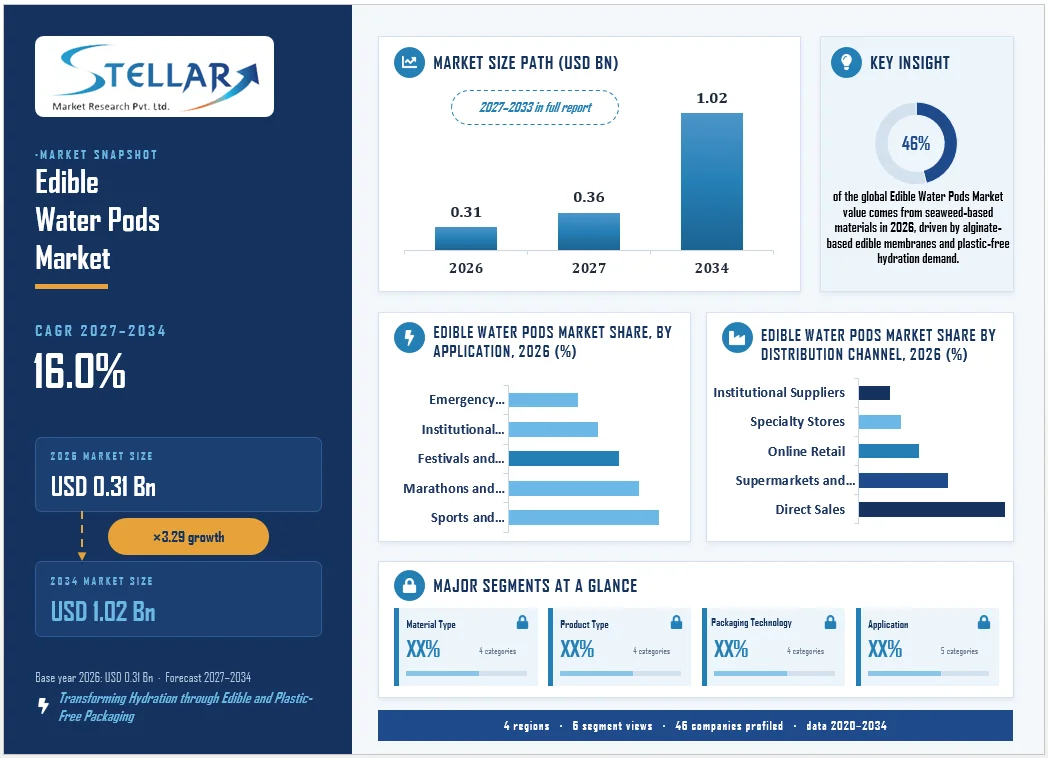
The Global Edible Water Pods Market was valued at USD 0.31 Billion in 2026 and is projected to reach USD 1.02 Billion by 2034, growing at a CAGR of 16.0% during 2027-2034
The Global Edible Water Pods Market was valued at USD 0.31 Billion in 2026 and is projected to reach USD 1.02 Billion by 2034, growing at a CAGR of 16.0% during 2027-2034, according to Stellar Market Research (SMR). Edible water pods, also called edible water capsules, edible water bubbles or edible water bottles, are bite-sized, biodegradable pouches that hold water, electrolyte drinks or flavored beverages inside a thin edible membrane made from seaweed, algae or plant-based biopolymers. The market covers single-chamber and multi-chamber pods, flavored and functional pods, made with spherification, encapsulation and biopolymer film technology, and sold to sports organizers, event venues, retailers, institutions and emergency-relief buyers as a plastic-free alternative to single-use bottles and cups.
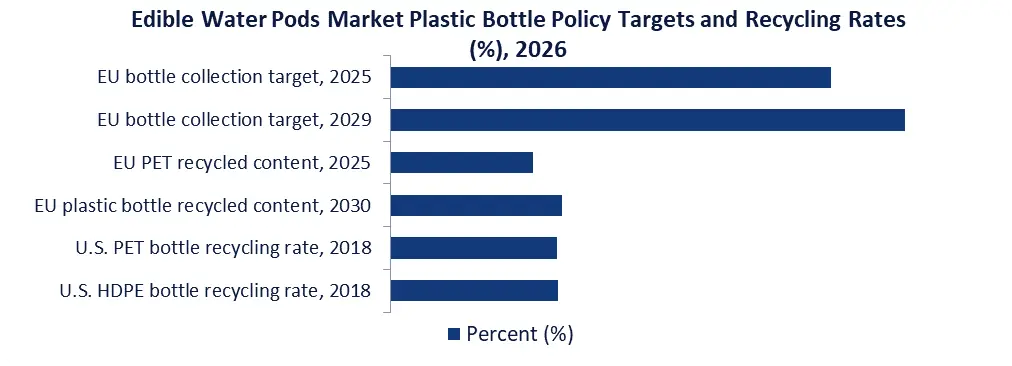
Demand is driven by plastic-reduction policy and event-led trials. The UK Intellectual Property Office reports that 36,000 Ooho edible capsules replaced single-use plastic cups and bottles at the 2019 London Marathon, a case that moved edible packaging from lab concept to a commercial pilot. In the European Union, the Single-Use Plastics Directive sets a 77% separate collection target for plastic beverage bottles by 2025, rising to 90% by 2029, and requires 25% recycled content in PET beverage bottles from 2025 and 30% in all plastic bottles from 2030. In the United States, the U.S. EPA reports that PET bottles and jars were recycled at only 29.1% in 2018 and that landfills received 27 million tons of plastic, 18.5% of all municipal solid waste landfilled.
Capital and ingredient safety are lining up behind the category. Notpla, the London company behind Ooho, closed a GBP 20 million (over USD 25 million) Series A+ round on 24 September 2024 and won the GBP 1 million Earthshot Prize in 2022, according to its company disclosures. On the ingredient side, the U.S. Food and Drug Administration lists sodium alginate, the sodium salt of alginic acid from brown algae, as a substance affirmed as Generally Recognized as Safe (GRAS) under 21 CFR 184.1724, alongside calcium alginate (21 CFR 184.1187), the two chemistries behind most seaweed-based spherification.
The market is still early and concentrated. Event and sports hydration is the proof-of-concept channel, while cost per pod, shelf life, hygiene and consumer familiarity limit mass retail. Value is shifting toward multi-chamber, electrolyte-infused and functional pods, and toward direct and online channels that reach organizers and brands.
This report answers both sides of the search: what the edible water pods market is worth for material suppliers, pod makers, beverage brands, event organizers and investors, and what buyers ask most, from edible water pods market size and edible water capsules price to seaweed-based edible packaging, how edible water bubbles are made, whether edible water pods are safe, and how plastic regulation shapes demand for biodegradable water pods.
Stellar Market Research provides a segment-level analysis of the global edible water pods market size, share and forecast by material type, product type, packaging technology, water type, application and distribution channel, together with regional analysis, value-chain mapping, competitive landscape and strategic scenarios through 2034.
To get more Insights: Request Free Sample Report
Global Edible Water Pods Market Overview: Size, Share, Trends and Outlook to 2034
SMR measures the market at vendor-revenue level across edible water pods and capsules: the membrane materials, the filled pods and the packaging-technology licences and equipment sold to beverage brands, event organizers and retailers. The defining traits are a young product category, a small number of patent-led pioneers, event-driven volume, and a regulatory tailwind from plastic-reduction law.
Three shifts shape 2026-2034: demand moves from one-off event trials to repeat institutional and retail contracts; value shifts from plain water pods to electrolyte-infused, flavored and functional pods that justify a higher price per unit; and manufacturing moves from hand-assisted spherification toward automated encapsulation and biopolymer film lines that cut cost per pod.
Key Findings: Eight Insights Shaping the Global Edible Water Pods Market
SMR’s analysis of European Commission, U.S. EPA, U.S. FDA and UK Intellectual Property Office data, and of company disclosures from Notpla, points to eight findings that explain where edible water pod value is created through 2034.
|
# |
Finding |
Evidence |
So what |
|
1 |
The market grows about 3.3x by 2034 |
USD 0.31 Bn (2026) to USD 1.02 Bn (2034) at 16.0% CAGR (SMR) |
A small base compounds quickly |
|
2 |
Policy targets raise the cost of plastic |
EU: 77% bottle collection by 2025, 90% by 2029; 25% recycled PET content from 2025, 30% from 2030 |
Brands look for plastic-free formats |
|
3 |
U.S. recycling leaves a large gap |
EPA: PET bottles and jars recycled at 29.1% in 2018; 27 million tons of plastic landfilled |
Waste cost supports alternatives |
|
4 |
Events are the proof point |
UK IPO: 36,000 Ooho capsules used at the 2019 London Marathon |
Sports and event buyers adopt first |
|
5 |
Ingredients have a safety track record |
FDA: sodium alginate affirmed GRAS in 21 CFR 184.1724; calcium alginate in 21 CFR 184.1187 |
Seaweed membranes start from a known base |
|
6 |
Capital is flowing to pioneers |
Notpla: GBP 20 million Series A+ closed 24 Sep 2024; GBP 1 million Earthshot Prize in 2022 |
Scale-up funding exists |
|
7 |
Functional pods earn the premium |
SMR: functional pods hold 18% of 2026 value and grow at 19.6% CAGR |
Price per pod rises with function |
|
8 |
Policy review is the next catalyst |
European Commission: SUP Directive evaluation due 3 July 2027, consultation held Dec 2025 to Mar 2026 |
Rules on alternatives may tighten |
Global Edible Water Pods Market Dynamics: Growth Drivers, Restraints and Opportunities
Edible Water Pods Market Growth Drivers: Plastic Regulation, Event Adoption and Sustainable Packaging Demand
- Plastic-reduction regulation. The EU Single-Use Plastics Directive requires 90% separate collection of plastic beverage bottles by 2029 and 30% recycled content in all plastic bottles by 2030, pushing brands to test packaging that does not enter the waste stream.
- Weak plastic recycling. The U.S. EPA reports a 29.1% recycling rate for PET bottles and jars in 2018 and an overall plastics recycling rate of 8.7%, which supports compostable and edible alternatives.
- Proven event use. The UK Intellectual Property Office records 36,000 Ooho capsules at the 2019 London Marathon, giving organizers a reference case for marathon and festival hydration.
- Recognised ingredients. Sodium alginate and calcium alginate are affirmed GRAS by the FDA, lowering the barrier to using seaweed-derived membranes in food contact.
- Investor interest. Notpla’s GBP 20 million Series A+ round shows that capital is available for edible and seaweed-based packaging.
- Brand sustainability targets. Beverage brands and event sponsors use edible pods as a visible, zero-waste hydration format in campaigns.
Edible Water Pods Market Restraints: High Unit Cost, Shelf Life and Consumer Familiarity
- Cost per pod. Pods cost more than a plastic cup or bottle at present because production is still partly manual and volumes are small.
- Shelf life and hygiene. A thin membrane holding water has a shorter storage life and needs protective outer packaging, which limits mass retail.
- Consumer habit. Many consumers are unfamiliar with biting and swallowing a membrane, so adoption is led by events rather than daily use.
- Capacity limits. Few companies hold the patents and equipment, which caps supply and concentrates the market.
- Regulatory clarity. Food-contact rules for novel edible films differ by country and may require separate approvals for each membrane recipe.
What Are the Biggest Edible Water Pods Market Opportunities Through 2034?
- Electrolyte-infused and functional pods: sports hydration, vitamins and recovery drinks command a higher price per pod.
- Multi-chamber pods: pods with separate compartments let brands combine water and flavor or supplement in one bite.
- Automated encapsulation lines: machine-made pods cut cost and open retail volume.
- Emergency hydration: compact, packaging-free water units suit disaster relief and remote events.
- Online and direct sales: subscription and bulk sales to organizers, gyms and corporate buyers.
- Policy-driven procurement: public venues and stadiums that must cut single-use plastics can specify edible and compostable formats.
Global Edible Water Pods Market Segmentation:
By Material Type, Product Type, Packaging Technology, Water Type, Application and Distribution Channel
Edible Water Pods Market by Material Type: Seaweed, Algae, Plant-Based Biopolymers and Other Biodegradable Materials
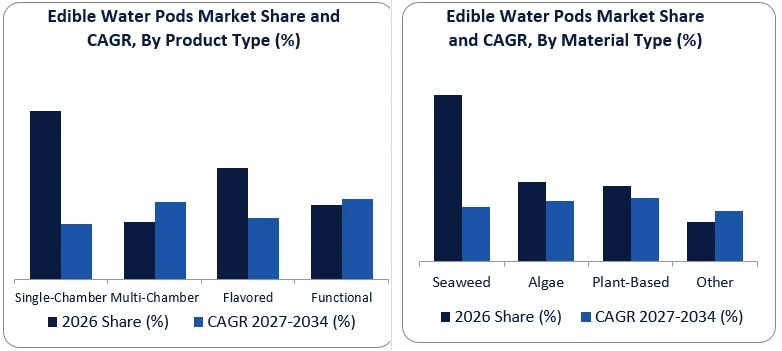
Seaweed-based materials lead with about 46% of 2026 value, built on sodium alginate and calcium chloride spherification used in Ooho-type pods. Algae-based materials hold 22% and grow at 16.8%. Plant-based biopolymers hold 21% and are the fastest-growing material at 17.5% CAGR as makers look for alternatives to marine feedstock. Other biodegradable materials hold 11% with a 14.0% CAGR.
Edible Water Pods Market by Product Type: Single-Chamber, Multi-Chamber, Flavored and Functional Pods
Single-chamber water pods hold about 41% of 2026 value and serve event hydration, growing at 13.5% CAGR. Flavored edible water pods hold 27% and grow at 15.0%. Functional edible water pods hold 18% and grow fastest at 19.6% CAGR as brands add electrolytes and vitamins. Multi-chamber pods hold 14% and grow at 18.9%.
Edible Water Pods Market by Packaging Technology: Spherification, Encapsulation, Biopolymer Film and Other Edible Packaging Technologies
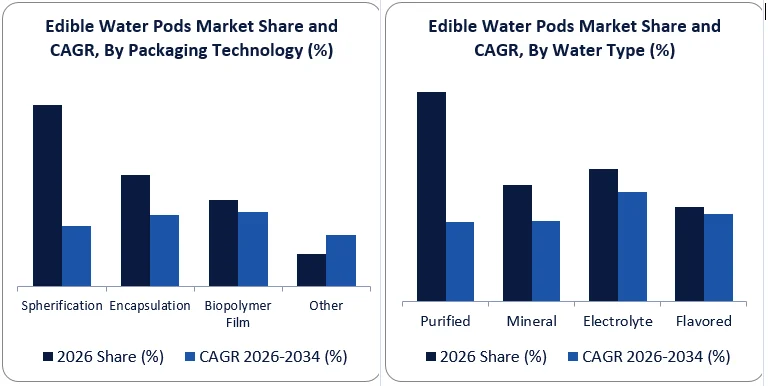
Spherification technology holds about 44% of 2026 value; it forms a gel membrane when an alginate solution meets calcium, the method behind seaweed-based pods. Encapsulation technology holds 27% and grows at 17.4%. Biopolymer film technology holds 21% and grows fastest at 18.0% as film-and-seal lines suit automation. Other edible packaging technologies hold 8% with a 12.5% CAGR.
Edible Water Pods Market by Water Type: Purified, Mineral, Electrolyte-Infused and Flavored Water
Purified water pods hold about 38% of 2026 value and grow at 14.3% CAGR. Electrolyte-infused water pods hold 24% and are the fastest-growing water type at 19.8% CAGR, driven by sports and fitness use. Mineral water pods hold 21% (14.6% CAGR) and flavored water pods hold 17% (15.8% CAGR).
Global Edible Water Pods Market Regional Analysis:
Europe, North America, Asia Pacific, Middle East & Africa, Central & South America
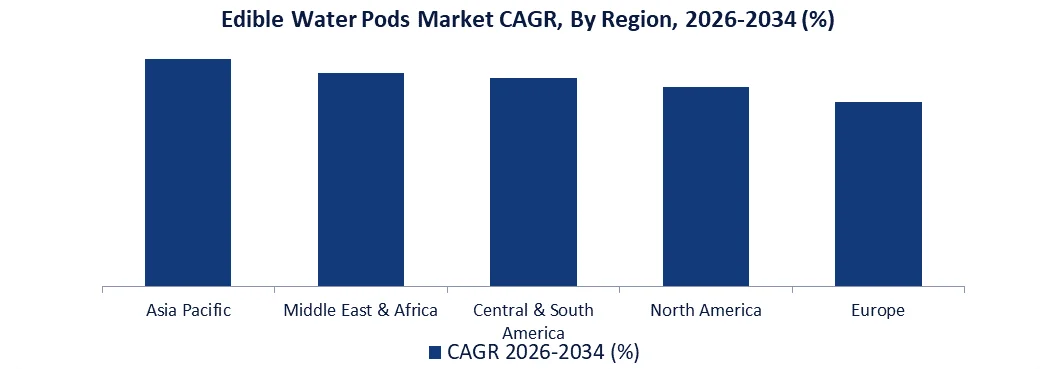
Europe is the largest region at about 38% of 2026 value, anchored by London-based Notpla, the UK Marathon trials and the EU Single-Use Plastics Directive. North America holds 27% with a 15.8% CAGR, shaped by U.S. EPA data on weak bottle recycling and by sports-event demand. Asia Pacific holds 24% and is the fastest-growing region at an 18.0% CAGR, led by marathon and festival growth in China, Japan, India and Australia, and by seaweed supply in Indonesia and South Korea. Middle East & Africa (6%) and Central & South America (5%) are smaller, with emergency hydration and event tourism as early uses.
Policy Benchmarks: Plastic Bottle Targets and Recycling Rates That Shape Edible Water Pods Demand
Government data frames the opportunity. The chart compares EU plastic-bottle targets under the Single-Use Plastics Directive with U.S. EPA recycling rates for beverage bottles. The gap between the EU’s 90% collection goal and the 29% U.S. PET bottle recycling rate shows why plastic-free formats are being tested.
Edible Water Pods Ecosystem: From Seaweed Feedstock to Consumer Hydration
|
Layer |
What happens |
Examples |
|
1. Raw materials |
Brown seaweed, algae and plant biopolymers are harvested and processed into alginate and hydrocolloids |
IFF, Cargill, Kimica Corporation, Algaia, Qingdao Bright Moon |
|
2. Membrane and pod technology |
Alginate and calcium chemistry forms an edible membrane around water |
Notpla (Ooho), WikiFoods, Evoware, Loliware |
|
3. Beverage brands and fillers |
Water, electrolyte and flavored drinks are encapsulated and branded |
Lucozade Ribena Suntory (Ooho trial), sports-drink and water brands |
|
4. Channels and buyers |
Pods are sold to events, institutions, retailers and online buyers |
Event organizers, stadiums, caterers (Compass Group), retailers (Decathlon) |
|
5. Government and standards |
Food-contact safety and plastic-reduction rules |
FDA, European Commission, U.S. EPA, UK IPO |
Edible Water Pods Companies and Competitive Landscape: Who Supplies the Global Edible Water Pods Market?
The global edible water pods market combines patent-led pioneers, edible-film and seaweed-packaging specialists, alginate ingredient suppliers and beverage brands that trial the format. Notpla, which developed Ooho, holds the strongest public record: its patented edible bubble was trademarked as Ooho in 2017, according to the UK Intellectual Property Office, and it has since been used at the London Marathon. Other players compete in edible films, seaweed-based packaging and water-soluble formats.
Company disclosures show how capital is arriving. Notpla announced a GBP 20 million Series A+ round on 24 September 2024, and its company biography records the 2022 Earthshot Prize. Customers named by the company in its announcements include Compass Group, Decathlon and Just Eat Takeaway.com.
Competitive Strategies in the Edible Water Pods Market
- Patent and brand protection: Notpla trademarked Ooho in 2017 and protects its process with a granted patent.
- Event partnerships: brand tie-ins, such as Lucozade at the 2019 London Marathon, give pods mass visibility.
- Portfolio widening: companies add films, sachets, coatings and pipettes to spread risk beyond water pods.
- Scale-up funding: pioneers raise equity to automate production and enter new markets such as the United States.
- Functional differentiation: electrolyte, vitamin and flavor pods lift price per unit.
Edible Water Pods Standards and Regulation: Key Frameworks and Policy
- U.S. FDA, 21 CFR 184.1724 (sodium alginate) and 21 CFR 184.1187 (calcium alginate): affirm both as GRAS for food use within set limits.
- EU Single-Use Plastics Directive (EU) 2019/904: 77% bottle collection by 2025 and 90% by 2029; 25% recycled PET content from 2025 and 30% for all plastic bottles from 2030.
- European Commission evaluation of the Directive: a public consultation ran from December 2025 to March 2026; the evaluation is due by 3 July 2027.
- U.S. EPA Facts and Figures: the national reference for plastic generation, recycling and landfilling.
- UK Intellectual Property Office: patent and trade mark records that protect edible packaging innovation.
Global Edible Water Pods Market Recent Developments
|
Date |
Company / Organization |
Recent Development |
Market Impact |
|
March 2026 |
Food Chemistry Research Team |
Develops centimetre-scale calcium alginate liquid-core capsules with improved water retention and 19.5% higher bursting force following process optimization. |
Enhances edible water pod durability and reduces leakage during handling. |
|
May 2026 |
Notpla |
Expands the reported deployment of seaweed-based Ooho edible water pods across sporting events and entertainment venues. |
Supports demand for sustainable hydration solutions and alternatives to single-use plastic bottles. |
|
August 2026 |
European Union |
Begins applying the Packaging and Packaging Waste Regulation (PPWR), strengthening packaging waste reduction requirements. |
Encourages investment in edible and biodegradable packaging alternatives. |
|
October 2026 |
Sustainable Food Packaging Researchers |
Publishes research evaluating edible films, encapsulation technologies, barrier performance and commercial manufacturing challenges. |
Supports material innovation and scalability in edible liquid packaging technologies. |
|
October 2026 |
Notpla and Innocent Drinks |
Conducts a consumer pilot featuring 12 mL ginger shots enclosed in edible seaweed-based Ooho pods. |
Expands potential applications beyond water into functional beverages and nutritional drinks. |
Global Edible Water Pods Market Scope: Inquire before buying
|
Global Edible Water Pods Market |
|||
|
Report Coverage |
Details |
||
|
Base Year: |
2026 |
Forecast Period: |
2027-2034 |
|
Historical Data: |
2021 to 2026 |
Market Size in 2026: |
USD 0.31 Billion |
|
Forecast Period 2027 to 2034 CAGR: |
16.0% |
Market Size in 2034: |
USD 1.02 Billion |
|
Edible Water Pods Market Segments Covered: |
By Material Type |
Seaweed-Based Materials Algae-Based Materials Plant-Based Biopolymers Other Biodegradable Materials |
|
|
|
By Product Type |
Single-Chamber Water Pods Multi-Chamber Water Pods Flavored Edible Water Pods Functional Edible Water Pods |
|
|
|
By Packaging Technology |
Spherification Technology Encapsulation Technology Biopolymer Film Technology Other Edible Packaging Technologies |
|
|
|
By Water Type |
Purified Water Mineral Water Electrolyte-Infused Water Flavored Water |
|
|
|
By Application |
Sports and Fitness Events Marathons and Outdoor Events Festivals and Entertainment Venues Institutional and Commercial Use Emergency Hydration |
|
|
|
By Distribution Channel |
Direct Sales Supermarkets and Hypermarkets Online Retail Specialty Stores Institutional Suppliers |
|
Global Edible Water Pods Market, By Region:
- North America (United States, Canada, Mexico, Rest of North America)
- Europe (United Kingdom, Germany, France, Spain, Italy, Rest of Europe)
- Asia Pacific (China, Japan, South Korea, India, Australia, Indonesia, Rest of Asia Pacific)
- Middle East & Africa (United Arab Emirates, Saudi Arabia, South Africa, Rest of Middle East & Africa)
- Central & South America (Brazil, Argentina, Rest of Central & South America)
Global Edible Water Pods Market Key Players:
North America
- Loliware Inc. (United States)
- DisSolves, Inc. (Canada)
- WikiFoods Inc. (United States)
- Sway Innovation Co. (United States)
- Carbonwave (United States)
- Ingredion Incorporated (United States)
- Cargill, Incorporated (United States)
- International Flavors & Fragrances Inc. (United States)
- CP Kelco (United States)
- Tate & Lyle PLC (United States operations)
- Green Dot Bioplastics, Inc. (United States)
- NatureWorks LLC (United States)
Europe
- Notpla Limited (United Kingdom)
- Skipping Rocks Lab Ltd. (United Kingdom)
- Xampla Limited (United Kingdom)
- B'ZEOS (Norway)
- Kelpi Limited (United Kingdom)
- FlexSea Limited (United Kingdom)
- SoluBlue (United Kingdom)
- PlantSea (United Kingdom)
- Marea (Iceland)
- Noriware AG (Switzerland)
- Oceanium Limited (United Kingdom)
- Biome Bioplastics Limited (United Kingdom)
- Lactips (France)
- Algaia (France)
- JRS Group (Germany)
Asia-Pacific
- Evoware (Indonesia)
- Biopac (Indonesia)
- Zerocircle Alternatives Pvt. Ltd. (India)
- ULUU (Australia)
- Sea6 Energy Private Limited (India)
- KIMICA Corporation (Japan)
- Qingdao Bright Moon Seaweed Group Co., Ltd. (China)
- Qingdao Gather Great Ocean Algae Industry Group Co., Ltd. (China)
- Shandong Lefan Capsule Co., Ltd. (China)
- Fujian Jiahua Packaging Co., Ltd. (China)
- Mitsubishi Chemical Group Corporation (Japan)
Middle East & Africa
- TIPA Corp. (Israel)
- Taghleef Industries (United Arab Emirates)
- Hotpack Global (United Arab Emirates)
- Napco National (Saudi Arabia)
South America
- Gelymar S.A. (Chile)
- Braskem S.A. (Brazil)
- Suzano S.A. (Brazil)
- CBPAK Tecnologia (Brazil)
Frequently Asked Questions
Ans: Edible water pods, also called edible water capsules or edible water bubbles, are small pouches of water or drink inside a thin membrane that can be eaten or composted. Most use alginate from brown seaweed.
Ans: The FDA affirms sodium alginate (21 CFR 184.1724) and calcium alginate (21 CFR 184.1187) as generally recognized as safe within set use limits. Each pod recipe and market still needs its own food-contact compliance check.
Ans: The UK Intellectual Property Office reports that 36,000 Ooho capsules were used instead of single-use plastic at the 2019 London Marathon. Festivals, sports events and food service are the main uses.
Ans: Seaweed-based materials lead by material type at about 46% of 2026 value, single-chamber pods lead by product type at 41%, and sports and fitness events lead by application at 29%.
Ans: Europe leads with about 38% of 2026 value. Asia Pacific is the fastest-growing region at an 18.0% CAGR.
Ans: The EU Single-Use Plastics Directive requires 90% separate collection of plastic beverage bottles by 2029 and 30% recycled content in all plastic bottles by 2030, which raises the cost of plastic and supports alternatives.
Ans: Notpla (Ooho) is the best-known developer. Other participants include WikiFoods, Evoware, Loliware and Sulapac, with alginate suppliers such as IFF, Cargill and Kimica supplying materials.
1. Executive Market Landscape & Industry Overview
1.1. Global Edible Water Pods Market Size (Value USD Million), 2026–2034
1.2. Evolution of Edible Water Packaging and Commercialization
1.3. Edible Water Pods Definition, Composition and Product Classification
1.4. Global Adoption of Sustainable Single-Use Hydration Alternatives
1.5. Global Production, Consumption and Commercial Availability Overview
1.6. Market CAGR Analysis and Long-Term Growth Outlook
2. Edible Water Pods Market Dynamics
2.1. Emerging Trends Across Edible Hydration Packaging Solutions
2.2. Market Dynamics Analysis
- 2.2.1. Drivers
- 2.2.2. Restraints
- 2.2.3. Opportunities
- 2.2.4. Challenges
2.3. PORTER's Five Forces Analysis of Industry Competition
2.4. PESTLE Analysis of Edible Water Pods Industry
2.5. Consumer Adoption Barriers and Market Acceptance Assessment
2.6. Commercial Scalability and Industry Profitability Considerations
3. Edible Water Pods Market Macroeconomic Factors
3.1. Global Plastic Waste Reduction Policies and Sustainability Investments
3.2. Food Packaging Industry Investments and Material Innovation Expenditure
3.3. Consumer Spending on Sustainable Food and Beverage Products
3.4. Sports Tourism, Outdoor Events and Hydration Consumption Trends
3.5. Biopolymer Manufacturing Costs and Raw Material Price Movements
3.6. International Trade Dynamics Across Sustainable Packaging Materials
4. Edible Water Pods Industry Trends & Emerging Technology Requirements
4.1. Growing Adoption of Plastic-Free Alternative Hydration Packaging
4.2. Increasing Commercialization of Seaweed-Based Edible Water Containers
4.3. Rising Interest in Compostable and Biodegradable Packaging Solutions
4.4. Advancements in Edible Membrane Strength and Stability
4.5. Expansion of Functional and Flavored Hydration Pod Offerings
4.6. Development of Scalable Edible Packaging Manufacturing Technologies
5. Edible Water Pods Material Composition & Technical Landscape
5.1. Seaweed-Based Material Composition and Alginate Extraction Characteristics
5.2. Algae-Based Biomaterials and Hydrocolloid Performance Assessment
5.3. Plant-Based Biopolymer Composition and Film Formation Properties
5.4. Other Biodegradable Materials and Functional Material Characteristics
5.5. Edible Membrane Thickness, Strength and Structural Integrity Requirements
5.6. Material Compatibility with Water and Beverage Formulations
6. Edible Water Pods Product Architecture & Design Landscape
6.1. Single-Chamber Pod Structure and Liquid Containment Characteristics
6.2. Multi-Chamber Pod Design and Compartmentalized Liquid Delivery
6.3. Flavored Pod Development and Sensory Experience Optimization
6.4. Functional Pod Formulations and Enhanced Hydration Applications
6.5. Pod Dimensions, Portion Sizes and Consumption Convenience Requirements
6.6. Product Shelf Life, Handling and Storage Characteristics
7. Edible Water Pods Packaging Technology & Manufacturing Processes
7.1. Spherification Technology and Alginate Membrane Formation Processes
7.2. Encapsulation Technology and Controlled Liquid Containment Mechanisms
7.3. Biopolymer Film Technology and Edible Barrier Development
7.4. Alternative Edible Packaging Technologies and Manufacturing Approaches
7.5. Automated Pod Production and Manufacturing Line Integration
7.6. Production Efficiency, Defect Rates and Quality Control
8. Edible Water Pods Water Formulation & Product Characteristics
8.1. Purified Water Pods and Consumer Hydration Applications
8.2. Mineral Water Pods and Mineral Composition Characteristics
8.3. Electrolyte-Infused Water Pods and Rehydration Benefits
8.4. Flavored Water Pods and Taste Customization Opportunities
8.5. Water Purity, Microbial Safety and Formulation Compatibility
8.6. Beverage Stability, Membrane Interaction and Sensory Performance
9. Edible Water Pods Applications & Consumption Landscape
9.1. Sports and Fitness Events Hydration Consumption Requirements
9.2. Marathons and Outdoor Events Sustainable Hydration Solutions
9.3. Festivals and Entertainment Venues Single-Use Plastic Alternatives
9.4. Institutional and Commercial Hydration Procurement Requirements Assessment
9.5. Emergency Hydration Applications and Portable Water Distribution
9.6. Application-Specific Product Selection and Consumption Preferences
10. Edible Water Pods End-Use Industry Demand Landscape
10.1. Sports Organizations and Fitness Facility Hydration Procurement
10.2. Marathon Organizers and Outdoor Event Management Companies
10.3. Music Festivals and Large Entertainment Venue Operators
10.4. Corporate Offices and Institutional Catering Service Providers
10.5. Emergency Response Agencies and Humanitarian Relief Organizations
10.6. Hospitality Operators and Commercial Foodservice Establishments
11. Edible Water Pods Consumer Preferences & Adoption Landscape
11.1. Consumer Awareness of Edible Water Packaging Alternatives
11.2. Sustainability Preferences and Plastic-Free Product Purchase Motivations
11.3. Taste, Texture and Consumption Experience Evaluation Factors
11.4. Convenience, Portability and On-the-Go Hydration Preferences
11.5. Willingness to Pay for Sustainable Hydration Products
11.6. Repeat Purchase Behavior and Consumer Adoption Barriers
12. Edible Water Pods Product Development & Innovation Landscape
12.1. Development of Advanced Seaweed-Based Edible Membrane Formulations
12.2. Innovation in Multi-Chamber Hydration Pod Product Designs
12.3. Development of Flavored and Nutrient-Enriched Water Pods
12.4. Improvements in Membrane Durability and Leakage Prevention
12.5. Product Customization for Event-Specific Hydration Requirements
12.6. Research Investments and Commercial Product Development Pipelines
13. Edible Water Pods Raw Material Sourcing & Supply Landscape
13.1. Seaweed Cultivation and Alginate Raw Material Availability
13.2. Algae Biomass Production and Industrial Processing Capabilities
13.3. Plant-Based Biopolymer Feedstock Sourcing and Procurement Strategies
13.4. Raw Material Supplier Networks and Regional Availability
13.5. Material Processing Costs and Procurement Price Fluctuations
13.6. Supply Reliability and Sustainable Feedstock Sourcing Assessment
14. Edible Water Pods Quality, Food Safety & Shelf Life
14.1. Edible Membrane Food-Grade Specifications and Safety Requirements
14.2. Microbial Contamination Prevention and Water Quality Management
14.3. Membrane Integrity Testing and Leakage Performance Evaluation
14.4. Shelf Life Optimization and Product Stability Assessment
14.5. Edible Material Ingestion Safety and Consumer Acceptance
14.6. Packaging Hygiene, Production Sanitation and Quality Assurance
15. Edible Water Pods Sustainability & Environmental Impact Assessment
15.1. Plastic Bottle Replacement Potential and Waste Reduction Benefits
15.2. Biodegradability Characteristics of Edible Packaging Materials
15.3. Environmental Impact of Seaweed-Based Material Production Processes
15.4. Carbon Footprint Comparison Across Hydration Packaging Alternatives
15.5. Marine Ecosystem Considerations and Sustainable Biomass Harvesting
15.6. Life Cycle Assessment and Circular Packaging Opportunities
16. Edible Water Pods Pricing, Cost Structure & Business Economics
16.1. Edible Water Pod Pricing Across Material and Product Categories
16.2. Raw Material Costs and Biopolymer Processing Expenditure Analysis
16.3. Manufacturing Costs and Production Capacity Utilization Economics
16.4. Packaging Technology Investments and Equipment Cost Requirements
16.5. Distribution Margins and Commercial Pricing Mechanism Assessment
16.6. Consumer Price Sensitivity and Product Affordability Evaluation
17. Edible Water Pods Distribution, Sales & Procurement Landscape
17.1. Direct Sales Through Edible Packaging Manufacturers and Brands
17.2. Supermarket and Hypermarket Retail Distribution Network Assessment
17.3. Online Retail Platforms and Digital Product Procurement Channels
17.4. Specialty Stores and Sustainable Product Retailer Networks
17.5. Institutional Suppliers and Bulk Procurement Distribution Partnerships
17.6. Customer Relationships, Contract Sales and Commercial Fulfillment
18. Edible Water Pods Supply Chain & Operational Ecosystem
18.1. Raw Seaweed and Biopolymer Feedstock Sourcing Networks
18.2. Material Extraction, Processing and Ingredient Preparation Operations
18.3. Edible Membrane Formation and Water Pod Manufacturing Processes
18.4. Product Handling, Storage and Temperature Management Requirements
18.5. Distribution Logistics and Commercial Inventory Management Practices
18.6. Global Trade, Supply Chain Resilience and Operational Challenges
19. Edible Water Pods Regulatory, Trade & Compliance Landscape
19.1. Food Contact Material Regulations and Edible Packaging Standards
19.2. Food Safety Regulations and Ingredient Approval Requirements
19.3. Biodegradability Certification and Environmental Claims Compliance Frameworks
19.4. Food Labeling, Allergen Disclosure and Consumer Information Requirements
19.5. International Trade Regulations and Sustainable Packaging Import Requirements
19.6. Regional Regulatory Differences and Commercial Market Entry Barriers
20. Edible Water Pods Technology Innovation, R&D & Commercialization
20.1. Advanced Spherification Processes and Membrane Engineering Innovations
20.2. Research into High-Performance Edible Biopolymer Material Formulations
20.3. Automation Technologies for Large-Scale Water Pod Manufacturing
20.4. Product Innovation Across Functional and Flavored Hydration Applications
20.5. Intellectual Property, Research Collaborations and Technology Partnerships
20.6. Commercialization Strategies and Industrial Production Scale-Up Initiatives
21. Edible Water Pods Market Adoption & Commercial Feasibility
21.1. Commercial Adoption Across Sports and Entertainment Applications
21.2. Event-Based Consumption Volumes and Procurement Frequency Patterns
21.3. Manufacturing Scalability and Commercial Production Feasibility Assessment
21.4. Retail Acceptance and Sustainable Product Shelf Placement Considerations
21.5. Consumer Switching from Conventional Bottled Water Packaging
21.6. Product Economics and Long-Term Commercial Viability Assessment
22. Edible Water Pods Regional & Country-Level Market Landscape
22.1. North American Edible Water Pods Innovation and Commercial Adoption
22.2. European Sustainable Packaging Regulations and Market Development Opportunities
22.3. Asia-Pacific Seaweed Resources and Edible Packaging Manufacturing Ecosystem
22.4. Middle East & Africa Sustainable Hydration Packaging Adoption
22.5. South American Biopolymer Resources and Emerging Commercial Opportunities
22.6. Regional Production Capacities, Consumption Patterns and Trade Flows
23. Edible Water Pods Market Size & Forecast by Segmentation (Value USD Million), 2026–2034
23.1. Edible Water Pods Market Size and Forecast, By Material Type
- 23.1.1. Seaweed-Based Materials
- 23.1.2. Algae-Based Materials
- 23.1.3. Plant-Based Biopolymers
- 23.1.4. Other Biodegradable Materials
23.2. Edible Water Pods Market Size and Forecast, By Product Type
- 23.2.1. Single-Chamber Water Pods
- 23.2.2. Multi-Chamber Water Pods
- 23.2.3. Flavored Edible Water Pods
- 23.2.4. Functional Edible Water Pods
23.3. Edible Water Pods Market Size and Forecast, By Packaging Technology
- 23.3.1. Spherification Technology
- 23.3.2. Encapsulation Technology
- 23.3.3. Biopolymer Film Technology
- 23.3.4. Other Edible Packaging Technologies
23.4. Edible Water Pods Market Size and Forecast, By Water Type
- 23.4.1. Purified Water
- 23.4.2. Mineral Water
- 23.4.3. Electrolyte-Infused Water
- 23.4.4. Flavored Water
23.5. Edible Water Pods Market Size and Forecast, By Application
- 23.5.1. Sports and Fitness Events
- 23.5.2. Marathons and Outdoor Events
- 23.5.3. Festivals and Entertainment Venues
- 23.5.4. Institutional and Commercial Use
- 23.5.5. Emergency Hydration
23.6. Edible Water Pods Market Size and Forecast, By Distribution Channel
- 23.6.1. Direct Sales
- 23.6.2. Supermarkets and Hypermarkets
- 23.6.3. Online Retail
- 23.6.4. Specialty Stores
- 23.6.5. Institutional Suppliers
23.7. Edible Water Pods Market Size and Forecast, By Region
- 23.7.1. North America
- United States
- Canada
- Mexico
- 23.7.2. Europe
- United Kingdom
- Germany
- France
- Norway
- Switzerland
- Iceland
- Rest of Europe
- 23.7.3. Asia-Pacific
- China
- India
- Japan
- Indonesia
- Australia
- Rest of Asia-Pacific
- 23.7.4. Middle East & Africa
- United Arab Emirates
- Saudi Arabia
- South Africa
- Rest of Middle East & Africa
- 23.7.5. South America
- Brazil
- Chile
- Rest of South America
24. Edible Water Pods Market Competitive Landscape
24.1. SMR Competition Matrix and Competitive Positioning Assessment
24.2. Market Concentration and Competitive Structure Analysis
24.3. Key Players Benchmarking
- 24.3.1. Company Name and Corporate Headquarters
- 24.3.2. Edible Water Pod Product Portfolio and Offerings
- 24.3.3. Material Sourcing and Processing Capabilities
- 24.3.4. Edible Packaging Technology and Manufacturing Capabilities
- 24.3.5. Commercial Partnerships and Distribution Network Strength
- 24.3.6. Geographic Presence and Market Expansion Activities
24.4. Market Structure and Participant Categorization
- 24.4.1. Direct Edible Water Pod Manufacturers and Innovators
- 24.4.2. Seaweed-Based Edible Packaging Technology Developers
- 24.4.3. Biopolymer Material Manufacturers and Ingredient Suppliers
- 24.4.4. Sustainable Packaging Solution Providers and Commercial Distributors
24.5. Company Revenue Growth Rate and Financial Performance Benchmarking
24.6. Manufacturing Capacity and Production Scalability Comparison
24.7. Product Innovation and Technology Portfolio Benchmarking
24.8. Geographic Market Presence and Commercial Reach Comparison
24.9. Strategic Partnerships, Collaborations and Distribution Agreements
24.10. Mergers, Acquisitions and Business Expansion Developments
24.11. Recent Product Launches and Industry Developments
25. Edible Water Pods Manufacturers' Strategies & Expansion Plans
25.1. Expansion of Seaweed-Based Edible Packaging Production Capabilities
25.2. Development of Advanced Biopolymer Material Product Portfolios
25.3. Investment in Automated Manufacturing and Production Technologies
25.4. Expansion into Sports and Commercial Hydration Applications
25.5. Strategic Collaborations with Event Organizers and Retailers
25.6. Geographic Expansion Across Emerging Sustainable Packaging Markets
26. Edible Water Pods Industry SWOT, Investments & Strategic Developments
26.1. Competitive Strengths of Edible Water Packaging Technology Providers
26.2. Material Limitations, Production Costs and Adoption Challenges
26.3. Emerging Opportunities Across Sustainable Hydration Packaging Applications
26.4. Competitive Threats from Conventional and Alternative Packaging Solutions
26.5. Investments in Biopolymer Research and Manufacturing Infrastructure
26.6. Product Launches, Partnerships and Strategic Industry Developments
27. Edible Water Pods Competitive Outlook & Market Positioning
27.1. Competitive Dynamics Across Edible Water Pod Product Categories
27.2. Market Positioning of Established and Emerging Industry Participants
27.3. Competitive Differentiation Through Material and Technology Innovation
27.4. Commercial Scalability and Manufacturing Capability-Based Competition
27.5. Competitive Positioning Across Regional and Application Markets
27.6. Long-Term Commercial Opportunities and Industry Growth Prospects
28. Company Profiles: Key Edible Water Pods Market Participants
Detailed Company Profile Parameters
- Company Overview and Business Operations
- Edible Packaging and Water Pod Product Portfolio
- Material Composition and Technology Capabilities
- Manufacturing Facilities and Production Capabilities
- Geographic Presence and Distribution Network
- Financial Overview and Revenue Performance
- SWOT Analysis
- Strategic Analysis and Growth Initiatives
- Recent Developments, Partnerships and Expansion Activities
Company Coverage by Region
North America
- Loliware Inc. (United States)
- DisSolves, Inc. (Canada)
- WikiFoods Inc. (United States)
- Sway Innovation Co. (United States)
- Carbonwave (United States)
- Ingredion Incorporated (United States)
- Cargill, Incorporated (United States)
- International Flavors & Fragrances Inc. (United States)
- CP Kelco (United States)
- Tate & Lyle PLC (United States operations)
- Green Dot Bioplastics, Inc. (United States)
- NatureWorks LLC (United States)
Europe
- Notpla Limited (United Kingdom)
- Skipping Rocks Lab Ltd. (United Kingdom)
- Xampla Limited (United Kingdom)
- B'ZEOS (Norway)
- Kelpi Limited (United Kingdom)
- FlexSea Limited (United Kingdom)
- SoluBlue (United Kingdom)
- PlantSea (United Kingdom)
- Marea (Iceland)
- Noriware AG (Switzerland)
- Oceanium Limited (United Kingdom)
- Biome Bioplastics Limited (United Kingdom)
- Lactips (France)
- Algaia (France)
- JRS Group (Germany)
Asia-Pacific
- Evoware (Indonesia)
- Biopac (Indonesia)
- Zerocircle Alternatives Pvt. Ltd. (India)
- ULUU (Australia)
- Sea6 Energy Private Limited (India)
- KIMICA Corporation (Japan)
- Qingdao Bright Moon Seaweed Group Co., Ltd. (China)
- Qingdao Gather Great Ocean Algae Industry Group Co., Ltd. (China)
- Shandong Lefan Capsule Co., Ltd. (China)
- Fujian Jiahua Packaging Co., Ltd. (China)
- Mitsubishi Chemical Group Corporation (Japan)
Middle East & Africa
- TIPA Corp. (Israel)
- Taghleef Industries (United Arab Emirates)
- Hotpack Global (United Arab Emirates)
- Napco National (Saudi Arabia)
South America
- Gelymar S.A. (Chile)
- Braskem S.A. (Brazil)
- Suzano S.A. (Brazil)
- CBPAK Tecnologia (Brazil)
29. Key Findings & Market Opportunities
30. Strategic Moves & Industry Outlook
31. Research Methodology