ENG
 Japanese
 French
 German
 Korean

Global Anaerobic Digestion Market & Forecast 2026 - 2034
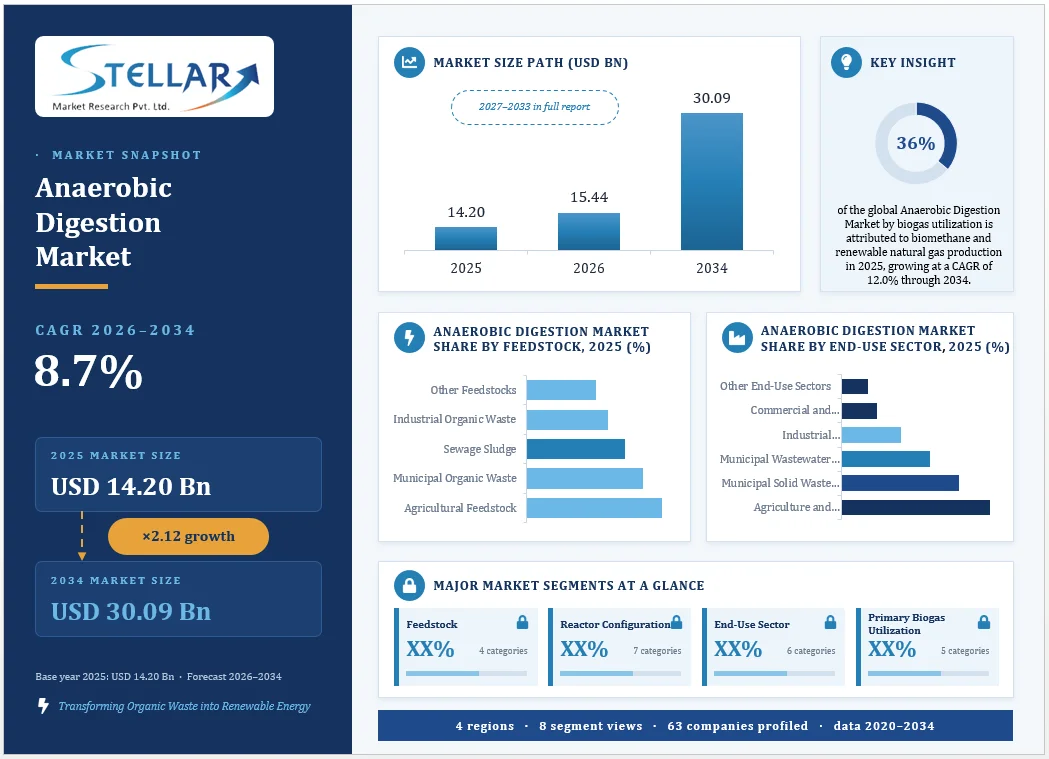
The Global Anaerobic Digestion Market was valued at USD 14.20 billion in 2025 and is expected to reach USD 30.09 billion by 2034, growing at a CAGR of 8.7% during 2026–2034.
The Global Anaerobic Digestion Market was valued at USD 14.20 billion in 2025 and is expected to reach USD 30.09 billion by 2034, growing at a CAGR of 8.7% during 2026–2034. Anaerobic digestion (AD) is a controlled biological process in which microorganisms break down organic matter, such as livestock manure, crop residues, food waste, sewage sludge and industrial effluents, in the absence of oxygen to produce biogas, a methane-rich fuel, and digestate, a nutrient-rich residue that can be used as fertiliser.
This Anaerobic Digestion Market analysis is valuable for equipment makers, engineering contractors, plant operators and investors, and for what project developers and waste managers want to know, from how anaerobic digestion technology works to the economics of agricultural waste and food waste anaerobic digestion, biomethane production and digestate use.
Equipment and integrated systems anchor the Anaerobic Digestion industry and agriculture, municipal waste and wastewater utilities are the largest buyers, but anaerobic digestion market growth is shifting toward biomethane and renewable natural gas, food and municipal organic waste, operations and maintenance services, and Asia Pacific as renewable gas mandates, landfill diversion rules and methane-reduction targets reshape project demand.
Stellar Market Research provides comprehensive analysis of global anaerobic digestion market size, share, feedstock, digestion process, operating temperature, reactor configuration, offering, plant capacity, end-use sector, biogas utilization and regional segmentation, the anaerobic digestion competitive landscape, strategic scenarios and growth opportunities. The report helps digester and equipment manufacturers, biogas upgrading suppliers, engineering and EPC contractors, plant developers, utilities, waste management companies and investors decide which segments, technologies and countries to prioritise through 2034.
To get more Insights: Request Free Sample Report
|
2025 | BASE YEAR |
2034 | FORECAST |
GROWTH RATE |
LARGEST REGION |
|
USD 14.20 Bn |
USD 30.09 Bn |
8.7% |
Europe |
Global Anaerobic Digestion Market Size, Share, Trends and Outlook to 2034
The Anaerobic Digestion Market is measured at plant and service level: anaerobic digestion equipment and integrated systems (digester vessels and reactors, feedstock preparation, mixing, heating and pumping, biogas handling, monitoring and automation), engineering, construction and installation services, and directly attributable operations and maintenance services sold worldwide for agricultural, municipal, industrial and commercial use. The resale value of biogas, biomethane, electricity, fertilisers and carbon credits is excluded to prevent double counting.
Three shifts shape 2026–2034: demand is broadening from farm-scale power generation to biomethane, food waste and wastewater projects; value is moving toward engineering, upgrading-ready designs and long-term operations contracts; and growth is rotating toward Asia Pacific, South America and North America as Europe matures. Anaerobic Digestion Market Suppliers are answering feedstock and grid-connection risk with modular plants, two-stage and high-solids systems and digital process control.
Anaerobic Digestion Quick Answers: 20 Most-Searched Questions About Anaerobic Digestion
|
Question |
Answers |
|
How big is the anaerobic digestion market? |
USD 14.20 Bn in 2025 (SMR); USD 30.09 Bn by 2034 at 8.7% CAGR |
|
How fast is the anaerobic digestion market growing? |
8.7% CAGR on SMR’s base |
|
Which region has the largest anaerobic digestion market share? |
Europe leads with 38.0% share; Asia Pacific is fastest at 10.7% CAGR |
|
What is anaerobic digestion? |
Microbial breakdown of organic matter without oxygen, producing biogas (mainly methane and CO2) and nutrient-rich digestate |
|
How does anaerobic digestion technology work? |
Four stages: hydrolysis, acidogenesis, acetogenesis and methanogenesis, inside a heated, sealed digester |
|
Which feedstocks are used in anaerobic digestion? |
Livestock manure, crop residues, food waste, sewage sludge, industrial effluents and energy crops |
|
How large is agricultural waste anaerobic digestion? |
Agricultural feedstock is the largest group at about 35% of 2025 value, growing at 8.2% CAGR |
|
How large is food waste anaerobic digestion? |
Municipal organic solid waste is about 22% of value and grows at XX%; commercial and institutional food waste is fastest at XX% |
|
Wet or dry anaerobic digestion? |
Wet digestion holds about XX% of value; dry digestion is faster at 9.7% CAGR |
|
Mesophilic or thermophilic digestion? |
Mesophilic holds about XX% of value; thermophilic is faster at 9.9% CAGR |
|
Which reactor type is most common? |
Continuous stirred tank reactors (CSTR) at about 38% of 2025 value |
|
Which offering is the largest? |
Equipment and integrated systems at about 54%; operations and maintenance are fastest at 10.6% CAGR |
|
How is biogas used? |
Biomethane and RNG lead at about XX% and grow fastest at 12.0% CAGR; CHP holds about XX% |
|
Which end-use sector buys the most? |
Agriculture and livestock farming at about XX%; municipal solid waste management is fastest at 10.5% |
|
Which plant size leads? |
1 MWe to below 5 MWe at about XX%; 5 MWe and above is fastest at 10.2% CAGR |
|
Who are the leading anaerobic digestion companies? |
Veolia, Air Liquide, EnviTec Biogas, WELTEC BIOPOWER, Anaergia, Hitachi Zosen Inova, Paques and Greenlane, among others |
|
Which regulations and policies drive demand? |
EU Renewable Energy Directive and REPowerEU biomethane target, US Renewable Fuel Standard and state fuel credits, landfill diversion rules, national biogas schemes |
|
What does an anaerobic digestion plant cost? |
Cost depends on capacity, feedstock, reactor type and gas use; biomethane upgrading and grid connection add materially to capital cost |
|
What are the main market restraints? |
High capital cost, feedstock supply and contamination, grid and permitting delays, and dependence on incentives |
Key Findings: Eight Insights Shaping the Global Anaerobic Digestion Market
The company announcements, regulatory frameworks and industry reports points to eight findings that explain where anaerobic digestion market growth and value are created through 2034.
|
Sr. No. |
Findings |
Evidence |
Descriptions |
|
1 |
The market more than doubles by 2034 |
USD 14.20 Bn (2025) to USD 30.09 Bn (2034) at 8.7% CAGR |
Digester fabrication, EPC capacity and skilled operators must scale about 2.1× by 2034 |
|
2 |
Equipment is the base, services the growth edge |
Equipment and systems 54% of 2025 value; O&M services grow at 10.6% CAGR |
Long-term service agreements become the margin engine |
|
3 |
Europe is the largest region |
Largest Market share in 2025, led by Germany, France, Italy and the UK |
Biomethane policy and grid access set technology standards and pricing |
|
4 |
Asia Pacific is the fastest-growing region |
XX% CAGR; China, India, Japan and South Korea scale waste and farm digestion |
Local manufacturing and municipal contracts decide share gains |
|
5 |
Agricultural feedstock remains the core |
Agricultural feedstock 35% of 2025 value; livestock manure is the largest sub-segment |
Manure and residue co-digestion anchors farm-scale demand |
|
6 |
Food and municipal organic waste grow faster |
Municipal organic solid waste XX% % CAGR; commercial food waste 11.2% |
Source-separation rules and landfill diversion open new plant demand |
|
7 |
Biomethane is the dominant growth pathway |
Biomethane and RNG 36% of utilization, XX% CAGR |
Upgrading-ready designs and offtake contracts win projects |
|
8 |
Consolidation and platform investing are rising |
Mobius Renewables completed its Air Liquide biogas acquisition in May 2026; Future Biogas bought out six AD plants in Oct 2026 |
Scale, financing access and operating track record separate winners |
Global Anaerobic Digestion Market Dynamics:
Growth Drivers, Restraints, Opportunities and Trends
Anaerobic Digestion Market Growth Drivers: Renewable Gas Mandates, Organic Waste Diversion, Carbon Pricing and Methane Reduction
Governments are setting renewable gas targets, restricting organic waste to landfill and pricing methane and carbon, which turns manure, food waste and sewage sludge from disposal costs into feedstock. The European Union’s REPowerEU plan targets 35 billion cubic metres of biomethane by 2030, and the European Biogas Association reported in April 2026 that animal manure, agricultural residues and industrial wastewater together account for about 81% of Europe’s technically achievable biomethane potential.
In the United States, the Renewable Fuel Standard and state low-carbon fuel programmes create credit revenue for biogas projects, while India’s SATAT scheme and a growing set of national biomethane mandates in South America and Asia widen the project base. Agriculture is the largest buyer at about 33% of 2025 value because digesters let farms manage manure odour and methane while generating power, heat or gas and a usable fertilizer, driving Anaerobic Digestion Market growth.
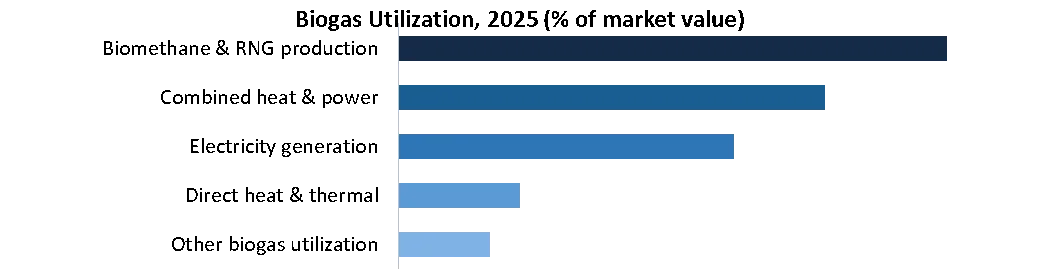
Biomethane, food waste and digitalisation add layers of demand. Biomethane and renewable natural gas account for about 36% of biogas utilization and are projected to grow at 12.0% CAGR, because upgraded gas can be injected into existing grids or sold as vehicle fuel at higher value than local electricity.
The collection of household and commercial food waste, required across much of the European Union, is lifting municipal organic solid waste to a XX% CAGR. Operations and maintenance services, growing at 10.6% CAGR, benefit from an ageing installed base that needs retrofits, repowering and process optimisation. AI-assisted process control, real-time gas monitoring and digital twins improve methane yield and plant availability, which supports repeat equipment and service demand.
Global Anaerobic Digestion Market Restraints: Capital Cost, Feedstock Supply, Grid Access and Permitting
High upfront investment in digester vessels, feedstock handling, gas cleaning, biomethane upgrading and grid connections remains a major restraint on the Anaerobic Digestion Market. Anaerobic digestion biogas plants require substantial capital investment, while biogas production and upgrading costs can reach USD 115 per MWh. The International Energy Agency (IEA) reports that integrating combined heat and power equipment, grid connections and heat recovery infrastructure can increase project costs by 40–70%, which hampers Anaerobic Digestion Market growth. Biomethane upgrading can add USD 3 per GJ, while gas grid connections can contribute another USD 3 per GJ, depending on project conditions. Smaller agricultural plants face financing challenges due to feedstock availability, energy prices and subsidy dependence. Permitting timelines of 2–5 years, combined with rising equipment costs, interest rates and uncertain long-term offtake agreements, can delay project development and reduce investment attractiveness.
Feedstock and permitting challenges add friction. Food waste arrives with plastics and other contaminants that require sorting and pretreatment; manure supply is seasonal and geographically dispersed; and competing uses for crop residues and energy crops affect cost and sustainability scoring. Permitting, odour, traffic and digestate-spreading rules differ by jurisdiction, and grid-injection queues can delay biomethane projects by months or years. Methane leakage, safety standards and digestate quality rules require strict operating discipline, and public acceptance of new plants varies by region. Alternative treatments, such as composting, incineration and direct landfill gas capture, compete for the same waste streams in some markets.
Anaerobic Digestion Market Investment Opportunities Through 2034
Biomethane, food waste and wastewater infrastructure represent the most significant investment opportunities because they extend revenue beyond conventional farm power plants. Biomethane and RNG are projected to grow at 12.0% CAGR as upgraded gas replaces natural gas in grids and transport. Platform investors are consolidating assets: in May 2026 Mobius Renewables, backed by funds managed by IFM Investors, completed the acquisition of Air Liquide’s biogas production activities in the United States, France, Norway and Sweden, and in October 2026 Future Biogas acquired the remaining stake in six anaerobic digestion facilities. Suppliers that offer upgrading-ready designs, standardised modular plants and bundled long-term operations contracts may be better positioned to win financing and retain customers.
Emerging-market expansion, digestate valorisation and industrial decarbonisation offer further routes to growth. Asia Pacific is projected to be the fastest-growing region at 10.7% CAGR as China, India, Japan, South Korea and Southeast Asian countries expand food waste, farm and wastewater digestion; South America grows at about 9.1% as Brazil and Argentina develop biomethane from sugar-ethanol, livestock and agro-industrial residues. Nutrient recovery and digestate fertiliser, carbon capture and utilisation from biogenic CO2, and on-site digestion at food and beverage plants add margin opportunities beyond gas. Anaerobic membrane bioreactors, which grow at about 12% CAGR, and high-rate reactors open industrial wastewater niches where energy recovery and effluent quality both matters.
Anaerobic Digestion Market Trends: Biomethane Scale-Up, Modular Plants, AI Monitoring and Digestate Valorisation
Four Anaerobic Digestion Market trends stand out through 2034. The biomethane scale-up: more plants are designed from the outset for upgrading and grid injection or bio-CNG and bio-LNG supply, and offtake agreements between producers and corporate buyers are lengthening, as in the reported ten-year biomethane supply deal between ENGIE and PepsiCo UK.
The modular and containerised plants lower the cost and lead time of small and medium projects, especially on farms and at food processors. The AI and digital monitoring: machine learning, SCADA integration and digital twins are being used to predict methane yield, balance feedstock blends and schedule maintenance. Fourth, digestate valorisation: solid-liquid separation, nitrogen and phosphorus recovery and certified organic fertilisers are turning residue handling into a revenue line and a regulatory necessity.
Global Anaerobic Digestion Market Segmentation:
By Feedstock, Digestion Process, Operating Temperature, Reactor Configuration, Offering, Plant Capacity, End-Use Sector and Biogas Utilization
Anaerobic Digestion Technology Market by End-Use Sector and Reactor Configuration: Wet, Dry, CSTR, Plug Flow and High-Rate Systems
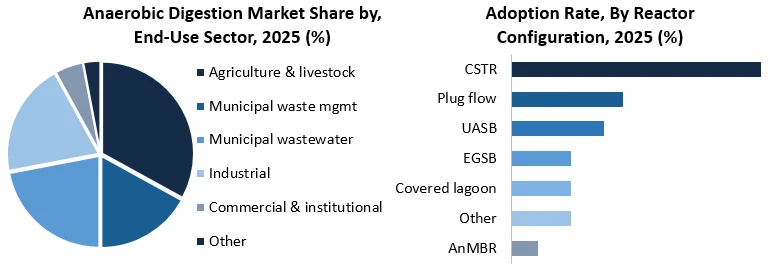
Agricultural Waste and Food Waste Anaerobic Digestion: Feedstock, Process, Offering and Plant Capacity Analysis
Agricultural feedstock is the largest group at about 35% of 2025 value, led by livestock manure at about 21%, with crop residues at 10% and dedicated energy crops at 4%. Municipal organic solid waste holds about 22% and is the fastest-growing feedstock group at XX% CAGR, driven by commercial and institutional food waste at XX%; sewage sludge holds about XX% and industrial organic waste and effluents about XX%.
By process, wet digestion leads with about 64% of value and dry digestion is faster at 9.7% CAGR; mesophilic operation holds about 69% and thermophilic is faster at 9.9%. Anaerobic Membrane Bioreactors (AnMBR) represent the fastest-growing segment, driven by increasing demand for efficient wastewater treatment and advanced organic waste processing. By offering, equipment and integrated systems account for the largest Anaerobic Digestion Market share, followed by engineering, construction and installation services, and operations and maintenance services. By plant capacity, 1 MWe to below 5 MWe facilities lead the market, supported by their commercial viability, scalability and adoption across agricultural, municipal and industrial applications.
|
Segmentation |
Largest segment (2025 share) |
Fastest segment (CAGR) |
SMR view |
|
Feedstock |
Agricultural feedstock (35%) |
Municipal Organic Solid Waste (10.4%) |
Manure anchors volume; food waste adds growth |
|
Digestion process |
Wet Anaerobic Digestion (XX%) |
Dry Anaerobic Digestion (XX%) |
Wet for slurries; dry for solid waste |
|
Operating temperature |
Mesophilic (XX%) |
Thermophilic (XX%) |
Thermophilic raises throughput and pathogen kill |
|
Reactor configuration |
Continuous Stirred Tank Reactors (CSTR) (XX%) |
Anaerobic Membrane Bioreactors (AnMBR) (XX%) |
CSTR dominates; membrane and EGSB niche growth |
|
Offering |
Equipment & Integrated Systems (XX%) |
Operations & Maintenance Services (XX% |
Value shifts to services and operations |
|
Plant capacity |
1 MWe to Below 5 MWe (XX%) |
5 MWe and Above (XX%) |
Large plants gain on biomethane economics |
|
End-use sector |
Agriculture & Livestock Farming (XX%) |
Municipal Solid Waste Management (XX%) |
Waste management closes the gap with farming |
|
Biogas utilization |
Biomethane & RNG Production (XX%) |
Biomethane & RNG Production (XX%) |
Biomethane pulls investment from power |
Anaerobic Digestion Applications: Where Biogas, Biomethane and Digestate Demand Sits
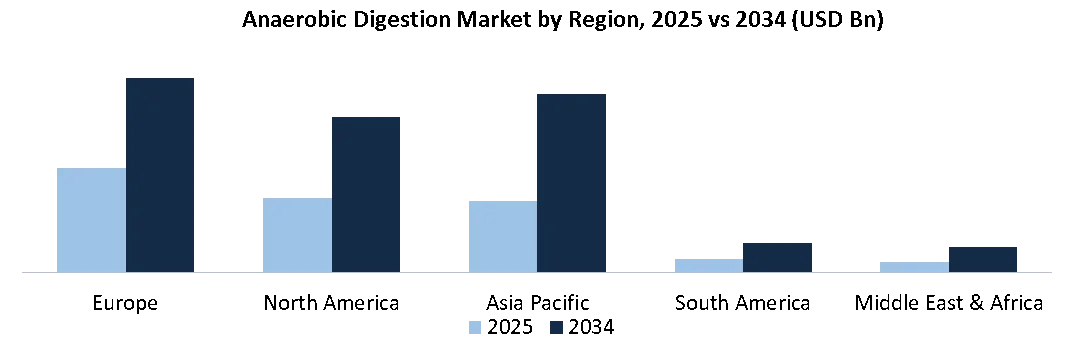
Anaerobic Digestion Market Regional Outlook: North America, Europe, Asia Pacific, Middle East & Africa and South America
Europe held the largest Anaerobic Digestion Market share about 38% of global value in 2025. Germany, France, Italy and the United Kingdom anchor demand, supported by long-established farm biogas, mandatory biowaste collection, the EU Renewable Energy Directive, the REPowerEU biomethane target and national green-gas support schemes, while Denmark, Sweden, the Netherlands and Poland add biomethane and food waste projects. The region is maturing, so growth is projected at about XX% CAGR, led by biomethane upgrading, retrofits and food waste plants. North America holds about XX% of 2025 value, driven by renewable natural gas projects at dairies, landfills and wastewater plants, the US Renewable Fuel Standard and California’s low-carbon fuel programme, and municipal organics diversion in Canada.
Asia Pacific is expected to be the fastest-growing region, with a 10.7% CAGR through 2034. China is scaling large biogas and food waste plants, India is pursuing compressed biogas through SATAT and the GOBARdhan scheme, Japan and South Korea are expanding food waste and sewage sludge digestion, and Australia and Southeast Asia are adding agro-industrial and wastewater projects. Middle East & Africa is a smaller market, about 4% of 2025 value, with growth of about 9.7% CAGR as Gulf states, Turkey, South Africa, Egypt and Nigeria invest in waste-to-energy and wastewater infrastructure. South America, about XX%, is projected to grow at about 9.1% CAGR, led by Brazil, where biomethane mandates and the sugar-ethanol and livestock industries create feedstock, and by Argentina, Chile and Colombia.
|
Region |
2025 share |
2025 (USD Bn) |
2034 (USD Bn) |
CAGR |
Notes |
|
Europe |
38.0% |
XX |
XX |
XX |
Germany, France, Italy and UK lead; RED III and REPowerEU shape biomethane; mandatory biowaste collection |
|
North America |
XX% |
XX |
XX |
XX |
RNG from farms, landfills and wastewater; RFS and low-carbon fuel credits; Canadian organics diversion |
|
Asia Pacific |
XX% |
XX |
XX |
XX |
China, India, Japan and South Korea expand food waste, farm and sludge digestion; fastest region |
|
Middle East & Africa |
XX% |
XX |
XX |
XX |
Gulf, Turkey and South Africa waste-to-energy and wastewater investment |
|
South America |
XX% |
XX |
XX |
XX |
Brazil biomethane mandates; sugar-ethanol, livestock and agro-industrial feedstock |
Anaerobic Digestion Market Key Players: Competitive Landscape and Top Anaerobic Digestion Companies
The Anaerobic Digestion Market competitive landscape includes several distinct groups rather than a single set of comparable companies. Global engineering and environmental groups such as Veolia (including Biothane), Air Liquide and Hitachi Zosen Inova supply digesters, upgrading and operations at scale. Specialist biogas plant builders, including EnviTec Biogas, WELTEC BIOPOWER, MT-Energie and Anaergia, serve farm, food waste and industrial projects. Biogas upgrading and gas-handling suppliers such as Greenlane Renewables, DMT Environmental Technology and Pentair Haffmans, wastewater reactor specialists such as Paques, and asset owners and operators such as Mobius Renewables, Future Biogas and Gasum complete the ecosystem. These groups compete on different dimensions and should not be ranked as though they were identical producers.
Competition is increasingly shaped by the ability to combine reliable digesters with upgrading, financing and long-term operations. EnviTec Biogas, for example, reported in October 2026 that construction of a combined biogas and upgrading plant for Biogas Västra Skaraborg in Vara, Sweden is progressing on schedule. Mobius Renewables, formed in December 2025, closed its acquisition of Air Liquide’s biogas production activities in May 2026, creating a producer with more than 5.5 million MMBtu of renewable natural gas output a year. Smaller players differentiate through modular designs, high-solids and membrane technologies, digital optimisation and regional service coverage. Consolidation and platform investing are likely to continue as lenders favour proven operators.
Top Anaerobic Digestion Companies: Technology Leaders, Plant Builders, Upgrading Specialists and Operators
SMR separates participants by role, because a digester technology leader, a plant builder and a gas operator do not compete with each other.
|
Group |
Examples |
Role |
|
Global technology and EPC leaders |
Veolia, Air Liquide, Hitachi Zosen Inova, Paques |
Digesters, wastewater reactors, thermal hydrolysis and global project delivery |
|
Biogas plant builders and farm specialists |
EnviTec Biogas, WELTEC BIOPOWER, MT-Energie, BTS Biogas, DVO |
Farm, food waste and industrial biogas plants |
|
Municipal, food waste and sludge specialists |
Anaergia, Cambi, Biogen, Hitachi Zosen Inova |
Organics processing, high-solids digestion and sludge pretreatment |
|
Biogas upgrading and gas-handling suppliers |
Greenlane Renewables, DMT Environmental Technology, Pentair Haffmans, Air Liquide Advanced Separations |
Membrane, scrubbing and adsorption upgrading; compression and grid injection |
|
Automation, CHP and engine suppliers |
INNIO Jenbacher, 2G Energy, Siemens, Schneider Electric, ABB |
Gensets, CHP, SCADA, instrumentation and digital control |
|
Developers, owners and operators |
Mobius Renewables, Future Biogas, Gasum, Verbio, Ameresco, Vanguard Renewables |
Project development, ownership, operations and gas offtake |
Anaerobic Digestion Company Benchmark: Strategic Signals, 2025–2026
|
Company |
Strategic signal |
|
Mobius Renewables |
Platform formed Dec 2025 by IFM Investors funds; closed Air Liquide biogas acquisition (US, France, Norway, Sweden) in May 2026 |
|
Air Liquide |
Divested biogas production activities in the US, France, Norway and Sweden to Mobius Renewables (closed May 2026) |
|
EnviTec Biogas |
Building a combined biogas and upgrading plant in Vara, Sweden; progress reported Oct 2026 |
|
Future Biogas |
Backed by 3i Infrastructure; acquired remaining stake in six UK anaerobic digestion facilities (Oct 2026) |
|
Veolia |
Biothane high-rate reactors serve food, beverage and industrial wastewater digestion |
Global Anaerobic Digestion Market Recent Developments, Technology Launches and Industry News | 2025–2026
|
Date |
Development |
Why it matters |
|
Dec 2025 |
IFM Investors funds establish Mobius Renewables, a vertically integrated RNG platform for North America and Europe |
Institutional capital enters renewable gas at scale |
|
Apr 2026 |
European Biogas Association reports that manure, agricultural residues and industrial wastewater are about 81% of Europe’s technically achievable biomethane potential |
Confirms agriculture and industry as the core feedstock pool |
|
4 May 2026 |
Mobius Renewables closes acquisition of Air Liquide’s biogas production activities in the US, France, Norway and Sweden |
Portfolio consolidation and cross-border RNG scale |
|
2026 |
ENGIE signs a reported ten-year biomethane supply agreement with PepsiCo UK from an AD plant producing 60 GWh a year |
Corporate offtake underpins project finance |
|
Aug 2026 |
Global Market Insights publishes an AD equipment outlook of USD 11.5 Bn in 2025 rising to USD 26 Bn by 2035 |
Equipment-only benchmark for market scope |
|
29 Oct 2026 |
Future Biogas acquires the remaining stake in six anaerobic digestion facilities |
Operators consolidate ownership of mature assets |
|
30 Oct 2026 |
EnviTec Biogas reports construction progress on the Vara, Sweden biogas and upgrading plant |
Integrated digestion-plus-upgrading builds gain share |
Anaerobic Digestion Market Scope: Inquire before buying
|
Global Anaerobic Digestion Market |
|||
|
Report Coverage |
Details |
||
|
Base Year: |
2025 |
Forecast Period: |
2026-2034 |
|
Historical Data: |
2020 to 2025 |
Market Size in 2025: |
USD 14.20 Billion |
|
Forecast Period 2026 to 2034 CAGR: |
8.7% |
Market Size in 2034: |
USD 30.09 Billion |
|
Segments Covered: |
By Feedstock |
Agricultural Feedstock Livestock Manure Crop Residues Dedicated Energy Crops Municipal Organic Solid Waste Household Organic Waste Commercial and Institutional Food Waste Other Municipal Organic Solid Waste Sewage Sludge Industrial Organic Waste and Effluents Food and Beverage Processing Residues Industrial Organic Wastewater Other Industrial Organic Residues Other Feedstocks |
|
|
By Digestion Process |
Wet Anaerobic Digestion Dry Anaerobic Digestion |
||
|
By Operating Temperature |
Psychrophilic Anaerobic Digestion Mesophilic Anaerobic Digestion Thermophilic Anaerobic Digestion |
||
|
By Reactor Configuration |
Continuous Stirred Tank Reactors (CSTR) Plug Flow Reactors Upflow Anaerobic Sludge Blanket (UASB) Reactors Expanded Granular Sludge Bed (EGSB) Reactors Anaerobic Membrane Bioreactors (AnMBR) Covered Lagoon Digesters Other Reactor Configurations |
||
|
By Offering |
Equipment and Integrated Systems Digester Vessels and Reactor Systems Feedstock Preparation and Handling Equipment Mixing, Heating and Pumping Equipment Biogas Collection, Storage and Handling Equipment Process Monitoring and Automation Systems Other Digestion Equipment Engineering, Construction and Installation Services Engineering and Plant Design Construction and Installation Commissioning and System Integration Operations and Maintenance Services Plant Operations Services Preventive and Corrective Maintenance Plant Optimization and Technical Support |
||
|
By Plant Capacity |
Below 100 kWe 100 kWe to Below 500 kWe 500 kWe to Below 1 MWe 1 MWe to Below 5 MWe 5 MWe and Above |
||
|
By Primary Biogas Utilization
|
Electricity Generation Combined Heat and Power (CHP) Direct Heat and Thermal Applications Biomethane and Renewable Natural Gas Production Other Biogas Utilization |
||
|
By End-Use Sector
|
Agriculture and Livestock Farming Municipal Solid Waste Management Municipal Wastewater Treatment Industrial Manufacturing and Processing Commercial and Institutional Facilities Other End-Use Sectors |
||
Global Anaerobic Digestion Market, By Region
North America (United States, Canada, Mexico)
Europe (Germany, United Kingdom, France, Italy, Spain, Netherlands, Denmark, Sweden, Poland, Austria, Switzerland, Rest of Europe)
Asia Pacific (China, India, Japan, South Korea, Australia, Thailand, Indonesia, Malaysia, Vietnam, Philippines, Rest of Asia Pacific)
Middle East & Africa (Saudi Arabia, United Arab Emirates, Turkey, South Africa, Egypt, Nigeria, Rest of Middle East & Africa)
South America (Brazil, Argentina, Chile, Colombia, Rest of South America)
Global Anaerobic Digestion Market, Key Players
North America
- Anaergia Inc.
- Greenlane Renewables Inc.
- Mobius Renewables LLC
- Air Liquide (U.S. Biogas Operations)
- DVO, Inc.
- Bioenergy Devco
- Montauk Renewables, Inc.
- Ameresco, Inc.
- Vanguard Renewables
- Brightmark LLC
- Clean Energy Fuels Corp.
- Waste Management, Inc.
- Republic Services, Inc.
- Caterpillar Inc.
- Xylem Inc.
- Ovivo Inc.
Europe
- Veolia Environnement S.A. (Veolia Water Technologies / Biothane)
- Air Liquide S.A.
- EnviTec Biogas AG
- WELTEC BIOPOWER GmbH
- MT-Energie GmbH & Co. KG
- Hitachi Zosen Inova AG
- BTS Biogas Srl
- Biogen Group
- Paques Biological Systems B.V.
- DMT Environmental Technology
- Pentair Haffmans
- Cambi AS
- Gasum Oy
- Verbio SE
- Future Biogas Ltd
- ENGIE S.A.
- INNIO Group (Jenbacher)
- 2G Energy AG
- Evonik Industries AG
- Clarke Energy
- Siemens AG
- Schneider Electric SE
- ABB Ltd.
Asia Pacific
- Hitachi Zosen Corporation
- JFE Engineering Corporation
- Ebara Corporation
- Kobelco Eco-Solutions Co., Ltd.
- Mitsubishi Kakoki Kaisha, Ltd.
- Kubota Corporation
- China Everbright Environment Group Ltd.
- Beijing Enterprises Water Group Ltd.
- Shanghai Environment Group Co., Ltd.
- Praj Industries Ltd.
- Thermax Limited
- GAIL (India) Limited
- Doosan Enerbility Co., Ltd.
- Energy Developments Limited (EDL)
Middle East & Africa
- Masdar
- ACWA Power
- Metito Holdings
- Enviroserv Waste Management
- Bio2Watt (Pty) Ltd.
South America
- Raízen S.A.
- Sabesp
- Ambipar
- Geo Biogás & Tech
- Sistema.bio
Frequently Asked Questions
Ans. Anaerobic digestion breaks organic matter down in four stages, hydrolysis, acidogenesis, acetogenesis and methanogenesis, inside a sealed, heated digester, producing biogas and digestate. Wet digestion handles pumpable slurries with low solids, such as manure and sewage sludge, and holds about 64% of value; dry digestion handles stackable, high-solids material such as organic municipal waste and crop residues, and grows faster at 9.7% CAGR.
Ans. Agricultural waste anaerobic digestion converts livestock manure, crop residues and energy crops into biogas on farms or at centralised plants, often blended with other residues to raise yield. Food waste anaerobic digestion processes source-separated household, retail and food processing waste, which has higher energy content than manure but needs depackaging and contamination control. Both streams also yield digestate that can replace part of mineral fertiliser use.
Ans. Europe holds the largest anaerobic digestion market share in 2025, led by Germany, France, Italy and the United Kingdom. North America follows at about 27% and Asia Pacific at about 26%. Asia Pacific is the fastest-growing region at 10.7% CAGR, led by China, India, Japan and South Korea.
Ans. Agricultural feedstock is the largest feedstock group at about 35% of 2025 value, while municipal organic solid waste grows fastest at 10.4% CAGR. Biomethane and RNG grow at 12.0%, operations and maintenance services at 10.6%, dry digestion at 9.7% and anaerobic membrane bioreactors at about 12%, all above the 8.7% market rate.
Ans. Leading names include Veolia (Biothane), Air Liquide, EnviTec Biogas, WELTEC BIOPOWER, MT-Energie, Anaergia, Hitachi Zosen Inova and Paques, alongside upgrading specialists such as Greenlane Renewables and DMT Environmental Technology and operators such as Mobius Renewables, Future Biogas and Gasum. This is the core of the anaerobic digestion market key players landscape.
- Executive Market Landscape and Industry Overview
- Global Anaerobic Digestion Market Size (Value USD Billion), 2025–2034
- Evolution of Anaerobic Digestion Technology and Commercial Biogas Production
- Market Definition, Scope and Classification of Anaerobic Digestion Systems
- Role of Anaerobic Digestion in Renewable Energy, Organic Waste Management and Circular Economy
- Integration of Feedstock Processing, Anaerobic Digestion, Biogas Recovery and Digestate Management
- Global Biogas and Biomethane Production Capacity and Infrastructure Development
- CAGR Analysis of Global Anaerobic Digestion Market During 2025–2034
- Anaerobic Digestion Market Dynamics
- Anaerobic Digestion Market Trends
- Anaerobic Digestion Market Dynamics
- Drivers
- Restraints
- Opportunities
- Challenges
- Porter's Five Forces Analysis
- PESTLE Analysis
- Anaerobic Digestion Market Macroeconomic Factors
- Global Renewable Energy Investment and Infrastructure Financing Trends
- Government Investments in Biogas, Biomethane and Waste-to-Energy Projects
- Agricultural Production, Livestock Population and Organic Waste Generation Trends
- Municipal Solid Waste Generation and Wastewater Treatment Infrastructure Development
- Natural Gas Prices, Electricity Tariffs and Renewable Energy Market Economics
- Carbon Pricing, Emission Reduction Incentives and Green Energy Subsidies
- Interest Rates, Project Financing Costs, Inflation and International Equipment Trade
- Anaerobic Digestion Industry Trends & Emerging Technology Requirements
- Increasing Adoption of Industrial-Scale Anaerobic Digestion Plants
- Expansion of Biomethane and Renewable Natural Gas Production
- Growing Integration of Anaerobic Digestion with Municipal Waste Management
- Increasing Utilization of Agricultural Residues and Livestock Manure
- Integration of Artificial Intelligence and Digital Monitoring in Biogas Plants
- Development of High-Solids and High-Rate Anaerobic Digestion Technologies
- Growing Demand for Digestate Valorization and Nutrient Recovery
- Anaerobic Digestion Technology Architecture & Ecosystem Landscape
- Anaerobic Digestion Process Fundamentals and Microbial Conversion Stages
- Hydrolysis, Acidogenesis, Acetogenesis and Methanogenesis
- Feedstock Collection, Pretreatment and Organic Material Conditioning
- Digester Reactor Design, Mixing Systems and Hydraulic Retention Time
- Biogas Collection, Gas Cleaning and Methane Recovery Systems
- Digestate Separation, Nutrient Recovery and Residue Management
- Process Automation, Gas Monitoring and Operational Performance Optimization
- Anaerobic Digestion Plant Configurations & System Design
- Centralized Anaerobic Digestion Facilities
- Decentralized and On-Site Anaerobic Digestion Systems
- Farm-Based Anaerobic Digestion Plants
- Municipal Organic Waste Anaerobic Digestion Facilities
- Industrial Organic Waste and Wastewater Digestion Systems
- Modular, Containerized and Small-Scale Digestion Plants
- Integrated Biogas, Biomethane and Combined Heat and Power Facilities
- Agricultural Anaerobic Digestion & Livestock Waste Management
- Agricultural Anaerobic Digestion Technology and Market Development
- Cattle Manure and Dairy Farm Waste Digestion
- Poultry and Swine Manure-Based Biogas Production
- Crop Residue and Agricultural Byproduct Digestion
- Energy Crop Utilization and Feedstock Sustainability
- Agricultural Co-Digestion and Feedstock Blending
- Farm-Level Biogas Economics and Digestate Fertilizer Utilization
- Municipal Solid Waste & Food Waste Anaerobic Digestion
- Organic Fraction of Municipal Solid Waste Processing
- Source-Separated Organic Waste Collection and Digestion
- Food Waste Anaerobic Digestion and Resource Recovery
- Commercial Food Processing and Hospitality Waste Management
- Municipal Anaerobic Digestion Infrastructure Development
- Organic Waste Contamination, Sorting and Pretreatment Requirements
- Municipal Waste Diversion, Landfill Reduction and Methane Recovery
- Industrial Anaerobic Digestion & Wastewater Treatment
- Industrial Anaerobic Digestion Technology and Market Applications
- Food and Beverage Industry Wastewater Treatment
- Pulp and Paper Industry Organic Effluent Treatment
- Chemical and Pharmaceutical Industry Organic Wastewater Treatment
- High-Rate Anaerobic Wastewater Treatment Reactors
- Industrial Biogas Recovery and On-Site Energy Utilization
- Industrial Effluent Treatment Economics and Operational Performance
- Sewage Sludge Anaerobic Digestion & Municipal Wastewater Infrastructure
- Municipal Sewage Sludge Anaerobic Digestion
- Primary and Waste Activated Sludge Stabilization
- Mesophilic and Thermophilic Sludge Digestion
- Sludge Thickening, Thermal Hydrolysis and Pretreatment
- Biogas Recovery from Wastewater Treatment Plants
- Biosolids Management and Nutrient Recovery
- Energy-Neutral and Energy-Positive Wastewater Treatment Facilities
- Anaerobic Digestion Equipment, Reactors & Plant Components
- Continuous Stirred Tank Reactors and Digester Vessels
- Plug Flow and High-Solids Digester Equipment
- Upflow Anaerobic Sludge Blanket and High-Rate Reactors
- Feedstock Pumps, Conveyors and Pretreatment Equipment
- Mixing, Heating and Temperature Control Systems
- Biogas Storage, Compression and Gas Handling Equipment
- Instrumentation, Sensors, Control Systems and Plant Automation
- Anaerobic Digestion Feedstock, Additives & Biological Process Materials
- Agricultural Residues and Livestock Manure Supply
- Food Waste and Municipal Organic Feedstock Supply
- Sewage Sludge and Industrial Organic Residues
- Microbial Inoculum and Biological Process Additives
- Trace Nutrients, Buffering Agents and Process Stabilizers
- Feedstock Quality, Contamination and Biodegradability Assessment
- Feedstock Storage, Logistics and Supply Chain Requirements
- Anaerobic Digestion Feedstock Preparation & Operational Workflow
- Feedstock Collection and Organic Waste Segregation
- Mechanical Sorting, Shredding and Size Reduction
- Thermal, Chemical and Biological Pretreatment
- Feedstock Mixing, Dilution and Slurry Preparation
- Digester Loading, Retention Time and Organic Loading Rate Optimization
- Biogas Collection, Digestate Discharge and Residue Processing
- Plant Monitoring, Maintenance and Process Efficiency Optimization
- Anaerobic Digestion Digital Monitoring, Automation & Analytics
- Real-Time Digester Monitoring and Process Control
- Methane Yield Prediction and Biogas Production Analytics
- AI-Enabled Feedstock Optimization and Process Stability Management
- SCADA and Industrial Automation Integration
- Digital Twin Technology for Anaerobic Digestion Plants
- Predictive Maintenance and Equipment Performance Analytics
- Remote Monitoring, Cloud-Based Plant Management and Data Integration
- Anaerobic Digestion Applications in Renewable Energy Generation
- Biogas-Based Electricity Generation
- Combined Heat and Power Applications
- Industrial Process Heat and Thermal Energy Generation
- Biomethane Production for Natural Gas Grid Injection
- Renewable Natural Gas for Transportation Fuel
- Compressed Biogas and Bio-CNG Applications
- Distributed Renewable Energy and Off-Grid Power Generation
- Anaerobic Digestion Applications in Waste Management & Resource Recovery
- Municipal Organic Waste Diversion from Landfills
- Food Waste Recycling and Circular Economy Applications
- Agricultural Waste Stabilization and Manure Management
- Industrial Organic Waste Treatment and Resource Recovery
- Wastewater Sludge Stabilization and Volume Reduction
- Digestate Fertilizer Production and Soil Nutrient Recycling
- Methane Emission Mitigation and Environmental Compliance
- Anaerobic Digestion Applications in Industrial & Commercial Facilities
- Food Processing Facility Biogas Recovery
- Dairy Processing and Beverage Manufacturing Waste Treatment
- Brewery, Distillery and Sugar Industry Anaerobic Digestion
- Pulp and Paper Manufacturing Wastewater Treatment
- Pharmaceutical and Chemical Industry Organic Effluent Treatment
- Commercial Food Waste and Hospitality Waste Processing
- Industrial Energy Cost Reduction and Decarbonization Applications
- Biomethane Production, Biogas Upgrading & Renewable Gas Infrastructure
- Raw Biogas Composition and Methane Concentration Analysis
- Membrane Separation and Biogas Upgrading Technologies
- Pressure Swing Adsorption and Water Scrubbing Systems
- Chemical and Physical Absorption-Based Biogas Purification
- Biomethane Compression, Storage and Transportation
- Natural Gas Grid Injection and Renewable Gas Certification
- Biomethane Commercialization, Offtake Agreements and Revenue Models
- Digestate Management, Nutrient Recovery & Fertilizer Applications
- Digestate Characteristics and Nutrient Composition
- Solid-Liquid Separation and Digestate Dewatering
- Digestate Composting and Organic Fertilizer Production
- Nitrogen and Phosphorus Recovery Technologies
- Agricultural Land Application and Soil Improvement
- Digestate Quality Standards and Environmental Regulations
- Digestate Commercialization and Circular Nutrient Economy
- Anaerobic Digestion Services, Engineering & Project Development
- Anaerobic Digestion Plant Feasibility and Technical Consulting
- Engineering, Procurement and Construction Services
- Digester Design, Equipment Integration and Plant Installation
- Commissioning, Testing and Performance Validation Services
- Operations and Maintenance Services
- Plant Retrofitting, Expansion and Technology Upgradation
- Project Development, Financing Advisory and Long-Term Service Agreements
- Anaerobic Digestion Manufacturing, Engineering & Quality Control
- Digester Tank and Reactor Manufacturing
- Steel, Concrete and Corrosion-Resistant Material Selection
- Gas Handling, Piping and Mechanical Equipment Manufacturing
- Electrical Systems, Instrumentation and Automation Integration
- Modular Plant Fabrication and Equipment Assembly
- Equipment Testing, Safety Validation and Quality Assurance
- Manufacturing Standards, Equipment Reliability and Performance Certification
- Anaerobic Digestion Pricing, Business Models & Project Economics
- Anaerobic Digestion Plant Capital Expenditure by Capacity
- Equipment Procurement, Installation and Civil Construction Costs
- Feedstock Collection, Transportation and Processing Costs
- Operating Expenditure, Maintenance and Labor Costs
- Biogas, Biomethane and Electricity Revenue Models
- Levelized Cost of Energy and Biomethane Production Economics
- Project IRR, NPV, Payback Period and Total Cost of Ownership
- Anaerobic Digestion Commercialization, Sales & Procurement Landscape
- Direct Sales by Anaerobic Digestion Technology Providers
- Engineering, Procurement and Construction Contracting Models
- Turnkey Anaerobic Digestion Plant Supply Agreements
- Public-Private Partnerships and Municipal Project Procurement
- Build-Own-Operate and Build-Own-Operate-Transfer Models
- Equipment Distribution, System Integrators and Regional Service Networks
- Long-Term Feedstock Supply, Energy Offtake and Maintenance Contracts
- Anaerobic Digestion Supply Chain & Operational Ecosystem
- Organic Feedstock Availability and Collection Infrastructure
- Digester Equipment and Mechanical Component Supply Chains
- Biogas Cleaning, Upgrading and Compression Equipment Procurement
- Engineering Contractors and Technology Licensing Networks
- Feedstock Transportation, Storage and Logistics Management
- International Equipment Trade and Supply Chain Resilience
- Project Execution Risks, Supplier Qualification and Operational Continuity
- Anaerobic Digestion Technology Innovation, R&D & Product Development
- High-Rate and High-Solids Anaerobic Digestion Technologies
- Two-Stage and Multi-Stage Anaerobic Digestion Systems
- Advanced Thermal Hydrolysis and Feedstock Pretreatment
- AI-Enabled Process Optimization and Automated Biogas Plants
- Integration of Anaerobic Digestion with Carbon Capture and Utilization
- Advanced Biomethane Upgrading and Methane Recovery Efficiency
- Research Investments, Patents and Technology Collaborations
- Anaerobic Digestion Market Adoption, Utilization & Customer Economics
- Adoption of Anaerobic Digestion Across Agricultural, Municipal and Industrial Facilities
- Installed Digestion Capacity and Plant Utilization Rates
- Biogas Yield, Methane Recovery and Operational Efficiency
- Feedstock Supply Reliability and Plant Availability
- Plant Replacement Cycles, Retrofitting and Capacity Expansion
- Customer Economics, Energy Savings and Waste Disposal Cost Reduction
- Procurement Preferences and Long-Term Investment Decisions
- Anaerobic Digestion Market Regulatory, Environmental & Technical Standards
- Renewable Energy Policies and Biogas Development Incentives
- European Union Renewable Energy Directive and Biomethane Sustainability Requirements
- United States EPA Requirements and Renewable Fuel Standard Framework
- Waste Management, Landfill Diversion and Organic Waste Treatment Regulations
- Biogas Plant Safety, Gas Handling and Environmental Permitting Standards
- Digestate Quality, Fertilizer Certification and Land Application Requirements
- Carbon Accounting, Methane Emission Monitoring and Renewable Gas Certification
- Anaerobic Digestion Regional & Country-Level Market Landscape
- North American Renewable Natural Gas, Agricultural Biogas and Waste Management Demand
- European Biomethane Infrastructure, Renewable Energy Policies and Anaerobic Digestion Investments
- Asia Pacific Organic Waste Treatment, Agricultural Biogas and Industrial Digestion Adoption
- Middle East & Africa Waste-to-Energy Infrastructure and Emerging Biogas Opportunities
- South American Agricultural Residue Digestion and Renewable Gas Development
- Country-Level Analysis of the United States, Canada, Germany, United Kingdom, France, Italy, China, India, Japan, Brazil and Argentina
- Regional Project Pipeline, Installed Capacity, Government Incentives and Investment Attractiveness
Section B: Market Sizing & Forecast
- Anaerobic Digestion Market: Market Size and Forecast by Segmentation (Value USD Billion), 2025–2034
Market sizing boundary: The recommended primary market measures revenue from anaerobic digestion plant equipment, integrated systems, engineering and installation, and directly attributable operation and maintenance services. It excludes the resale value of biogas, biomethane, electricity, fertilizers and carbon credits to prevent double counting.
-
- Anaerobic Digestion Market Size and Forecast, by Feedstock Type
- Agricultural Feedstock
- Livestock Manure
- Crop Residues
- Dedicated Energy Crops
- Municipal Organic Solid Waste
- Source-Separated Household Organic Waste
- Commercial and Institutional Food Waste
- Other Municipal Organic Solid Waste
- Sewage Sludge
- Industrial Organic Waste and Effluents
- Food and Beverage Processing Residues
- Industrial Organic Wastewater
- Other Industrial Organic Residues
- Other Feedstocks
- Agricultural Feedstock
- Anaerobic Digestion Market Size and Forecast, by Digestion Process
- Wet Anaerobic Digestion
- Dry Anaerobic Digestion
- Anaerobic Digestion Market Size and Forecast, by Operating Temperature
- Psychrophilic Anaerobic Digestion
- Mesophilic Anaerobic Digestion
- Thermophilic Anaerobic Digestion
- Anaerobic Digestion Market Size and Forecast, by Reactor Configuration
- Continuous Stirred Tank Reactors (CSTR)
- Plug Flow Reactors
- Upflow Anaerobic Sludge Blanket (UASB) Reactors
- Expanded Granular Sludge Bed (EGSB) Reactors
- Anaerobic Membrane Bioreactors (AnMBR)
- Covered Lagoon Digesters
- Other Reactor Configurations
- Anaerobic Digestion Market Size and Forecast, by Offering
- Equipment and Integrated Systems
- Digester Vessels and Reactor Systems
- Feedstock Preparation and Handling Equipment
- Mixing, Heating and Pumping Equipment
- Biogas Collection, Storage and Handling Equipment
- Process Monitoring and Automation Systems
- Other Digestion Equipment
- Engineering, Construction and Installation Services
- Engineering and Plant Design
- Construction and Installation
- Commissioning and System Integration
- Operations and Maintenance Services
- Plant Operations Services
- Preventive and Corrective Maintenance
- Plant Optimization and Technical Support
- Equipment and Integrated Systems
- Anaerobic Digestion Market Size and Forecast, by Plant Capacity
- Below 100 kWe
- 100 kWe to Below 500 kWe
- 500 kWe to Below 1 MWe
- 1 MWe to Below 5 MWe
- 5 MWe and Above
- Anaerobic Digestion Market Size and Forecast, by Feedstock Type
Capacity classification uses electrical-equivalent output for comparability. Biomethane-only, heat-only and wastewater-treatment facilities require standardized conversion assumptions; where this is not feasible, capacity should be reported separately rather than forced into these bands.
-
- Anaerobic Digestion Market Size and Forecast, by Primary End-Use Sector
- Agriculture and Livestock Farming
- Municipal Solid Waste Management
- Municipal Wastewater Treatment
- Industrial Manufacturing and Processing
- Commercial and Institutional Facilities
- Other End-Use Sectors
- Anaerobic Digestion Market Size and Forecast, by Primary Biogas Utilization
- Electricity Generation
- Combined Heat and Power
- Direct Heat and Thermal Applications
- Biomethane and Renewable Natural Gas Production
- Other Biogas Utilization
- Anaerobic Digestion Market Size and Forecast, by Region
- North America
- United States
- Canada
- Mexico
- Europe
- Germany
- United Kingdom
- France
- Italy
- Spain
- Netherlands
- Denmark
- Sweden
- Poland
- Austria
- Switzerland
- Rest of Europe
- Asia Pacific
- China
- India
- Japan
- South Korea
- Australia
- Thailand
- Indonesia
- Malaysia
- Vietnam
- Philippines
- Rest of Asia Pacific
- Middle East and Africa
- Saudi Arabia
- United Arab Emirates
- Turkey
- South Africa
- Egypt
- Nigeria
- Rest of Middle East and Africa
- South America
- Brazil
- Argentina
- Chile
- Colombia
- Rest of South America
- North America
- Anaerobic Digestion Market Size and Forecast, by Primary End-Use Sector
- Anaerobic Digestion Market Competitive Landscape
- SMR Competition Matrix
- Competitive Positioning of Leading Key Players – Revenue and Market Share (%)
- Key Players Benchmarking
- Company Name
- Headquarters
- Anaerobic Digestion Technology Portfolio
- Digester Equipment and Reactor Capabilities
- Biogas and Biomethane Technology Portfolio
- Engineering, Construction and Maintenance Services
- Installed Plant Capacity and Project Portfolio
- Total Company Revenue (2025)
- Anaerobic Digestion-Related Revenue (2025)
- Geographic Presence
- Commercial and Distribution Network
- Strategic Partnerships and Technology Collaborations
- Market Structure
- Market Leaders
- Market Followers
- Emerging Players
- Specialized Anaerobic Digestion Technology Providers
- Growth Rate / YoY (%) of Companies
- Profit Margin (%) of Companies
- R&D Investments (%) of Companies
- Revenue vs. Net Earnings – Financial Health Benchmarking
- Revenue Performance and Financial Analysis
- Mergers and Acquisitions
- Recent Key Developments
- Agricultural & Farm-Based Anaerobic Digestion Technology Providers
- Agricultural Biogas Plant Manufacturers
- Livestock Manure Digestion Technology Providers
- Crop Residue and Energy Crop Digestion Solution Providers
- Farm-Based Modular Biogas System Manufacturers
- Agricultural Co-Digestion Technology Developers
- Farm-Level Biogas and CHP Integration Providers
- Agricultural Digestion Technology Performance Benchmarking
- Municipal Waste, Food Waste & Sewage Sludge Digestion Providers
- Municipal Organic Waste Anaerobic Digestion Companies
- Food Waste Processing and Digestion Technology Providers
- Sewage Sludge Digestion System Manufacturers
- Municipal Waste-to-Energy Project Developers
- Thermal Hydrolysis and Sludge Pretreatment Technology Providers
- Municipal Digestion Plant EPC Contractors
- Municipal Digestion Capacity, Performance and Cost Benchmarking
- Industrial Anaerobic Digestion & Wastewater Technology Providers
- Industrial Anaerobic Wastewater Treatment Companies
- UASB and EGSB Reactor Technology Providers
- Anaerobic Membrane Bioreactor Developers
- Food and Beverage Industry Biogas Technology Providers
- High-Strength Industrial Effluent Treatment Companies
- Industrial Biogas Recovery and Energy Integration Providers
- Industrial Reactor Performance and Technology Benchmarking
- Anaerobic Digestion Equipment, Reactor & Component Manufacturers
- Anaerobic Digester Tank and Reactor Manufacturers
- Mixing, Pumping and Feedstock Handling Equipment Suppliers
- Heating, Temperature Control and Process Equipment Manufacturers
- Biogas Storage, Gas Handling and Compression Equipment Providers
- Process Instrumentation and Automation System Suppliers
- Digestate Separation and Dewatering Equipment Manufacturers
- Equipment Efficiency, Reliability and Cost Benchmarking
- Biogas Upgrading, Biomethane & Digital Technology Providers
- Membrane-Based Biogas Upgrading Technology Providers
- Pressure Swing Adsorption and Gas Scrubbing System Manufacturers
- Biomethane Compression and Grid Injection Technology Providers
- Biogas Monitoring and Methane Measurement Equipment Suppliers
- AI-Enabled Anaerobic Digestion Optimization Providers
- SCADA, Digital Twin and Remote Plant Monitoring Companies
- Biomethane Recovery Efficiency and Technology Benchmarking
- Anaerobic Digestion EPC, Operations & Project Development Companies
- Anaerobic Digestion Engineering and Design Companies
- Turnkey Biogas Plant EPC Contractors
- Anaerobic Digestion Project Developers
- Plant Operations and Maintenance Service Providers
- Biogas and Biomethane Asset Owners and Operators
- Plant Retrofitting and Capacity Expansion Service Providers
- Project Delivery, Installed Capacity and Service Capability Benchmarking
- Anaerobic Digestion Manufacturers' Strategies & Expansion Plans
- Expansion of Industrial and Municipal Anaerobic Digestion Portfolios
- Development of High-Solids and High-Rate Digestion Technologies
- Expansion into Biomethane and Renewable Natural Gas Markets
- Development of Modular and Containerized Anaerobic Digestion Systems
- Integration of AI-Based Process Optimization and Automation
- Strategic Partnerships with Municipalities, Utilities and Agricultural Organizations
- Geographic Expansion Across Emerging Biogas Markets
- Mergers, Acquisitions and Technology Collaborations
- Anaerobic Digestion Industry SWOT, Investments & Strategic Developments
- Competitive Strengths of Established Anaerobic Digestion Technology Providers
- Technology Limitations, Feedstock Constraints and Operating Challenges
- Emerging Opportunities in Biomethane and Circular Economy Infrastructure
- Competitive Threats from Alternative Waste Treatment and Renewable Energy Technologies
- Strategic Investments in Anaerobic Digestion Plants and Biogas Infrastructure
- Investments in Biomethane Upgrading and Renewable Gas Distribution
- Major Project Announcements, Partnerships and Industry Developments
- Anaerobic Digestion Competitive Outlook & Market Positioning
- Competitive Dynamics Across Agricultural, Municipal and Industrial Digestion
- Market Concentration Across Equipment, EPC and O&M Services
- Technology Differentiation Through Methane Yield, Efficiency and Plant Reliability
- Competitive Positioning of Established Manufacturers and Emerging Providers
- Expansion of Biomethane and Renewable Natural Gas Infrastructure
- Future Technology Innovation and Digitalization of Anaerobic Digestion Plants
- Long-Term Competitive Positioning of Leading Anaerobic Digestion Companies
40. Company Profiles – Key Players (63+ Key Players)
Detailed Profile Considering the Parameters
- Company Overview
- Anaerobic Digestion Technology Portfolio
- Digester Equipment and Reactor Capabilities
- Biogas and Biomethane Technology Portfolio
- Engineering, Construction and Maintenance Services
- Financial Overview
- Geographic Presence
- SWOT Analysis
- Strategic Analysis
- Recent Developments
North America
- Anaergia Inc.
- Greenlane Renewables Inc.
- Mobius Renewables LLC
- Air Liquide (U.S. Biogas Operations)
- DVO, Inc.
- Bioenergy Devco
- Montauk Renewables, Inc.
- Ameresco, Inc.
- Vanguard Renewables
- Brightmark LLC
- Clean Energy Fuels Corp.
- Waste Management, Inc.
- Republic Services, Inc.
- Caterpillar Inc.
- Xylem Inc.
- Ovivo Inc.
Europe
- Veolia Environnement S.A. (Veolia Water Technologies / Biothane)
- Air Liquide S.A.
- EnviTec Biogas AG
- WELTEC BIOPOWER GmbH
- MT-Energie GmbH & Co. KG
- Hitachi Zosen Inova AG
- BTS Biogas Srl
- Biogen Group
- Paques Biological Systems B.V.
- DMT Environmental Technology
- Pentair Haffmans
- Cambi AS
- Gasum Oy
- Verbio SE
- Future Biogas Ltd
- ENGIE S.A.
- INNIO Group (Jenbacher)
- 2G Energy AG
- Evonik Industries AG
- Clarke Energy
- Siemens AG
- Schneider Electric SE
- ABB Ltd.
Asia Pacific
- Hitachi Zosen Corporation
- JFE Engineering Corporation
- Ebara Corporation
- Kobelco Eco-Solutions Co., Ltd.
- Mitsubishi Kakoki Kaisha, Ltd.
- Kubota Corporation
- China Everbright Environment Group Ltd.
- Beijing Enterprises Water Group Ltd.
- Shanghai Environment Group Co., Ltd.
- Praj Industries Ltd.
- Thermax Limited
- GAIL (India) Limited
- Doosan Enerbility Co., Ltd.
- Energy Developments Limited (EDL)
Middle East & Africa
- Masdar
- ACWA Power
- Metito Holdings
- Enviroserv Waste Management
- Bio2Watt (Pty) Ltd.
South America
- Raízen S.A.
- Sabesp
- Ambipar
- Geo Biogás & Tech
- Sistema.bio
41. Key Findings
41.1. Global Anaerobic Digestion Market Growth Outlook
41.2. Leading Feedstock and Technology Segments
41.3. Regional Market Opportunities and Growth Potential
41.4. Biomethane Infrastructure and Renewable Energy Investment Opportunities
41.5. Competitive Landscape and Technology Differentiation
41.6. Emerging Market Opportunities and Strategic Recommendations
42. Strategic Moves & Industry Outlook
42.1. Strategic Priorities for Anaerobic Digestion Equipment Manufacturers
42.2. Market Entry and Geographic Expansion Opportunities
42.3. Technology Investment and Product Development Priorities
42.4. Strategic Partnerships, Joint Ventures and M&A Opportunities
42.5. Long-Term Biogas and Biomethane Infrastructure Development
42.6. Anaerobic Digestion Market Outlook Through 2034
43. Research Methodology
43.1. Research Scope and Market Definition
43.2. Primary Research Methodology
43.3. Secondary Research Methodology
43.4. Market Size Estimation and Revenue Mapping
43.5. Bottom-Up and Top-Down Market Estimation
43.6. Feedstock, Technology and Regional Market Share Allocation
43.7. Data Triangulation and Validation
43.8. Forecast Modeling and CAGR Estimation
43.9. Assumptions, Limitations and Quality Control