ENG
 Japanese
 French
 German
 Korean

Europe Cell-to-Pack (CTP) Battery Market Size , Share, Trends and Forecast 2034
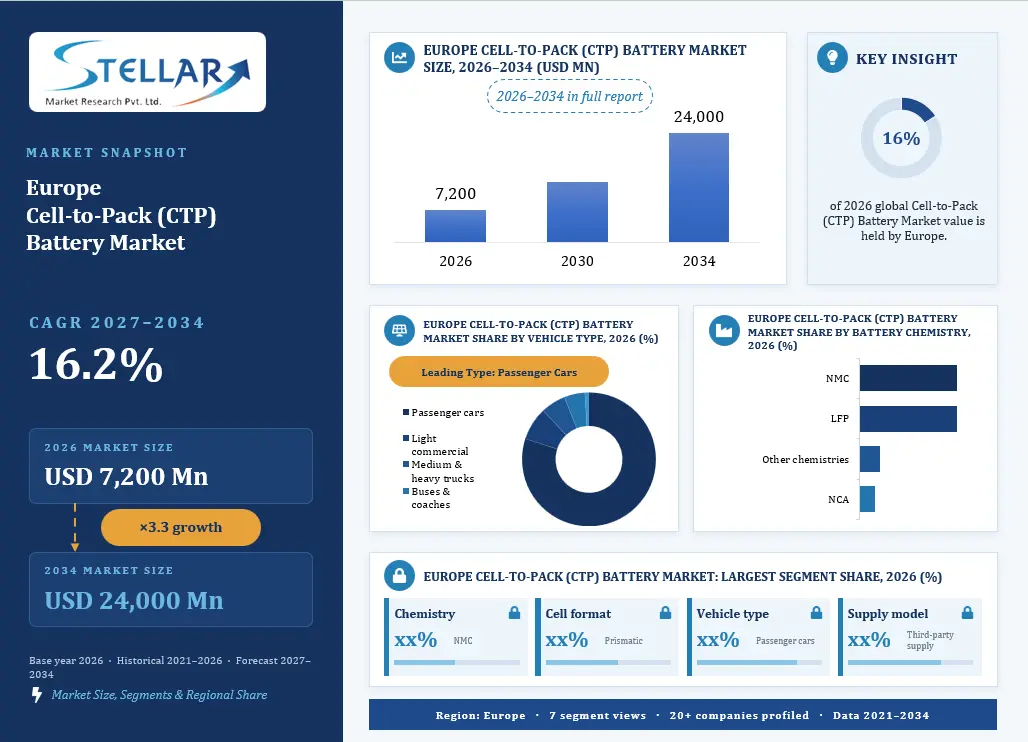
The Europe Cell-to-Pack (CTP) Battery Market is valued at USD 7,200 million in 2026 and is projected to reach USD 24,000 million by 2034
The Europe Cell-to-Pack (CTP) Battery Market is valued at USD 7,200 million in 2026 and is projected to reach USD 24,000 million by 2034, growing at a CAGR of 16.2% during 2027–2034, according to Stellar Market Research (SMR). In volume terms, SMR estimates the market at 70 GWh in 2026, rising to 285 GWh by 2034, measured as the capacity of CTP packs installed in new electric vehicles. Cell-to-pack (CTP) batteries are electric vehicle (EV) battery packs in which cells are assembled directly into the pack without an intermediate module layer, so a larger share of the pack volume holds active material. SMM analysis puts space utilization at about 40% for module-based packs and above 70% for CTP, which cuts parts count and weight and raises energy density and range. CTP is used in prismatic LFP and NMC packs from CATL, BYD and others and in structural cylindrical packs, and this report tracks CTP packs, including prismatic LFP and NMC packs, fitted to European-built and European-sold passenger cars, commercial vehicles, trucks and buses. This Cell-to-Pack (CTP) Battery Market overview and Cell-to-Pack (CTP) Battery Market synopsis summarizes the European CTP battery market size, CTP battery revenue generated, CTP battery growth prospects and Cell-to-Pack (CTP) Battery Market outlook, based on SMR's Cell-to-Pack (CTP) Battery Market research findings.
This Europe Cell-to-Pack (CTP) Battery Market analysis explains what the European Cell-to-Pack (CTP) Battery Market size and forecast mean for battery makers, automakers, pack integrators, tier-1 suppliers, fleet operators, policy makers and investors, from how a CTP pack differs from a module-based pack to energy density, charging speed, safety and cost per kWh. The European Cell-to-Pack (CTP) Battery Market insights also cover CTP battery demand, the LFP and NMC pack market and market growth by segment, along with consumer behavior (how automakers, fleets and swapping operators buy and specify packs), industry trends and CTP battery market trends.
NMC packs in passenger cars anchor the market, with NMC at about 48% and LFP at about 38% of 2026 value, but growth is shifting toward LFP, medium and heavy-duty trucks, high-capacity packs and local cell production as Chinese makers open plants in Hungary and Spain and European makers add LFP to entry-level models. The industry landscape is shaped by growth drivers, market dynamics, challenges and opportunities that influence the Cell-to-Pack (CTP) Battery Market industry outlook. LFP CTP batteries, NMC CTP batteries, Blade battery packs and structural pack designs are the main product pools within the market.
Stellar Market Research provides comprehensive analysis of the European Cell-to-Pack (CTP) Battery Market size, share, battery chemistry, cell format, propulsion type, CTP technology, battery capacity, vehicle type, supply and sales model and regional segmentation, the CTP battery competitive landscape, strategic scenarios and growth opportunities. The report helps battery makers, automakers, pack integrators, fleet operators and investors decide which segments, vehicle platforms and countries to prioritize through 2034. Market segmentation, key players and market strategies, including technology choices, support market entry decisions.
|
2026 | BASE YEAR |
2034 | FORECAST |
CAGR 2027–2034 |
LEADING CHEMISTRY |
|
USD 7,200 Mn |
USD 24,000 Mn |
16.2% |
NMC |
Europe Cell-to-Pack (CTP) Battery Market Overview: Cell-to-Pack (CTP) Battery Market Size, Share, Trends and Outlook, 2026–2034
The market is measured at product level as the value of CTP battery packs, meaning packs with no module layer, installed in new electric vehicles built or sold in Europe, and aftermarket pack replacement. Revenue is measured at pack level, with cells counted inside the pack. Stationary storage packs, module-based packs and standalone cells are excluded, and Russia sits within Rest of Europe. This market summary also reflects the economic factors, macroeconomic factors, technological advancements and regulatory influences that determine CTP battery consumption across Europe.
Volume: SMR estimates the European market at 70 GWh in 2026 and 285 GWh by 2034, a 19.2% CAGR over 2027–2034, measured as the capacity of CTP packs installed in new electric vehicles (GWh per year). This is about 14% of the 500 GWh global estimates for 2026. No source publishes a market-level CTP volume, so this is an SMR estimate with a range of about plus or minus 25%, built with the same method as the global estimate (annualized SNE Research installation data multiplied by an assumed CTP share, with a regional average pack price of about USD 103 per kWh in 2026).
Three shifts shape the market through 2034: demand is broadening from premium models into entry-level EVs and commercial vehicles; value is moving toward LFP and toward locally made cells; and growth is rotating toward Hungary, Spain and Central and Eastern Europe as Chinese-led plants start. Suppliers are answering cell shortages and carbon rules with local plants and supply agreements. These shifts highlight industry evolution, growth catalysts and competitive forces across the European CTP battery industry.
To get more Insights: Request Free Sample Report
Key Findings: Eight Insights Shaping the Europe Cell-to-Pack (CTP) Battery Market
SMR's analysis of published market data, plant announcements, manufacturer statements, regulatory filings and industry reports points to eight findings that explain where Cell-to-Pack (CTP) Battery Market growth and value are created through 2034. This market trends analysis also identifies growth catalysts, the market gap and the competitive landscape shifts affecting key players
|
Sr.No. |
Findings |
Evidence |
So what |
|
1 |
The market grows about 3.3× by 2034 |
USD 7,200 Mn (2026) to USD 24,000 Mn (2034) at 16.2% CAGR over 2027–2034 |
Suppliers must scale cell, pack and testing capacity with demand |
|
2 |
Passenger cars are the anchor buyer |
Passenger cars 80% of 2026 value; third-party supply to OEMs 74% |
Platform wins at automakers set long-run volumes |
|
3 |
Europe is about 16% of the global market |
USD 7,200 million of USD 45,000 million in 2026; EU BEV share 20.7% in the first half of 2026 (ACEA) |
Rising EV share lifts pack demand faster than the global rate |
|
4 |
LFP and NMC dominate chemistry |
LFP 38% and NMC 48% of 2026 value; LFP grows at 20.5% CAGR |
Chemistry mix decides cost, range and supplier fit |
|
5 |
Cell format shapes the pack |
Prismatic 58%, pouch 28% and cylindrical 14% of 2026 value |
Format choice follows platform, supplier and sourcing rules |
|
6 |
Larger packs grow faster |
Packs of 100 kWh and above grow at 18.8% CAGR over 2027–2034 against 16.2% for the market |
Long-range SUVs, trucks and buses need larger packs |
|
7 |
Commercial vehicles and services grow fastest |
Medium and heavy-duty trucks 19.0% and battery swapping and leasing 19.5% CAGR over 2027–2034 |
Fleet and swapping models open new pack demand |
|
8 |
Local cell supply is the next test |
CATL Debrecen trial production started 22 September 2026; Zaragoza LFP plant planned by end-2026 |
Local plants decide who captures European pack demand |
Europe Cell-to-Pack (CTP) Battery Market Dynamics: Growth Drivers, Restraints, Opportunities and Trends
Europe Cell-to-Pack (CTP) Battery Market Growth Drivers: EV Adoption, Pack Cost Advantage, Technology and Local Production
The Europe Cell-to-Pack (CTP) Battery Market is supported by rapid EV registration growth. ACEA reports that 1,220,890 new battery-electric cars were registered in the EU in the first half of 2026 (up 40.5%), a 20.7% share against 15.6% a year earlier, and registrations across 17 European markets reached 275,060 in June, a 25.6% share. Germany led with 84,057 June registrations, and France posted a record 55,831. Each of these vehicles needs a pack, and CTP raises range at lower cost for the price-sensitive buyers entering the market. These drivers reflect EV battery demand and supply, technological advancements and regulatory influences.
Local cell supply adds a second layer. CATL began trial production on two lines at its Debrecen plant in Hungary on 22 September 2026, with 100 GWh planned at full build, and it has been assembling modules there since May 2026. Stellantis and CATL's 50:50 joint venture is building a 50 GWh LFP plant in Zaragoza, Spain, scheduled to start production by the end of 2026. SNE Research notes that growing use of LFP in entry-level European models is making price a key factor in choosing a supplier, and technological advancements raise pack energy density. These factors reflect battery technology innovation, battery manufacturing infrastructure and growing local supply.
Europe Cell-to-Pack (CTP) Battery Market Restraints: Safety, Policy, Supply and Trade Friction
Supply tightness and cost are the main restraints. A media report cited by electrive says Mercedes-Benz had to halt GLC production in Bremen in summer 2026 because CATL could not supply enough cells, and the Debrecen start slipped from spring to September 2026. Pack makers also face energy cost and permitting delays, and market fluctuation analysis shows how supply gaps and demand swings create market volatility in orders. These constraints reflect supply gaps, cost pressure and competitive landscape shifts.
Trade and regulation add friction. Chinese makers held 56.4% of the non-China market in January–September 2026 (SNE Research), which raises local-content and security questions in Brussels and member states, and EU battery-regulation rules on carbon footprint, due diligence and recycled content lengthen qualification. Regulatory changes, industry disruptors and external market influences remain key constraints. These regulatory influences reflect strategic market changes, gigafactory investments and industry resilience.
What Are the Biggest European Cell-to-Pack (CTP) Battery Market Opportunities Through 2034?
LFP, trucks and local cells represent the most significant opportunities. LFP is projected to grow at 20.5% CAGR, medium and heavy-duty trucks at 19.0% and packs of 100 kWh and above at 18.8%, against 16.2% for the market, as entry-level models adopt LFP and fleets electrify. The Debrecen and Zaragoza plants make local pack supply possible, and these growth catalysts support long-term demand for CTP packs in Europe.
New suppliers and niches offer further routes. Valeo, MAHLE, Henkel and other European tier-1 suppliers can sell thermal-management, adhesive and structural parts into module-free packs, and European makers such as BMW, PowerCo and ACC pursue their own cell formats. Battery swapping, second-life packs and recycling, which the EU battery regulation favors, are unexplored market niches that add recurring revenue.
European Cell-to-Pack (CTP) Battery Market Trends: Faster Charging, LFP, Localization and Integration
Four market trends stand out through 2034. First, LFP in mass-market models: entry-level EVs adopt lower-cost chemistries. Second, local cell production: Debrecen and Zaragoza cut import dependence. Third, larger and faster-charging packs: Qilin- and Blade-class designs are entering European models. Fourth, commercial electrification: trucks and buses move to larger CTP packs. These trends reflect industry evolution, technology trends and strategic market changes.
Europe Cell-to-Pack (CTP) Battery Market Segmentation: By Battery Chemistry, Cell Format, Propulsion Type, CTP Technology, Battery Capacity, Vehicle Type and Supply and Sales Model
European Cell-to-Pack (CTP) Battery Market by Vehicle Type and Supply and Sales Model: Passenger Cars, Trucks, Buses, OEM Supply and Swapping
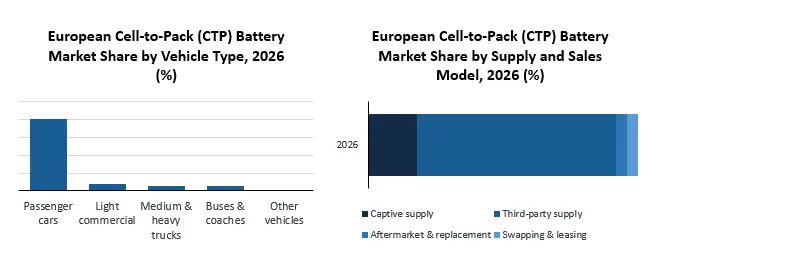
By vehicle type, passenger cars hold about 80% of 2026 value, light commercial vehicles 8%, medium and heavy-duty trucks 6%, buses and coaches 5% and other vehicles 1%; medium and heavy-duty trucks are the fastest at 19.0% CAGR over 2027–2034. By supply and sales model, third-party supply to OEMs accounts for about 74%, captive (in-house) battery supply 18%, battery swapping and leasing 4% and aftermarket and pack replacement 4%; battery swapping and leasing grow fastest at 19.5% CAGR. This market segment analysis supports target market analysis, end-user analysis and customer profiling. Geographic segmentation by country and plant pipeline further refines the picture.
Battery Chemistry, Cell Format, Propulsion, CTP Technology and Capacity Analysis of the European Cell-to-Pack (CTP) Battery Market
By battery chemistry, lithium iron phosphate (LFP) holds about 38% of 2026 value, nickel manganese cobalt (NMC) 48%, nickel cobalt aluminum (NCA) 6% and other chemistries (LMFP, sodium-ion and solid-state) 8%; LFP grows at 20.5% CAGR over 2027–2034. By cell format, prismatic cells hold 58%, pouch 28% and cylindrical 14%. By propulsion type, battery electric vehicles (BEV) account for 64% and plug-in hybrid and extended-range electric vehicles (PHEV and EREV) 36%. By CTP technology, Blade-type LFP CTP holds 28%, Qilin- and Shenxing-class prismatic CTP 40% and cylindrical and structural-pack CTP 32%. This product and battery chemistry segmentation highlights segment attractiveness, emerging market segments and EV platform applications.
European Cell-to-Pack (CTP) Battery Market by Battery Capacity: Packs Below 50 kWh to 100 kWh and Above
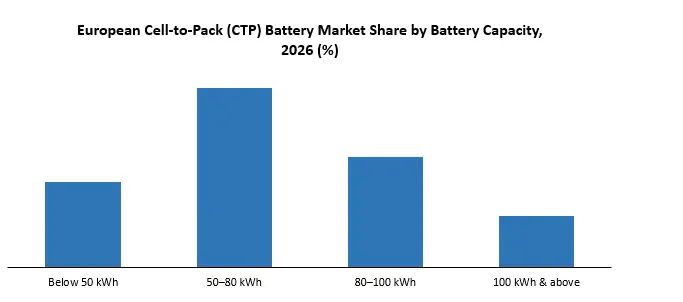
By battery capacity, packs below 50 kWh account for about 20% of 2026 value, 50 to 80 kWh 42%, 80 to 100 kWh 26% and 100 kWh and above 12%. Packs of 100 kWh and above are the fastest-growing capacity class at 18.8% CAGR over 2027–2034, as larger packs serve long-range SUVs, trucks and buses. Segmentation strategies and market niche exploration for EV platform applications point to specialized battery pack segments, unexplored market niches and segment-specific opportunities.
Europe Cell-to-Pack (CTP) Battery Market Regional Analysis
Germany, France, the United Kingdom, Norway, Italy and Spain make up most of the region's demand, and Germany remains the largest single BEV market with 367,388 first-half 2026 registrations. Hungary has become a cell and vehicle production hub, with CATL in Debrecen and BMW's EV plant, and Spain is gaining through Zaragoza. Europe is about 16% of the global market in 2026 (USD 7,200 million) and is projected to grow at 16.2% CAGR over 2027–2034, above the 15.0% global rate. This geographic analysis highlights regional market trends, battery manufacturing infrastructure, the regional competitive landscape and local market entry strategies.
Poland, Central and Eastern Europe and the Nordics add demand and production, though ICCT reported a 16% fall in Poland's battery electric sales in its mid-2026 update. EU rules, national incentives and energy costs shape local demand, and regional values sum with other regions to the global total. Regional insights also cover regional EV battery demand, battery import and export trends and local market challenges.
European Cell-to-Pack (CTP) Battery Market Companies and Competitive Landscape: Who Are the Top CTP Battery Manufacturers?
The European competitive landscape combines Asian cell makers with European plants, European start-ups and automaker-led ventures. CATL (Germany and Hungary), LG Energy Solution (Poland), Samsung SDI and SK On (Hungary), Gotion (Germany) and Envision AESC operate in the region, ACC, Verkor and PowerCo are building European capacity, and BMW, Mercedes-Benz, Stellantis, Renault and Volvo Cars design the vehicles. Valeo, MAHLE and Henkel supply thermal-management and adhesive parts. Competitors differ in cell format, chemistry and ownership and are not ranked as identical producers. This competitor analysis draws on competitive intelligence, competitor profiling, competitive positioning and benchmarking of key players, including company revenue and net sales.
Selection is shaped by cell price, local production, carbon footprint and delivery reliability. CATL's Debrecen plant has been fully booked for its initial capacity, according to the company, and the Stellantis–CATL joint venture shows automakers pairing with Asian technology owners. Competitive landscape trends favor firms that combine LFP and NMC options, local plants and regulatory compliance. Market rivalry assessment and competitive positioning analysis suggest that local plants, cost position and regulatory compliance will shape who wins share.
Europe Cell-to-Pack (CTP) Battery Market Recent Developments and Industry News | 2026
|
Date |
Development |
Why it matters |
|
Mar 2026 |
BYD launches the second-generation Blade Battery as it expands in Europe |
Raises the competitive benchmark for European LFP supply |
|
May 2026 |
CATL begins module assembly at its new Debrecen facility, with about 240,000 modules produced to date |
Starts local pack supply ahead of cell production |
|
Jun 2026 |
BEV registrations across 17 European markets reach 275,060, a 25.6% share, with France at a record 55,831 |
Shows monthly EV share passing 25% |
|
Jul 2026 |
ACEA reports 1,220,890 new battery-electric cars in the EU in the first half of 2026 (up 40.5%), a 20.7% share |
Confirms the demand base for CTP packs |
|
Jul 2026 |
ICCT reports battery electric cars at 24% of European registrations in June and 22% in the first half |
Provides a second view of Europe's EV share |
|
Sep 2026 |
CATL begins trial production at Debrecen on 22 September; a media report says Mercedes-Benz paused GLC production in Bremen over cell supply |
Shows both the start of local supply and the cell supply gap |
|
Nov 2026 |
SNE Research says growing LFP use in entry-level European models makes price a key factor in supplier choice |
Points to price-led demand for LFP CTP packs |
Europe Cell-to-Pack (CTP) Battery Market Scope: Inquire before buying
| Europe Cell-to-Pack (CTP) Battery Market | |||
|---|---|---|---|
| Report Coverage | Details | ||
| Base Year: | 2026 | Forecast Period: | 2027–2034 |
| Historical Data: | 2021–2026 | Market Size in 2026: | USD 7,200 million |
| Forecast Period 2027 to 2034 CAGR: | 16.2% | Market Size in 2034: | USD 24,000 million |
| Segments Covered: | By Battery Chemistry | Lithium Iron Phosphate (LFP); Nickel Manganese Cobalt (NMC); Nickel Cobalt Aluminum (NCA); Other Chemistries (LMFP, Sodium-Ion and Solid-State) | |
| By Cell Format | Prismatic; Pouch; Cylindrical | ||
| By Propulsion Type | Battery Electric Vehicles (BEV); Plug-in Hybrid and Extended-Range Electric Vehicles (PHEV and EREV) | ||
| By CTP Technology | Blade-Type LFP CTP; Qilin- and Shenxing-Class Prismatic CTP; Cylindrical and Structural-Pack CTP | ||
| By Battery Capacity | Below 50 kWh; 50 to 80 kWh; 80 to 100 kWh; 100 kWh and above | ||
| By Vehicle Type | Passenger Cars; Light Commercial Vehicles; Medium and Heavy-Duty Trucks; Buses and Coaches; Other Vehicles | ||
| By Supply and Sales Model |
Captive (In-House) Battery Supply; Third-Party Supply to OEMs; Aftermarket and Pack Replacement; Battery Swapping and Leasing |
||
Europe Cell-to-Pack (CTP) Battery Market, By Region
Europe (Germany, France, United Kingdom, Norway, Italy, Spain, Netherlands, Hungary, Poland, Rest of Europe)
Europe Cell-to-Pack (CTP) Battery Market, 20+ Key Players
Europe
- Automotive Cells Company (ACC)
- Verkor SAS
- PowerCo SE (Volkswagen Group)
- BMW Group
- Mercedes-Benz Group AG
- Stellantis N.V.
- Renault Group (Ampere)
- Volvo Cars
- Volkswagen AG
- Contemporary Star Energy (Stellantis–CATL joint venture)
- CATL (Germany and Hungary operations)
- LG Energy Solution Wroclaw Sp. z o.o.
- Samsung SDI Co., Ltd. (Hungary)
- SK On Co., Ltd. (Hungary)
- Gotion High-Tech (Germany)
- Envision AESC Group Ltd. (UK and France)
- BYD Europe B.V.
- Valeo SE
- MAHLE GmbH
- Henkel AG & Co. KGaA
- Daimler Truck AG
- Volvo Group (Volvo Trucks)Others
Frequently Asked Questions
Europe accounts for about 16% of global value in 2026 (USD 7,200 million of USD 45,000 million) and is projected to grow at a 16.2% CAGR over 2027–2034.
LFP is 38% of 2026 value and passenger cars 80%, but medium and heavy-duty trucks (19.0% CAGR), battery swapping and leasing (19.5%), packs of 100 kWh and above (18.8%) and LFP (20.5%) are growing faster than the 16.2% market average over 2027–2034.
SMR estimates 70 GWh in 2026 and 285 GWh by 2034, a 19.2% CAGR over 2027–2034, measured as the capacity of CTP packs installed in new EVs. No source publishes a market-level CTP volume, so this is an SMR estimate with a range of about plus or minus 25%.
Leading names include CATL, LG Energy Solution, Samsung SDI, SK On, Gotion, Envision AESC, BYD, ACC, Verkor and PowerCo, together with vehicle makers such as BMW, Mercedes-Benz, Stellantis, Renault and Volvo Cars that specify packs, among the 20+ key players profiled in this report. Competitive positioning depends on energy density, charge speed, cost per kWh, safety performance, local manufacturing and automaker relationships
A module-based pack groups cells into modules and then fits the modules into a pack. A cell-to-pack design places cells directly in the pack, so more of the volume holds cells (SMM puts utilization at above 70% against about 40%) and the pack has fewer parts. The trade-offs are harder repair and tighter thermal-runaway control, which makers address with heat barriers and venting design.
1. Executive Market Landscape and Industry Overview
1.1. Cell-to-Pack (CTP) Battery Market Size (Value USD Million and Volume in GWh), 2026–2034
1.2. Evolution of EV Battery Pack Architecture from Modules to Cell-to-Pack
1.3. Definition, Scope and Classification of CTP Battery Packs
1.4. CTP Battery Pack Design, Cell Integration and Operating Principles
1.5. Role of CTP Packs in EV Range, Cost and Safety
1.6. Demand for CTP Packs Across Passenger Cars, Trucks and Buses
1.7. CAGR Analysis of the CTP Battery Market During 2027–2034
2. CTP Battery Market Dynamics
2.1. CTP Battery Market Trends
2.2. CTP Battery Market Dynamics
2.3. Drivers
2.4. Restraints
2.5. Opportunities
2.6. Challenges
2.7. Porter's Five Forces Analysis
2.8. PESTLE Analysis
3. CTP Battery Market Macroeconomic Factors
3.1. EV Sales Growth, Policy Support and Electrified Vehicle Share Trends
3.2. Lithium-Ion Battery Demand and Cell Production Capacity Trends Across Regions
3.3. Raw Material Prices for Lithium, Nickel, Iron Phosphate and Graphite
3.4. Trade Policy, Tariffs and Local-Content Rules Affecting Battery Supply Chains
3.5. Capital Expenditure on Gigafactories and Pack Assembly Plants in Europe
3.6. Fuel Prices, Energy Security and Geopolitical Developments Influencing EV Demand
3.7. Currency Movements and Import Duties Affecting Pack and Cell Costs
4. CTP Battery Industry Trends and Emerging Technology Requirements
4.1. Faster Charging and Higher Energy Density Raising Pack Performance Requirements
4.2. Shift Toward LFP and LMFP Chemistries in Mass-Market Electric Vehicles
4.3. Progression From Cell-to-Module to Cell-to-Pack, Cell-to-Body and Cell-to-Chassis
4.4. Heavy-Duty Trucks, Buses and Battery Swapping Adopting Larger CTP Packs
4.5. Localization of Cell Production and Pack Assembly Near Vehicle Plants
4.6. Sodium-Ion, Condensed-Matter and Solid-State Cells Entering Module-Free Pack Designs
4.7. Digital Pack Monitoring, Battery Passports and Software-Defined Battery Management
5. CTP Battery Technology Architecture and Ecosystem Landscape
5.1. Cell Integration Fundamentals Behind Module-Free Battery Pack Architecture Designs
5.2. Structural Pack Housings, Cross-Beams and Load-Bearing Frame Designs
5.3. Thermal Management Systems Including Cooling Plates, Films and Heat Barriers
5.4. Battery Management Systems and Cell Balancing for Large Cell Counts
5.5. High-Voltage Connections, Busbars and Safety Disconnect Components
5.6. Venting, Fire Protection and Thermal Runaway Propagation Control Systems
5.7. Pack Integration With Vehicle Platforms, Chassis and Body Structures
6. CTP Battery Types, Configurations and Design Landscape
6.1. Blade-Type LFP CTP Packs Using Long, Thin Prismatic Cells
6.2. Qilin- and Shenxing-Class Prismatic CTP Packs for Long Range
6.3. Cylindrical and Structural-Pack CTP Designs Integrating Cells Into Vehicle Structure
6.4. LFP, NMC, NCA and Other Chemistry Options Within CTP Packs
6.5. Prismatic, Pouch and Cylindrical Cell Formats Used in Module-Free Designs
6.6. Pack Capacity Classes From Under 50 kWh Upward
6.7. Specialized CTP Configurations for Trucks, Buses and Swapping Packs
7. CTP Battery Performance, Capacity and Efficiency Characteristics
7.1. Volumetric and Gravimetric Energy Density Gains From Removing Modules
7.2. Charging Speed, C-Rate Capability and Fast-Charging Thermal Limits
7.3. Driving Range Improvements Delivered at Equal Pack Volume and Weight
7.4. Cycle Life, Calendar Aging and Warranty Performance of CTP Packs
7.5. Safety Performance Including Nail Penetration and Thermal Propagation Test Results
7.6. Low-Temperature and Hot-Climate Performance Affecting Regional Suitability
7.7. Pack Weight, Space Utilization and Vehicle Efficiency Benchmarking Across Designs
8. CTP Battery Manufacturing Processes and Production Technologies
8.1. Cell Manufacturing Processes Supplying Large-Format Cells for Module-Free Packs
8.2. Cell Stacking, Gluing and Bonding Methods Used in CTP Assembly
8.3. Pack Housing Fabrication Using Aluminum, Steel and Composite Materials
8.4. Automated Assembly Lines and Inline Quality Inspection for Large Packs
8.5. End-of-Line Testing, Formation and Pack Validation Procedures Before Shipment
8.6. Manufacturing Capacity, Yield and Ramp-Up Challenges in New Gigafactories
8.7. Production Localization Strategies Supporting Regional Content and Supply Security
9. CTP Battery Components, Systems and Materials Ecosystem
9.1. Cathode and Anode Materials Determining Cell Energy Density and Cost
9.2. Electrolytes, Separators and Binders Used in Large-Format Prismatic Cells
9.3. Structural Adhesives and Potting Compounds Bonding Cells Inside the Pack
9.4. Thermal Interface Materials, Cooling Plates and Heat Barriers
9.5. Busbars, Connectors and High-Voltage Components Inside the Battery Pack
9.6. Battery Management Electronics, Sensors and Pack Control Software Systems
9.7. Pack Enclosures, Sealing and Underbody Protection Components for Vehicles
10. CTP Battery Service, Repair, Second-Life and Recycling
10.1. After-Sales Service Models for Harder-to-Repair Module-Free Packs
10.2. Pack Diagnostics, State-of-Health Assessment and Remote Monitoring Services
10.3. Pack Replacement and Remanufacturing Options for Aging Electric Vehicles
10.4. Second-Life Applications Reusing Retired Packs in Stationary Energy Storage
10.5. Recycling Processes Recovering Lithium, Nickel, Cobalt and Phosphate Materials
10.6. Battery Passports, Traceability and Recycled-Content Requirements for Packs
10.7. Warranty Terms and Lifecycle Cost Models for Large Integrated Packs
11. CTP Battery Testing, Certification and Technical Standards
11.1. UN 38.3 Transport Testing Requirements for Lithium-Ion Battery Packs
11.2. UN ECE R100 and Vehicle Battery Safety Approval Requirements
11.3. GB 38031 Chinese Thermal Runaway Standard for Electric Vehicle Batteries
11.4. IEC and ISO Standards Covering Pack Safety and Functional Reliability
11.5. Thermal Propagation, Crush and Penetration Testing Applied to Module-Free Packs
11.6. EU Battery Regulation Requirements on Carbon Footprint and Due Diligence
11.7. Quality Management and Supplier Qualification Systems Used by Vehicle Makers
12. CTP Battery Applications in Passenger Cars
12.1. Compact and Entry-Level Electric Cars Using Low-Cost LFP CTP Packs
12.2. Mid-Size Sedans and SUVs Using Mixed LFP and NMC Packs
12.3. Premium and Performance Vehicles Using High-Density Nickel-Based CTP Packs
12.4. Plug-In Hybrid and Extended-Range Vehicles Using Smaller CTP Packs
12.5. Fast-Charging Passenger Cars Using High C-Rate Prismatic Pack Designs
12.6. Platform Strategies Linking Vehicle Architecture and Battery Pack Design
12.7. Passenger Car Pack Economics Linking Cost per kWh and Range
13. CTP Battery Applications in Light Commercial Vehicles
13.1. Electric Vans and Delivery Vehicles Using Mid-Capacity CTP Packs
13.2. Pickup Trucks Using Larger Packs for Payload and Towing Needs
13.3. Fleet Electrification Programs Driving Standardized Pack Purchases by Operators
13.4. Charging Patterns and Duty Cycles Shaping Light Commercial Pack Design
13.5. Total Cost of Ownership Advantages of LFP CTP Fleet Packs
13.6. Robotaxi, Ride-Hailing and Last-Mile Fleet Pack Requirements and Replacement
13.7. Pack Warranty and Replacement Terms Offered to Commercial Fleet Customers
14. CTP Battery Applications in Medium and Heavy-Duty Trucks and Buses
14.1. Heavy-Duty Electric Trucks Using High-Capacity LFP CTP Battery Packs
14.2. Electric Buses and Coaches Using Large Packs for Daily Routes
14.3. Battery-Swapping Heavy Trucks Using Standardized Swappable Pack Formats
14.4. Megawatt Charging Requirements Shaping Heavy-Duty Pack Thermal Design
14.5. Duty Cycle, Payload and Range Trade-Offs in Commercial Pack Selection
14.6. Operator Economics Comparing Pack Cost, Fuel Savings and Uptime
14.7. Public Transport Electrification Programs Creating Recurring Bus Pack Demand
15. CTP Battery Applications in Other Vehicles, Swapping and Mobility Services
15.1. Electric Two-Wheelers and Three-Wheelers Using Compact Module-Free Packs
15.2. Off-Highway, Mining and Construction Vehicles Adopting Rugged CTP Packs
15.3. Marine, Rail and Specialty Vehicles Evaluating Large-Format Cell Packs
15.4. Battery Swapping Stations Using Standardized CTP Packs for Fast Turnaround
15.5. Battery Leasing and Battery-as-a-Service Models Separating Pack Ownership From Vehicles
15.6. Stationary Storage Spin-Offs Reusing CTP Pack Designs Outside Vehicles
15.7. Emerging Applications Extending Module-Free Pack Designs Into New Segments
16. CTP Battery Procurement, Contracting and Supply Agreements
16.1. Long-Term Cell and Pack Supply Contracts Between Makers and Automakers
16.2. Technology Licensing Agreements Transferring Pack and Cell Know-How to Automakers
16.3. Joint Ventures Between Battery Makers and Automakers for Local Plants
16.4. Tendering and Qualification Timelines Affecting Vehicle Platform Launch Schedules
16.5. Price Indexing Clauses Linking Pack Prices to Metal Costs
16.6. Financing, Offtake and Capacity Reservation Structures for New Gigafactories
16.7. Local Content Requirements Influencing Supplier Selection and Manufacturing Localization
17. CTP Battery Production, Manufacturing Capacity and Industrial Infrastructure
17.1. Global Gigafactory Capacity by Region and Leading Battery Manufacturer
17.2. Prismatic Cell and CTP Pack Production Capacity Concentration in China
17.3. European Cell and Pack Plants Including Hungary, Germany and Spain
17.4. North American Cell and Pack Plants Including Michigan and Tennessee
17.5. Emerging Production Hubs in Morocco, Brazil, India and Southeast Asia
17.6. Capacity Expansion Investments Announced by Leading Pack and Cell Makers
17.7. Production Efficiency Benchmarking Across Manufacturers, Plants and Technology Platforms
18. CTP Battery Pricing, Business Models and Cost Economics
18.1. Pack Pricing by Chemistry Across LFP, NMC and NCA Designs
18.2. Pack Pricing by Capacity and Vehicle Segment Across Markets
18.3. Bill of Materials Cost Structure Covering Cells, Housings and Cooling
18.4. Cost Savings From Removing Modules Compared With Module-Based Packs
18.5. Battery-as-a-Service, Leasing and Swapping Business Models and Revenue
18.6. Raw Material Price Pass-Through and Margin Pressure on Battery Makers
18.7. Total Cost of Ownership Guiding Buyer Decisions and Supplier Selection
19. CTP Battery Distribution, Sales and Service Landscape
19.1. Direct Supply Agreements Between Battery Makers and Automakers in Europe
19.2. Captive Pack Supply by Vertically Integrated Vehicle and Battery Groups
19.3. Tier-One Pack Integrators Serving Automakers Without In-House Capability
19.4. Importers and Distributors Selling Electric Vehicles in Emerging Markets
19.5. Authorized Service Centers Handling Pack Diagnostics and Replacement Locally
19.6. Spare Pack and Replacement Logistics Near Dealerships and Service Hubs
19.7. After-Sales Support Programs Strengthening Customer Retention and Recurring Revenue
20. CTP Battery Supply Chain and Operational Ecosystem
20.1. Lithium, Nickel and Phosphate Sourcing Affecting Cell Cost and Availability
20.2. Cathode, Anode and Electrolyte Supplier Networks Serving Cell Manufacturers
20.3. Cell Supply to Pack Plants From Imported and Local Sources
20.4. Pack Component Suppliers Providing Housings, Thermal Parts and Electronics
20.5. Assembly and Integration Networks Combining Cells Into Tested Packs
20.6. International Logistics for Hazardous Goods Including Packs and Cells
20.7. Supply Chain Resilience and Risk Management Under Trade Disruptions
21. CTP Battery Technology Innovation, R&D and Product Development
21.1. Next-Generation Blade, Qilin and Shenxing Platforms Raising Density and Speed
21.2. Cell-to-Body and Cell-to-Chassis Integration Moving Beyond Standalone Battery Packs
21.3. LMFP, Sodium-Ion and Condensed-Matter Chemistries Developed for Module-Free Packs
21.4. Solid-State Battery Development and Compatibility With CTP Pack Architectures
21.5. Advanced Thermal Management and Fire Protection Reducing Pack Propagation Risk
21.6. Artificial Intelligence and Digital Twins Improving Pack Design and Monitoring
21.7. R&D Investment, Intellectual Property and Collaboration Among Makers and Automakers
22. CTP Battery Market Adoption, Utilization and Customer Economics
22.1. Adoption Rates of CTP Packs Across Vehicle Models and Segments
22.2. Share of New EV Platforms Designed Around Module-Free Pack Architectures
22.3. Charging Behavior and Daily Usage Patterns Affecting Pack Aging
22.4. Seasonal and Regional Climate Effects on Pack Performance and Range
22.5. Replacement and Residual Value Considerations for Integrated Battery Packs
22.6. Customer Purchasing Preferences Covering Range, Price, Safety and Charging Speed
22.7. Reliability, Warranty Claims and Customer Satisfaction Measures Evaluating Suppliers
23. CTP Battery Market Regulatory, Safety and Technical Standards
23.1. Vehicle Battery Safety Rules Including UN ECE R100, GB 38031
23.2. Transport Regulations for Lithium-Ion Cells and Packs by Sea
23.3. EU Battery Regulation Covering Carbon Footprint, Passports and Recycled Content
23.4. Trade Remedies, Tariffs and Sourcing Rules Affecting Chinese Cells
23.5. Incentive Programs and Tax Credits Supporting Electric Vehicle Purchases
23.6. Emission Standards and Zero-Emission Vehicle Mandates Driving EV Adoption
23.7. Environmental Compliance, Permitting and Recycling Obligations for Battery Plants
24. Europe CTP Battery Regional and Country-Level Market Landscape
24.1. Europe EV Market Development Across Leading Countries
24.2. EV Import, Assembly and Local Production Trends Shaping Pack Demand
24.3. Battery Plant and Pack Assembly Project Pipeline Supporting Local Supply
24.4. Regional Economic, Incentive and Policy Factors Influencing EV Adoption
24.5. Country-Level Market Assessment Covering Leading Countries and Sub-Regions
24.6. Local Market Entry Strategies for New Suppliers and Service Providers
24.7. Regional Installed Base and Investment Trends Supporting Pack Demand
25. CTP Battery Market: Market Size and Forecast by Segmentation (Value USD Million and Volume in GWh) (2026–2034)
25.1. CTP Battery Market Size and Forecast, By Battery Chemistry
25.1.1. Lithium Iron Phosphate (LFP)
25.1.2. Nickel Manganese Cobalt (NMC)
25.1.3. Nickel Cobalt Aluminum (NCA)
25.1.4. Other Chemistries (LMFP, Sodium-Ion and Solid-State)
25.2. CTP Battery Market Size and Forecast, By Cell Format
25.2.1. Prismatic
25.2.2. Pouch
25.2.3. Cylindrical
25.3. CTP Battery Market Size and Forecast, By Propulsion Type
25.3.1. Battery Electric Vehicles (BEV)
25.3.2. Plug-in Hybrid and Extended-Range Electric Vehicles (PHEV and EREV)
25.4. CTP Battery Market Size and Forecast, By CTP Technology
25.4.1. Blade-Type LFP CTP
25.4.2. Qilin- and Shenxing-Class Prismatic CTP
25.4.3. Cylindrical and Structural-Pack CTP
25.5. CTP Battery Market Size and Forecast, By Battery Capacity
25.5.1. Below 50 kWh
25.5.2. 50 to 80 kWh
25.5.3. 80 to 100 kWh
25.5.4. 100 kWh and above
25.6. CTP Battery Market Size and Forecast, By Vehicle Type
25.6.1. Passenger Cars
25.6.2. Light Commercial Vehicles
25.6.3. Medium and Heavy-Duty Trucks
25.6.4. Buses and Coaches
25.6.5. Other Vehicles
25.7. CTP Battery Market Size and Forecast, By Supply and Sales Model
25.7.1. Captive (In-House) Battery Supply
25.7.2. Third-Party Supply to OEMs
25.7.3. Aftermarket and Pack Replacement
25.7.4. Battery Swapping and Leasing
25.8. CTP Battery Market Size and Forecast, By Region
25.8.1. Germany
25.8.2. France
25.8.3. United Kingdom
25.8.4. Norway
25.8.5. Italy
25.8.6. Spain
25.8.7. Netherlands
25.8.8. Hungary
25.8.9. Poland
25.8.10. Rest of Europe
26. CTP Battery Market Competitive Landscape
26.1. SMR Competition Matrix
26.2. Competitive Positioning of Leading Key Players
26.3. Key Players Benchmarking
26.4. Company Name
26.5. Headquarters
26.6. CTP Battery Product Portfolio
26.7. Cell Chemistries, Pack Capacities and Technical Specifications
26.8. Manufacturing and Assembly Capabilities
26.9. Vehicle Maker Customers and Platform References
26.10. Total Company Revenue (2026)
26.11. CTP Battery-Related Revenue (2026), Where Available
26.12. Geographic Presence
26.13. Customer Base
26.14. Strategic Partnerships and Collaborations
26.15. Market Structure
26.16. Market Share Analysis of Leading Companies
26.17. Revenue Growth Rate / Y-o-Y (%) of Companies
26.18. Profit Margin (%) of Companies, Where Available
26.19. Revenue vs. Net Earnings – Financial Health Benchmarking
26.20. Mergers, Acquisitions and Strategic Partnerships
26.21. Recent Key Developments
27. CTP Battery Manufacturers and Original Equipment Manufacturers Landscape
27.1. LFP Cell and Pack Manufacturers Serving Mass-Market Electric Vehicles in Europe
27.2. NMC and NCA Pack Manufacturers Serving Premium and Long-Range Models
27.3. Vertically Integrated Vehicle and Battery Groups Designing Their Own Packs
27.4. Cylindrical and Structural Pack Manufacturers Integrating Cells Into Vehicle Structures
27.5. Regional and Local Manufacturers Supporting Domestic Vehicle and Assembly Programs
27.6. Manufacturing Capacity and Product Portfolio Benchmarking Across Leading Manufacturers
28. CTP Battery Pack Integrators, Vehicle Makers and Tier-One Suppliers
28.1. Pack Integrators Combining Cells, Housings and Electronics for Automakers
28.2. Vehicle Makers Developing In-House Pack Architectures for New Platforms
28.3. Tier-One Suppliers Providing Structural, Thermal and Electrical Pack Systems
28.4. Truck and Bus Builders Specifying Large Packs for Commercial Vehicles
28.5. Battery Swapping Operators Integrating Standardized Packs Into Station Networks
28.6. Capability Benchmarking of Integrators, Vehicle Makers and Tier-One Suppliers
29. CTP Battery Materials, Components and Technology Suppliers
29.1. Cathode and Anode Material Suppliers Serving Large-Format Cell Manufacturers
29.2. Electrolyte and Separator Suppliers Providing Critical Cell Materials in Europe
29.3. Adhesive and Thermal Interface Suppliers Serving Module-Free Pack Assembly
29.4. Busbar, Connector and Housing Suppliers Providing Structural Pack Components
29.5. Battery Management and Monitoring Technology Providers Enabling Safer Pack Operation
29.6. Supplier Capability Benchmarking Across Materials, Components and Technology Providers
30. CTP Battery Service, Recycling and Second-Life Providers
30.1. OEM Service Organizations Supporting Installed Packs Through Authorized Service Networks
30.2. Independent Pack Diagnostic and Repair Providers Competing on Cost
30.3. Battery Recyclers Recovering Metals From Retired Packs and Production Scrap
30.4. Second-Life Storage Providers Reusing Retired Packs in Stationary Applications
30.5. Remote Monitoring Providers Offering Pack Analytics and Performance Support Services
30.6. Service Coverage Benchmarking Across Regions, Response Times and Pack Designs
31. CTP Battery Manufacturers' Strategies and Expansion Plans
31.1. Capacity Expansion in China, Europe, North America and Emerging Regions
31.2. Development of Faster-Charging and Higher-Density Next-Generation Pack Platforms
31.3. LFP and Sodium-Ion Product Development Responding to Cost Needs
31.4. Localization Strategies Including Licensing, Joint Ventures and Local Pack Assembly
31.5. Partnerships With Automakers Securing Early Platform Specifications and Volumes
31.6. Mergers, Acquisitions and Strategic Collaborations Reshaping the Competitive Landscape
32. CTP Battery Industry SWOT, Investments and Strategic Developments
32.1. Strengths of Established Manufacturers Including Scale, Cost Position and Technology
32.2. Cost, Safety and Repairability Constraints Affecting Module-Free Pack Adoption
32.3. Investment Opportunities in Gigafactories Supporting Long-Term Pack Demand
32.4. Fleet Electrification and Replacement Cycles Creating Aftermarket Opportunities
32.5. Geopolitical and Trade Risks Affecting Cell Supply and Plant Investments
32.6. Strategic Recommendations Derived From Strengths, Constraints, Opportunities and Risks
33. CTP Battery Market Opportunity Assessment and Strategic Recommendations
33.1. Segment and Region Opportunity Mapping Highlighting Where Demand Is Growing
33.2. Fast-Growing Segments Offering Above-Average Growth Through the 2027–2034 Forecast
33.3. Truck, Bus and Swapping Opportunities Created by Commercial Fleet Electrification
33.4. Market Entry Strategies for New Suppliers and Regional Assembly Partners
33.5. Partnership Opportunities With Automakers, Cell Makers, Fleets and Technology Providers
33.6. Investment Priorities for Manufacturers, Automakers, Fleets and Financial Investors
33.7. Key Takeaways Summarizing Opportunities, Risks and Recommended Actions for Participants
34. CTP Battery Market Scenario Analysis
34.1. Base Case Assumptions Behind SMR's Central Value and Volume Forecast
34.2. High-Growth Case Assuming Faster EV Adoption and Rapid Truck Electrification
34.3. Low-Growth Case Assuming Policy Rollbacks and Slower Consumer EV Adoption
34.4. Impact of Raw Material Price Swings on Pack Cost
34.5. Impact of Trade Policy and Tariffs on Cell Sourcing Costs
34.6. Impact of Alternative Technologies Including Solid-State and Module-Based Packs
34.7. Scenario Summary Comparing Base, High-Growth and Low-Growth Outcomes Through 2034
35. Company Profiles – Europe CTP Battery Market
35.1. Company Overview
35.2. Product Portfolio
35.3. Key Financials
35.4. Geographic Presence
35.5. Strategic Moves
35.6. Recent Developments
35.7. SWOT Analysis
Europe Cell-to-Pack (CTP) Battery Market, 20+ Key Players
Europe
- Automotive Cells Company (ACC)
- Verkor SAS
- PowerCo SE (Volkswagen Group)
- BMW Group
- Mercedes-Benz Group AG
- Stellantis N.V.
- Renault Group (Ampere)
- Volvo Cars
- Volkswagen AG
- Contemporary Star Energy (Stellantis–CATL joint venture)
- CATL (Germany and Hungary operations)
- LG Energy Solution Wroclaw Sp. z o.o.
- Samsung SDI Co., Ltd. (Hungary)
- SK On Co., Ltd. (Hungary)
- Gotion High-Tech (Germany)
- Envision AESC Group Ltd. (UK and France)
- BYD Europe B.V.
- Valeo SE
- MAHLE GmbH
- Henkel AG & Co. KGaA
- Daimler Truck AG
- Volvo Group (Volvo Trucks)
Others
36. Key Findings
37. Strategic Moves and Recommendations
38. Research Methodolog