ENG
 Japanese
 French
 German
 Korean

Early Childhood Education Market: Global Industry Analysis, Market Size, Share, Trends and Forecast (2027–2034)
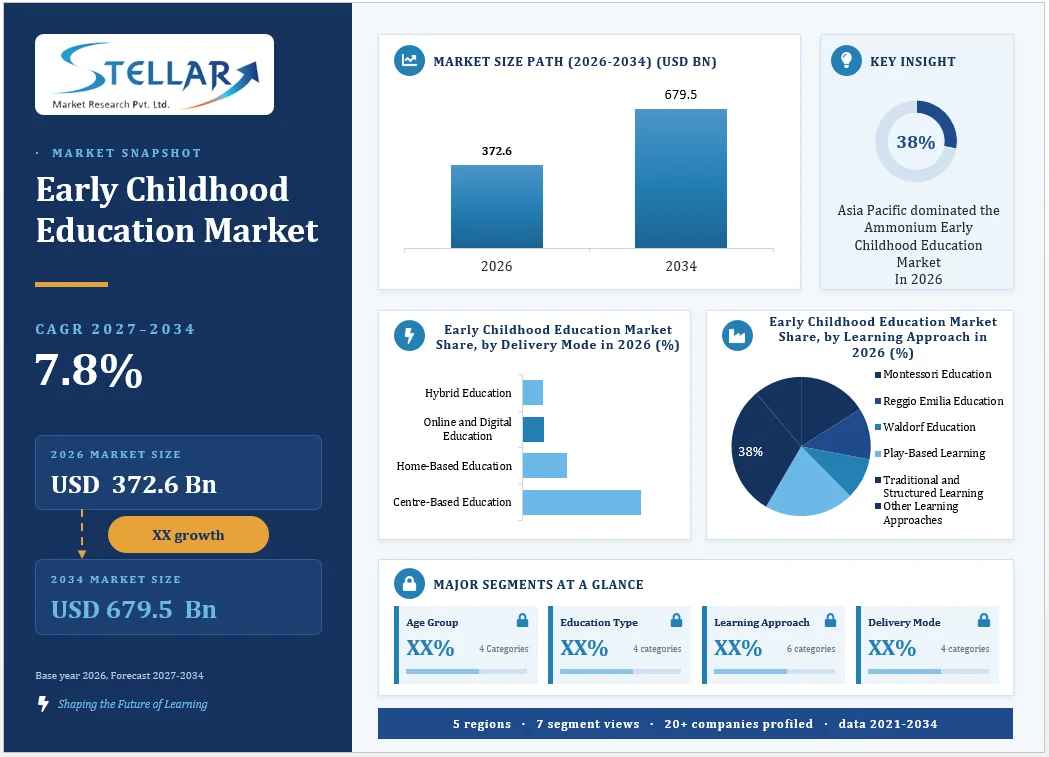
The Global Early Childhood Education Market was valued at USD 372.6 Bn in 2026 and is expected to reach USD 679.5 Bn by 2034, growing at a CAGR of 7.8% during 2027–2034.
The Global Early Childhood Education Market was valued at USD 372.6 Bn in 2026 and is expected to reach USD 679.5 Bn by 2034, growing at a CAGR of 7.8% during 2027–2034.
Early childhood education comprises structured care, learning and developmental programmes for children from birth to about eight years of age, delivered through childcare centres, nurseries, preschools, kindergartens, early primary programmes, home-based services and online platforms. The market spans Early Childhood Care and Education (ECCE), preschool and kindergarten education, early primary programmes, Montessori, Reggio Emilia, Waldorf, play-based and structured learning approaches, and digital early learning, funded through tuition and enrolment fees, subscriptions and memberships, government funding and subsidies, and franchise and licensing arrangements. The global Early Childhood Education Market, therefore, encompasses Early Childhood Education consumption, Early Childhood Education demand and Early Childhood Education supply across public, private and non-profit providers for infants, toddlers, preschool-age and early primary-age children.
This Early Childhood Education Market analysis supports preschool and childcare operators, education investors, curriculum and edtech developers, early learning material and furniture suppliers, franchisors, governments and policymakers. It evaluates tuition and fee trends, enrolment and capacity, workforce cost, pricing and business models, institutional investment opportunities and consumer demographics across age groups, education types, learning approaches, delivery modes, ownership, service types, revenue models and countries through 2034.
Preschool education and private and commercially operated institutions accounted for the largest shares of Early Childhood Education Market revenue in 2026, at about 36% and 52% of value, respectively, while Asia Pacific led the regional split with about 38%. Early Childhood Education Market growth is moving toward play-based and Montessori learning, hybrid and digital delivery, full-day and extended-day services, inclusive and specialised learning, franchise-led expansion and emerging economies, as rising dual-income households, government funding for early learning and parental focus on school readiness change what families buy and how they buy it.
Stellar Market Research delivers a comprehensive Early Childhood Education Market Research Report covering global value (USD Bn) by age group, education type, learning approach, delivery mode, ownership, service type, revenue model and region, across 5 regions and their countries, together with a competitive landscape, strategic scenarios and growth opportunities.
Early Childhood Education Market Size and Growth: Industry Outlook to 2034
The Early Childhood Education Market is sized at the service level: tuition and enrolment fees, subscription and membership revenue, government-funded and subsidised service revenue, and franchise and licensing revenue earned by childcare centres, nurseries, preschools, kindergartens, early primary programmes, home-based services and digital early learning providers. Market size is measured as provider revenue in USD Billion for 2026–2034. The market forecast rests on a visible public funding and enrolment pipeline: England’s funded childcare entitlement reached 30 hours a week for eligible working parents from nine months old in September 2025, the Institute for Fiscal Studies puts spending on free entitlements at £8.7 billion in 2025–26, Bright Horizons operated 988 centres at 30 June 2026 and KinderCare operated 1,606 early childhood education centres at 4 April 2026, supporting the Early Childhood Education Market growth outlook across North America, Europe and Asia Pacific.
To get more Insights: Request Free Sample Report
Key Findings: Insights Shaping the Global Early Childhood Education Market
Government funding data, company filings and family enrolment behavior point to the following key market research findings, highlighting Early Childhood Education Market demand, consumption, supply, revenue generated and Early Childhood Education industry value creation through 2034.
- Preschool and ECCE lead education types; early primary programmes extend the opportunity. Preschool education held about 36% of 2026 value and grows at 7.5%, Early Childhood Care and Education (ECCE) held 28% and grows at 9.3%, kindergarten education held 22% and early primary programmes held 14%. Demand is moving from custodial childcare to structured learning with measurable school-readiness outcomes.
- Play-based and Montessori approaches grow fastest. Play-based learning held about 27% of 2026 value and grows at 10.6%, Montessori education held 16% and grows at 9.4%, Reggio Emilia and Waldorf education held 11% combined, and traditional and structured learning held 38% and grows at 5.2%. Parents increasingly value experiential, child-led learning alongside early literacy and numeracy.
- Hybrid and digital delivery outgrow centre-based education. Centre-based education still held the largest delivery share of about 64% in 2026, but hybrid education grows at 12.8% and online and digital education at 11.4%, against 7.0% for home-based education, as learning applications, smart classroom tools and parent communication platforms spread.
- Full-day and extended-day services are the faster service route. Full-day early education services held about 46% of 2026 value and grow at 8.3%, against 5.9% for part-time services, as dual-income households need longer, safe learning hours, supported by employer-sponsored and back-up care models.
- Asia Pacific is the largest and fastest-growing region. It held about 38% of 2026 value and grows at a 9.2% CAGR, lifting its share to about 42.1% by 2034. India’s National Education Policy 2020 foundational stage for ages 3 to 8, China’s Preschool Education Law, in force since June 2025, and growing urban middle-class demand in Southeast Asia are strengthening regional Early Childhood Education Market demand.
- Europe’s market is policy-led and increasingly publicly funded. England’s funded entitlement reached 30 hours a week for eligible working parents from nine months old in September 2025, and the Institute for Fiscal Studies expects about 80% of pre-school childcare in England to be delivered through free entitlements once fully rolled out, shifting provider revenue toward government-funded and subsidised services.
- North America is mature, and listed operators are optimising footprints. Bright Horizons reported second-quarter 2026 revenue of USD 779.2 Million, up 7%, while KinderCare reported USD 697.5 Million, down 0.4%, and closed 49 centres in the quarter, showing enrolment pressure, tuition-rate gains and centre-network optimisation in a mature market.
- The competitive landscape is layered. Global childcare and preschool chains, international school groups, franchise-led brands, regional operators and curriculum and edtech providers compete on quality, curriculum, safety, location, teacher quality and price.
Early Childhood Education Market Overview: Industry Landscape, Market Insights and Growth Prospects
This Early Childhood Education Market overview and market synopsis summarises the industry landscape, market insights and market research findings: Early Childhood Education Market size reached USD 372.6 Bn in 2026, and market analysis shows industry trends toward play-based, digital and full-day early learning. Early Childhood Education Market dynamics, market segmentation, key players and the competitive landscape are covered in detail, along with growth prospects, Early Childhood Education Market opportunities, challenges, emerging markets and the market outlook through 2034. The market summary, revenue generated by leading providers, growth drivers and market strategies, together with consumer behavior (parent and family purchasing behavior) and market entry considerations, give decision makers a complete view of Early Childhood Education consumption, Early Childhood Education demand and Early Childhood Education supply and investment priorities.
Early Childhood Education Market Trends
1. Rising Early Childhood Education Demand and Enrolment: Government funding, dual-income households and growing awareness of early brain development support Early Childhood Education Market demand, consumption and revenue growth across childcare, preschool and kindergarten services.
2. Shift to Play-Based, Montessori and Experiential Learning: Parents and educators are moving from rote, teacher-led instruction to child-led, play-based and project-based learning. Montessori, Reggio Emilia and Waldorf models, along with inquiry-based activities, are expanding through franchise networks and link pedagogy to early literacy, numeracy and school-readiness outcomes.
3. Government-Funded Entitlements Reshaping Provider Revenue: In England, eligible working parents have been entitled to 30 funded hours a week from nine months old since September 2025, and the Coram Childcare Survey 2026 found that the cost of a full-time under-two place had fallen 39% on 2025. Funded entitlements raise Early Childhood Education Market demand and shift revenue mix toward government-funded and subsidised services.
4. Centre Network Optimisation and Consolidation: Operators are tuning footprints rather than only expanding. KinderCare closed 49 early childhood education centres in the second quarter of 2026 as part of a centre optimisation initiative, while Bright Horizons operated 988 centres with capacity for about 112,500 children at 30 June 2026. Occupancy, tuition rates and teacher availability shape Early Childhood Education Market supply and share.
5. Digitalization, AI and Personalised Early Learning: Providers are layering learning management systems, AI-based personalised learning, interactive classroom devices and parent communication apps on top of physical centres. These layers turn one-time tuition into subscription, content and service revenue and support Early Childhood Education Market growth beyond classrooms.
Early Childhood Education Market Drivers: Working Parent Households, Government Funding, School Readiness Focus and Digital Learning
Rising female workforce participation and dual-income households are the primary demand drivers. Families need full-day, safe and structured care that also builds language, numeracy and social skills, and governments are funding it: the Institute for Fiscal Studies puts England’s spending on free entitlements at about £8.7 billion in 2025–26, and the Australian Capital Territory reports more than 3,000 three-year-olds in its Free Three-Year-Old Preschool program, with a planned move toward 600 hours. Public funding lowers the effective price of early learning and supports growth opportunities across the Asia Pacific, Europe and North America Early Childhood Education Market.
School readiness and child development evidence convert policy into enrolment. Early literacy, numeracy, language and social-emotional development are widely treated as the foundation for later learning, and national frameworks such as India’s National Education Policy 2020, which designates ages 3 to 8 as a foundational stage, and China’s Preschool Education Law bring structure, quality standards and curriculum requirements to the sector. Entitlements and mandates of this kind give providers multi-year enrolment visibility.
Urbanisation, rising disposable income and private education investment widen the addressable base. Growing demand for Montessori and international curricula, employer-sponsored childcare, digital learning applications and inclusive education for children with developmental needs is attracting franchisors, private equity and education groups into the Early Childhood Education Market.
Early Childhood Education Market Restraints and Challenges: Teacher Shortages, Tuition Affordability, Operating Costs and Regulatory Compliance
Workforce availability and cost are the most persistent restraint. Qualified early childhood educators, teaching assistants and centre leaders are in short supply, and salary, retention and training costs can rise faster than fee income. Staffing ratios, qualification standards and supervision requirements also limit how quickly centres can add capacity, which affects Early Childhood Education supply even where demand is strong.
Affordability and funding design constrain growth. Tuition, inflation and operating costs strain household budgets, and funded-hours schemes depend on government rates: the Institute for Fiscal Studies notes that in England the government sets the price for funded hours, so providers face margin pressure if rates lag costs. KinderCare’s first-quarter 2026 results showed early childhood education centre revenue down 0.8%, with a 3.0% decline from lower enrolment partly offset by 2.2% from higher tuition rates.
Regulation, safety and quality assurance add Early Childhood Education Market constraints. Child safety, hygiene, licensing, accreditation and inspection requirements raise compliance and facility maintenance costs, while real estate costs, leases and centre-level occupancy risk affect returns, as seen in impairment charges and closures at large operators. Fragmented standards across countries, limited access in rural and low-income regions and uneven provision for children with special needs also extend time to scale.
Early Childhood Education Market Dynamics Analysis: Economic Factors, Demand and Supply, Competitive Forces and Regulatory Influences
1. Early Childhood Education Market Demand and Supply Gap Analysis: The Institute for Fiscal Studies expects about 80% of pre-school childcare in England to be delivered through free entitlements once fully rolled out, while the Australian Capital Territory notes that doubling funded preschool hours depends on service capacity and a workforce able to deliver them, highlighting the market gap between Early Childhood Education demand and supply of qualified places and educators.
2. Consumer Behavior Trends and Preference Evolution: Parents increasingly compare curriculum, teacher quality, safety, digital communication and outcomes before enrolling, and a growing share seek Montessori, play-based or bilingual programmes, reflecting evolving Early Childhood Education consumer demographics shaped by working parents and urban households.
3. Technological Advancements and Innovation Impact: Learning management systems, AI-based personalised learning, smart classroom devices and parent progress-monitoring apps support individual learning paths, administrative efficiency and family engagement, and extend Early Childhood Education services into home-based and hybrid delivery.
4. Regulatory Influences and Regulatory Changes: Licensing, staffing ratios, curriculum frameworks, safety and accreditation rules shape provider economics. China’s Preschool Education Law, in force since June 2025, and India’s National Education Policy 2020 foundational stage show how regulatory changes bring structure to early learning and influence demand for compliant providers.
5. Competitive Forces and Market Forces: Global childcare chains, international school groups, franchise brands and local operators compete on location, curriculum, quality and price, while low entry barriers in home-based and small-centre formats and high capital needs in large campuses shape supplier positioning and rivalry.
6. Market Drivers, Growth Catalysts and Market Growth Factors: Higher female workforce participation, rising disposable income, government funding and employer-sponsored childcare are growth catalysts. Bright Horizons grew second-quarter 2026 revenue 7% to USD 779.2 Million, supported by service levels and its back-up care segment.
7. Market Challenges, Market Constraints and Industry Disruptors: Teacher shortages, wage inflation, enrolment softness in some markets and declining birth rates in several economies constrain growth, while low-cost digital learning applications and informal care act as industry disruptors.
8. Market Shifts and Market Segmentation Shifts: Demand is shifting from part-time to full-day and extended-day services, from traditional to play-based and Montessori approaches, and from purely centre-based to hybrid delivery, reshaping segment mix across age groups, delivery modes and revenue models.
9. Environmental Factors and Socioeconomic Influences: Urbanisation, smaller families, rising childcare costs and expectations for outdoor play, health and nutrition influence facility design, location and service mix, while public investment in disadvantaged communities supports access and early intervention.
10. Market Trends Analysis, Emerging Trends and Industry Evolution: The industry is evolving from custodial childcare to integrated early childhood care and education, with early literacy, numeracy, inclusive education, multilingual learning and school-readiness assessment now central to programme design and Early Childhood Education Market opportunities.
11. Competitive Landscape Shifts, Market Fluctuation Analysis and External Market Influences: KinderCare reported second-quarter 2026 revenue of USD 697.5 Million, down 0.4%, with 49 centres closed, while Bright Horizons grew revenue 7%, illustrating market volatility and divergent competitive positioning among large operators.
12. Consumer Preferences Evolution, Customer Engagement Dynamics and Industry Resilience: Parent communication apps, progress reports and family engagement programmes strengthen retention. Demand for early education has stayed resilient through economic cycles because childcare enables parental employment, supporting market adaptability and market responsiveness.
Early Childhood Education Consumer Scenario: Parent Behavior, Enrolment Patterns and Institutional Buying Expectations
The consumer of early childhood education is both the child, who learns, and the parent, family, employer or government that selects, pays for and monitors the service. Understanding this consumer scenario, Early Childhood Education consumer demographics, customer profiling and purchasing behavior is essential for market entry and market strategies.
1. Working Parents Drive Enrolment Decisions: Dual-income and single-parent working households account for most Early Childhood Education Market demand for full-day and extended-day services, choosing providers on location, operating hours, safety and quality. Employer-sponsored models, such as Bright Horizons’ employer-centric centres and back-up care, show that employers also act as buyers.
2. Quality, Safety and Teacher Credentials Gate Selection: Parents shortlist centres that meet licensing and safety standards and then compare curriculum, teacher qualifications, class size, facilities and reviews before price. Accreditation and inspection outcomes are strong signals of quality.
3. Price Sensitivity and Government Funding Shape Purchases: Funded entitlements reduce out-of-pocket cost: Coram’s 2026 survey found that a full-time under-two place in England cost 39% less than in 2025. Families still weigh extras, fee increases and funded-hour availability, so government-funded and subsidised services influence provider choice.
4. Pedagogy Preference Is Segmenting the Market: Parents seeking child-led development choose Montessori, Reggio Emilia or Waldorf programmes, while others prioritise structured learning and early literacy and numeracy for primary-school entry. Bilingual and international curricula appeal to urban, higher-income households.
5. Digital Expectations and Family Engagement: Parents expect real-time updates, photos, attendance and progress reports through apps, and increasingly accept digital learning content and hybrid options as a complement to centre-based education.
6. Special Needs and Inclusive Learning Requirements: Families of children with developmental delays, autism spectrum conditions or speech and language needs look for inclusive classrooms, individualised education plans and early intervention, creating a specialised, high-value niche market segment.
7. Franchise Brands Reduce Perceived Risk: Recognised brands such as Primrose Schools, The Goddard School, Maple Bear and EuroKids give parents a consistent curriculum and standards, which supports franchise and licensing-based revenue and market entry in new regions.
Early Childhood Education Market Innovations: Digital Learning Platforms, AI-Personalised Learning, Play-Based Pedagogy and Inclusive Learning Technologies
Innovation is centred on digital learning applications, AI-based personalised early learning, interactive smart classrooms, learning management systems for centres, parent communication and progress-monitoring platforms, and assistive tools for inclusive education. These tools support early literacy and numeracy, language development and school-readiness assessment while reducing administrative effort for educators.
Pedagogical innovation is equally important: blended play-based and structured curricula, STEM and creative arts integration, outdoor and nature-based learning, multilingual programmes and individualised education plans. Providers use developmental milestone tracking and assessment data to benchmark learning outcomes, and curriculum standardisation helps franchise networks scale while keeping quality consistent.
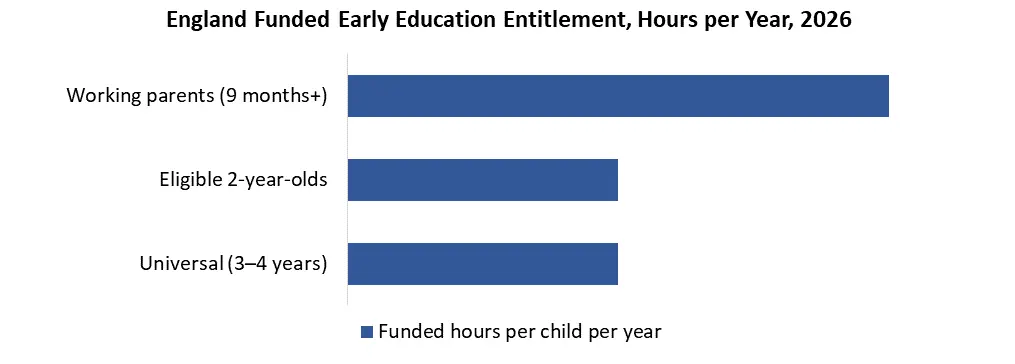
Policy frameworks also shape innovation and funding. England’s funded entitlement provides 570 hours a year for all three- and four-year-olds and up to 1,140 hours for eligible working families, and operators design services around funded hours, extended-day care and flexible patterns. Licensing, accreditation, curriculum frameworks and child data privacy rules now form part of how digital early learning products and centres are approved and trusted.
Early Childhood Education Learning Approach Landscape: Montessori, Reggio Emilia, Waldorf, Play-Based and Structured Learning
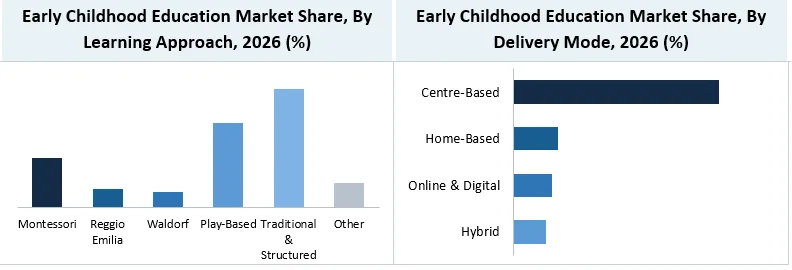
Learning approach defines how a child is taught. Montessori education uses child-led activity with specially designed learning materials and practical life equipment. The Reggio Emilia approach is project-based and builds on children’s interests. Waldorf education emphasises creative development, rhythm and imagination. Play-based learning uses experiential activities and games to build cognitive, language, social and motor skills, while traditional and structured learning relies on teacher-led instruction aligned with kindergarten and primary-school readiness. Their shares of 2026 value are about 16% for Montessori, 6% for Reggio Emilia, 5% for Waldorf, 27% for play-based, 38% for traditional and structured learning and 8% for other approaches.
Early Childhood Care and Education (ECCE) and Preschool: Curriculum Frameworks, School Readiness and Foundational Learning
Early Childhood Care and Education programmes combine care, nutrition, play and learning for infants and toddlers, while preschool and kindergarten programmes add structured curriculum in language, mathematics and science readiness, creative arts, music and physical education. Early primary programmes for ages 7 to 8 extend foundational literacy and numeracy. Curriculum standardisation, programme benchmarking and school readiness assessment are decisive for parents, regulators and franchise networks, which is why curriculum alignment is a key criterion in provider selection and accreditation.
Policy framing differs by country. India’s National Education Policy 2020 defines a foundational stage covering ages 3 to 8, Germany gives children a legal entitlement to a childcare place from age one, and Japan has offered free early childhood education for ages 3 to 5 since 2019. This divergence creates a long, multi-country pipeline of enrolment growth, curriculum upgrades and facility investment through 2034.
Digital, Teacher and Infrastructure Enablers: Learning Platforms, Educator Workforce and Child-Safe Facilities
Digital platforms, qualified educators and safe, well-designed facilities determine service quality. Learning management systems, smart classroom technologies and digital content support personalised learning and parent engagement, while teacher qualification, professional development and retention decide classroom quality. Child safety, hygiene, outdoor play areas, educational furniture and learning materials add capital and maintenance cost to every centre.
Global Early Childhood Education Market Segmentation
By age group, toddlers (3–4 years) led with about 34% of 2026 value, followed by preschool-age children (5–6 years) at 30%, infants (0–2 years) at 22% and early primary-age children (7–8 years) at 14%. Preschool-age and toddler programmes grow at 8.1% CAGR as families seek structured learning before school entry, whereas infant care grows at 7.6% on funded entitlements for children under two.
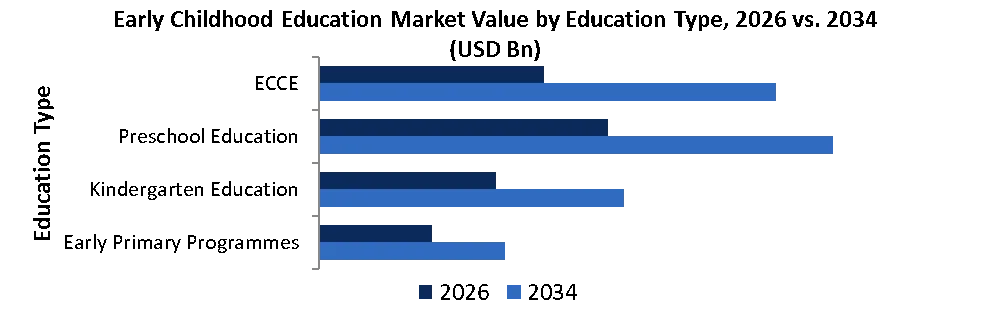
By education type, preschool education led with about 36% of 2026 value, followed by Early Childhood Care and Education (ECCE) at 28%, kindergarten education at 22% and early primary education programmes at 14%. ECCE grows fastest at 9.3% CAGR because of public funding for childcare and learning from birth, whereas kindergarten education grows at 7.1%.
By learning approach, traditional and structured learning led with about 38% of 2026 value, followed by play-based learning at 27%, Montessori education at 16%, Reggio Emilia education at 6%, Waldorf education at 5% and other approaches at 8%. Play-based learning grows fastest at 10.6% CAGR, followed by Montessori education at 9.4%, as parents shift from rote instruction to experiential, child-led learning.
By delivery mode, centre-based education led with about 64% of 2026 value, followed by home-based education at 14%, online and digital education at 12% and hybrid education at 10%. Hybrid education is expected to register the fastest growth, followed by online and digital education, home-based education and centre-based education.
By ownership, private and commercially operated institutions led with about 52% of 2026 value, followed by public and government-owned institutions at 36% and non-profit and community-based institutions at 12%. Private and commercially operated institutions grow at 8.5% CAGR on franchise-led and urban demand, whereas public institutions grow at 6.9%.
By service type, full-day early education services led with about 46% of 2026 value, followed by part-time early education services at 27%, extended-day and after-school services at 18% and specialized early learning and development services at 9%. Specialized services grow fastest at 10.4% CAGR.
By revenue model, tuition and enrolment fee-based services led with about 58% of 2026 value, followed by government-funded and subsidized services at 27%, subscription and membership-based services at 6% and franchise and licensing-based revenue at 9%. Subscription and membership-based services grow fastest at 12.1% CAGR.
Early Childhood Education Market Regional Outlook: Asia Pacific, North America, Europe, Middle East & Africa and South America
The Asia Pacific Early Childhood Education Market held the largest share, about 38% of global value in 2026, and is also expected to be the fastest-growing region at a 9.2% CAGR through 2034, rising to about 42.1% of value. China’s Preschool Education Law, India’s National Education Policy 2020 foundational stage and rapid urban middle-class growth in Indonesia, Thailand, Malaysia, Vietnam and Singapore support enrolment, while Japan, South Korea, Australia and New Zealand contribute mature, publicly supported systems, with the Australian Capital Territory’s Free Three-Year-Old Preschool program reaching more than 3,000 children.
North America held about 26% of 2026 value and grows at about 6.3% CAGR. The United States, Canada and Mexico are led by large operators such as Bright Horizons, KinderCare and Learning Care Group, and by franchise brands. Europe held about 24% of 2026 value and grows at about 6.9% CAGR as Germany, the United Kingdom, France, Italy, Spain and the Nordic countries expand funded entitlements. The Middle East and Africa held about 7% of 2026 value and grow at 8.4% on private and international school groups in the Gulf and national early learning programmes, while South America held about 5% and grows at about 7.6% on private preschool demand in Brazil, Chile and Colombia.
|
Region |
2026 share |
2026 (USD Bn) |
2034 (USD Bn) |
CAGR |
Notes |
|
North America |
26% |
XX |
XX |
XX |
US, Canada and Mexico; Bright Horizons, KinderCare, Learning Care Group and franchise brands; mature, employer-sponsored and funding-led |
|
Europe |
XX |
XX |
XX |
XX |
UK, Germany, France, Italy, Spain and Nordics; funded childcare entitlements, accreditation and nursery groups |
|
Asia Pacific |
XX |
XX |
XX |
XX |
China, India, Japan, South Korea, Australia and Southeast Asia; largest and fastest-growing region |
|
Middle East & Africa |
XX |
XX |
XX |
XX |
Saudi Arabia, UAE, Türkiye, Israel, South Africa, Egypt and Nigeria; private and international school groups, national early learning programmes |
|
South America |
XX |
XX |
XX |
XX |
Brazil leads; Argentina, Chile, Colombia and Peru; private preschool networks and public early education programmes |
Leading Early Childhood Education Service Providers: Competitive Landscape and Early Childhood Education Market Key Players
The Early Childhood Education Market competitive landscape includes several distinct groups rather than a single set of comparable companies. North American childcare and early learning chains such as Bright Horizons Family Solutions, KinderCare Learning Companies, Learning Care Group, Primrose Schools and The Goddard School serve working-parent families and employers. European nursery and education groups such as Busy Bees Nurseries, Kids Planet Day Nurseries, Babilou Family, AcadeMedia and Nord Anglia Education combine childcare, preschool and school offerings. Asia Pacific operators, including Maple Bear Global Schools, EtonHouse International Education Group, Sanko Holdings, RYB Education, Xuhui Education Group, Zee Learn, EuroKids International and Kangaroo Kids Education, lead franchise-led and international curriculum expansion. Middle East and Africa groups such as GEMS Education, Taaleem Holdings and SABIS, and South American operators such as Grupo SEB and Vitamina, complete the ecosystem.
Global Early Childhood Education Market Recent Developments, Product Launches and Industry News | 2026
|
Date |
Company / Source |
Key Development |
Impact on Early Childhood Education Market |
|
Mar 26 |
Institute for Fiscal Studies |
Estimated that spending on England’s free childcare entitlements reached £8.7 billion in 2025–26 and that about 80% of pre-school childcare will be delivered through free entitlements once fully rolled out. |
Shows the shift of Early Childhood Education Market revenue toward government-funded and subsidised services. |
|
May 26 |
KinderCare Learning Companies |
Reported first-quarter 2026 revenue of USD 672.5 Million, with 1,606 early childhood education centres and 1,159 before- and after-school sites at 4 April 2026; centre revenue fell 0.8% as lower enrolment outweighed higher tuition rates. |
Indicates enrolment pressure and pricing power in the mature North America Early Childhood Education Market. |
|
Jul 26 |
Department for Education (England) |
Published statistics on eligibility codes issued and validated for the extended childcare entitlement for working parents. |
Tracks uptake of funded hours and supports Early Childhood Education Market demand in Europe. |
|
Jul 26 |
Bright Horizons Family Solutions |
Reported second-quarter 2026 revenue of USD 779.2 Million, up 7%, and 988 early education and child care centres with capacity for about 112,500 children at 30 June 2026. |
Highlights the strength of employer-sponsored care and back-up care in the Early Childhood Education Market. |
|
Aug 26 |
KinderCare Learning Companies |
Reported second-quarter 2026 revenue of USD 697.5 Million, down 0.4%, and closed 49 early childhood education centres under its centre optimisation initiative. |
Shows footprint optimisation and enrolment-led competition among large operators. |
Early Childhood Education Competitive Landscape Analysis: Competitor Benchmarking, Rivalry Intensity and Market Strategies
1. Competitor Analysis, Company Revenue and Early Childhood Education Market Share: The report evaluates leading service providers based on company revenue, net sales, market share, enrolment, centre network, profitability, financial performance and competitive positioning using company filings and industry data.
2. Competitor Profiling, Industry Rivals Examination and Competitive Positioning: Competitive analysis examines global childcare and preschool chains, international school groups, franchise brands and regional operators, focusing on curriculum capabilities, learning approach, institutional network, quality accreditation, pricing strategies and competitive advantages.
3. Rivalry Intensity, Market Rivalry Intensity and Industry Player Dynamics: Competition is influenced by local supply and enrolment, teacher availability, government funding rules, licensing and quality ratings, while digital learning, parent engagement and brand reputation intensify rivalry among providers.
4. Market Player Strategies, Competitive Benchmark Analysis and Rival Market Share: Leading companies strengthen positioning through centre network optimisation, acquisitions, franchise expansion, curriculum differentiation, employer partnerships and digital platforms, while competitive benchmarking evaluates market share, enrolment capacity, product differentiation and revenue growth.
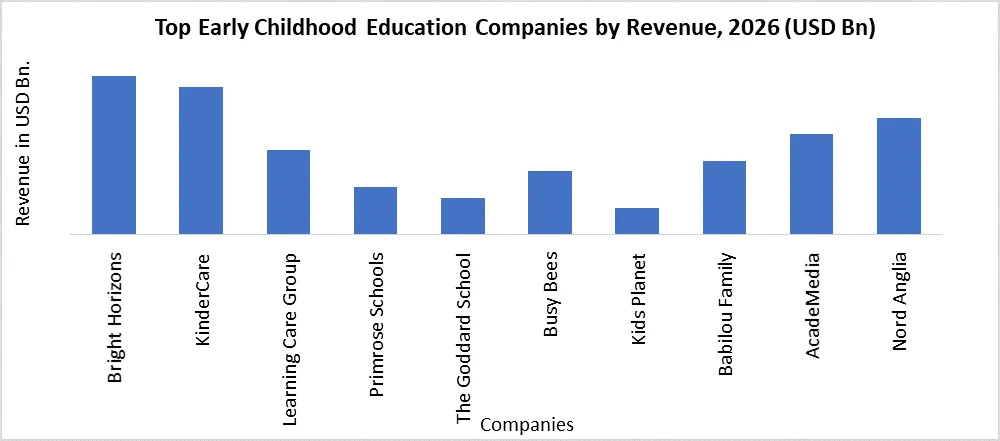
5. Strategic Analysis and Competitive Ecosystem: The competitive ecosystem includes multinational childcare groups, regional preschool networks, franchise and consultancy providers, curriculum developers, edtech platforms and infrastructure and equipment suppliers competing through pricing, quality, strategic alliances, product innovation and expansion across global early learning markets.
Global Early Childhood Education Market Scope: Inquire before buying
|
Global Early Childhood Education Market |
|||
|
Report Coverage |
Details |
||
|
Base Year: |
2026 |
Forecast Period: |
2027-2034 |
|
Historical Data: |
2021 to 2026 |
Market Size in 2026: |
USD 372.6 Billion |
|
Forecast Period 2027 to 2034 CAGR: |
7.8% |
Market Size in 2034: |
USD 679.5 Billion |
|
Early Childhood Education Market Segments Covered: |
By Age Group |
Infants (0–2 Years) Toddlers (3–4 Years) Preschool-Age Children (5–6 Years) Early Primary-Age Children (7–8 Years) |
|
|
By Education Type |
Early Childhood Care and Education (ECCE) Preschool Education Kindergarten Education Early Primary Education Programmes |
||
|
By Learning Approach |
Montessori Education Reggio Emilia Education Waldorf Education Play-Based Learning Traditional and Structured Learning Other Learning Approaches |
||
|
By Delivery Mode |
Centre-Based Education Home-Based Education Online and Digital Education Hybrid Education |
||
|
By Ownership |
Public and Government-Owned Institutions Private and Commercially Operated Institutions Non-Profit and Community-Based Institutions |
||
|
By Service Type |
Full-Day Early Education Services Part-Time Early Education Services Extended-Day and After-School Services Specialized Early Learning and Development Services |
||
|
By Revenue Model |
Tuition and Enrolment Fee-Based Services Subscription and Membership-Based Services Government-Funded and Subsidized Services Franchise and Licensing-Based Revenue |
||
Global Early Childhood Education Market, By Region
North America (United States, Canada, Mexico, Rest of North America)
Europe (Germany, United Kingdom, France, Italy, Spain, Netherlands, Belgium, Switzerland, Austria, Sweden, Norway, Poland, Rest of Europe)
Asia Pacific (China, India, Japan, South Korea, Australia, New Zealand, Indonesia, Thailand, Malaysia, Singapore, Vietnam, Rest of Asia Pacific)
Middle East and Africa (Saudi Arabia, United Arab Emirates, Türkiye, Israel, South Africa, Egypt, Nigeria, Kenya, Morocco, Rest of Middle East and Africa)
South America (Brazil, Argentina, Chile, Colombia, Peru, Venezuela,Rest of South America)
Key players/Competitors profiles covered in the Early Childhood Education Market report from a strategic perspective
North America
- Bright Horizons Family Solutions, Inc. (United States)
- KinderCare Learning Companies, Inc. (United States)
- Learning Care Group, Inc. (United States)
- Primrose Schools (United States)
- The Goddard School (United States)
Others
Europe
- Busy Bees Nurseries (United Kingdom)
- Kids Planet Day Nurseries (United Kingdom)
- Babilou Family (France)
- AcadeMedia AB (Sweden)
- Nord Anglia Education (United Kingdom)
Others
Asia Pacific
- Maple Bear Global Schools (Canada / International Operations)
- EtonHouse International Education Group (Singapore)
- Sanko Holdings Co., Ltd. (Japan)
- RYB Education, Inc. (China)
- Xuhui Education Group (China)
- Zee Learn Limited (India)
- EuroKids International (India)
- Kangaroo Kids Education Limited (India)
Others
Middle East & Africa
- GEMS Education (United Arab Emirates)
- Taaleem Holdings PJSC (United Arab Emirates)
- SABIS (United Arab Emirates / International Operations)
Others
South America
- Grupo SEB (Brazil)
- Vitamina (Chile)
Others
Frequently Asked Questions
Ans. Growth comes from rising dual-income households, government funding and entitlements, parental focus on school readiness, expansion of play-based and Montessori learning, full-day and extended-day services, hybrid and digital delivery, and franchise-led expansion.
Ans. Asia Pacific held the largest share in 2026, about 38% of value, and is also the fastest-growing region at 9.2% CAGR. China and India lead regional demand, supported by policy and legislation such as China’s Preschool Education Law and India’s National Education Policy 2020.
Ans. Preschool education is the largest education type at about 36% of 2026 value, but Early Childhood Care and Education grows fastest at 9.3% CAGR. Traditional and structured learning leads learning approaches at 38%, play-based learning grows at 10.6%, hybrid education leads delivery-mode growth at 12.8%, and full-day services grow at 8.3%.
Ans. Leading names include Bright Horizons, KinderCare, Learning Care Group, Primrose Schools, The Goddard School, Busy Bees, Babilou Family, AcadeMedia, Nord Anglia Education, Maple Bear, EtonHouse, RYB Education, EuroKids, GEMS Education and Grupo SEB, among others profiled in the report.
Ans. Early Childhood Care and Education (ECCE) covers care and learning from birth, preschool education prepares toddlers and young children through play and early curriculum, and kindergarten education builds school readiness before primary school. All three, together with early primary programmes, are covered in the report and differ in age group, curriculum, regulation and funding.
Ans. The market outlook to 2034 is positive, with growth led by Asia Pacific, play-based and Montessori learning, hybrid and digital delivery, full-day services and government-funded programmes, and with a large remaining enrolment pipeline in emerging economies.
1. Executive Market Landscape and Industry Overview
1.1. Global Early Childhood Education Market Size (Value USD Billion), 2026–2034
1.2. Evolution of Global Early Childhood Education Services and Learning Models
1.3. Definition, Scope and Classification of Early Childhood Education Services
1.4. Role of Early Childhood Education in Child Development
1.5. Global Education Industry Structure and Early Learning Value Chain
1.6. Early Childhood Education Infrastructure and Institutional Development Landscape
1.7. CAGR Analysis of Global Early Childhood Education Market During 2027–2034
2. Early Childhood Education Market Dynamics
2.1. Early Childhood Education Market Trends and Emerging Developments
2.2. Early Childhood Education Market Dynamics and Growth Influencing Factors
2.2.1. Market Drivers
2.2.2. Market Restraints
2.2.3. Market Opportunities
2.2.4. Market Challenges
2.3. PORTER's Five Forces Analysis of the Industry
2.4. PESTLE Analysis of the Global Market Environment
3. Early Childhood Education Market Macroeconomic Factors
3.1. Global Birth Rates and Population Growth Trends
3.2. Household Income, Disposable Income and Education Expenditure
3.3. Female Workforce Participation and Dual-Income Household Growth
3.4. Government Expenditure on Early Childhood Education and Care
3.5. Urbanization and Development of Working Parent Households
3.6. Private Education Investment and Institutional Infrastructure Development
3.7. Inflation, Tuition Fee Trends and Operating Cost Movements
4. Early Childhood Education Industry Trends and Emerging Requirements
4.1. Increasing Demand for Structured Early Childhood Learning Programmes
4.2. Growing Adoption of Play-Based and Experiential Learning Methods
4.3. Expansion of Montessori and Alternative Education Models
4.4. Rising Demand for Full-Day Childcare and Preschool Services
4.5. Increasing Focus on Early Literacy and Numeracy Development
4.6. Growing Adoption of Digital Learning and Educational Technologies
4.7. Increasing Focus on Inclusive Education and Developmental Support
5. Early Childhood Development, Learning and Educational Ecosystem
5.1. Cognitive Development and Early Learning Milestone Requirements
5.2. Language Development and Early Communication Skills Acquisition
5.3. Social and Emotional Development Through Structured Learning Activities
5.4. Physical Development and Motor Skills Improvement Programmes
5.5. Early Literacy, Numeracy and Foundational Learning Development
5.6. Creative Expression, Problem-Solving and Critical Thinking Development
5.7. School Readiness Assessment and Developmental Progress Monitoring
6. Early Childhood Education Infrastructure and Institutional Requirements
6.1. Preschool and Kindergarten Infrastructure Development Requirements
6.2. Daycare and Childcare Centre Facility Planning Requirements
6.3. Classroom Design, Learning Spaces and Activity Areas
6.4. Outdoor Playgrounds and Physical Development Infrastructure Requirements
6.5. Child Safety, Hygiene and Sanitation Facility Requirements
6.6. Educational Furniture, Learning Materials and Classroom Equipment
6.7. Institutional Infrastructure Investment and Facility Maintenance Costs
7. Early Childhood Education Programme Types and Curriculum Frameworks
7.1. Early Childhood Care and Education Programme Characteristics
7.2. Preschool Curriculum Structure and Educational Learning Objectives
7.3. Kindergarten Curriculum Frameworks and School Readiness Programmes
7.4. Early Primary Learning and Foundational Education Programmes
7.5. Language, Mathematics and Science Readiness Curriculum Development
7.6. Creative Arts, Music and Physical Education Curriculum
7.7. Curriculum Standardization and Programme Performance Benchmarking
8. Early Childhood Education Learning Approaches and Pedagogical Models
8.1. Montessori Education Model and Child-Led Learning Approaches
8.2. Reggio Emilia Approach and Project-Based Learning Practices
8.3. Waldorf Education Model and Creative Development Approaches
8.4. Play-Based Learning and Experiential Education Methodologies
8.5. Traditional Teacher-Led Learning and Structured Classroom Instruction
8.6. Inquiry-Based Learning and Collaborative Educational Activities
8.7. Pedagogical Effectiveness and Learning Outcome Benchmarking
9. Early Childhood Education Teaching Methods and Classroom Practices
9.1. Interactive Teaching and Activity-Based Classroom Learning Methods
9.2. Storytelling, Reading and Language Development Teaching Techniques
9.3. Educational Games and Structured Play-Based Teaching Activities
9.4. Arts, Crafts and Creative Expression Learning Activities
9.5. Group Learning and Peer Interaction Teaching Practices
9.6. Individualized Instruction and Child-Centred Teaching Strategies
9.7. Classroom Management and Teaching Effectiveness Assessment
10. Early Childhood Education Learning Materials and Educational Resources
10.1. Printed Books, Workbooks and Early Learning Educational Materials
10.2. Educational Toys, Puzzles and Cognitive Development Resources
10.3. Montessori Learning Materials and Practical Life Equipment
10.4. Art Supplies, Creative Kits and Activity-Based Learning Resources
10.5. Digital Educational Content and Interactive Learning Applications
10.6. Classroom Furniture, Learning Tools and Teaching Equipment
10.7. Learning Resource Procurement and Educational Material Cost Benchmarking
11. Early Childhood Education Digital Technologies and Learning Platforms
11.1. Learning Management Systems for Early Childhood Education Institutions
11.2. Digital Learning Applications and Interactive Educational Platforms
11.3. Artificial Intelligence-Based Personalized Early Learning Solutions
11.4. Smart Classroom Technologies and Interactive Learning Devices
11.5. Digital Parent Communication and Student Progress Monitoring Systems
11.6. Online Learning Resources and Educational Content Management Platforms
11.7. Education Technology Integration and Digital Adoption Benchmarking
12. Early Childhood Education Teachers, Workforce and Professional Development
12.1. Preschool Teachers and Early Childhood Educator Workforce Requirements
12.2. Teacher Qualifications, Certification and Professional Competency Standards
12.3. Teaching Assistant and Classroom Support Staff Requirements
12.4. Early Childhood Educator Recruitment and Workforce Availability
12.5. Teacher Training and Continuous Professional Development Programmes
12.6. Educator Salaries, Retention and Workforce Cost Analysis
12.7. Teacher Performance Evaluation and Educational Quality Benchmarking
13. Early Childhood Education Institutional Operations and Service Delivery
13.1. Institutional Planning and Early Learning Programme Administration
13.2. Student Admission, Enrolment and Registration Management Processes
13.3. Classroom Scheduling and Daily Learning Activity Management
13.4. Child Attendance and Institutional Capacity Management Systems
13.5. Parent Communication and Family Engagement Management Processes
13.6. Child Safety, Supervision and Institutional Risk Management
13.7. Operational Efficiency and Institutional Performance Optimization
14. Early Childhood Education Childcare and Developmental Support Services
14.1. Full-Day Childcare and Early Learning Service Provision
14.2. Part-Time Childcare and Flexible Learning Service Arrangements
14.3. Infant Care and Early Development Support Services
14.4. Toddler Care and Developmental Activity-Based Services
14.5. After-School Care and Extended Learning Support Services
14.6. Special Needs Support and Inclusive Childcare Services
14.7. Childcare Service Quality and Customer Satisfaction Benchmarking
15. Early Childhood Education Curriculum Integration and Learning Outcomes
15.1. Early Literacy and Foundational Reading Skills Development
15.2. Early Numeracy and Mathematical Thinking Skills Development
15.3. Science Awareness and Environmental Learning Programme Integration
15.4. Language Acquisition and Multilingual Learning Programme Development
15.5. Social Skills and Emotional Intelligence Development Programmes
15.6. Physical Education and Health Awareness Learning Activities
15.7. Learning Assessment and School Readiness Outcome Measurement
16. Early Childhood Education Special Needs and Inclusive Learning Services
16.1. Inclusive Education Frameworks and Early Intervention Programmes
16.2. Autism Spectrum Support and Individualized Learning Approaches
16.3. Speech and Language Development Support Services
16.4. Learning Difficulties Identification and Developmental Assistance
16.5. Physical Disability Support and Accessible Classroom Infrastructure
16.6. Individualized Education Plans and Specialized Teaching Resources
16.7. Inclusive Education Outcomes and Institutional Accessibility Benchmarking
17. Early Childhood Education Parent Engagement and Family Support Ecosystem
17.1. Parent Participation in Early Childhood Learning Activities
17.2. Parent-Teacher Communication and Progress Reporting Systems
17.3. Family-Based Learning and Home Education Support Programmes
17.4. Parent Education and Child Development Awareness Initiatives
17.5. Parent Feedback and Institutional Satisfaction Measurement
17.6. Family Engagement Platforms and Digital Communication Solutions
17.7. Parent Retention and Institutional Relationship Management Strategies
18. Early Childhood Education Health, Nutrition and Child Wellbeing
18.1. Child Nutrition Programmes and Healthy Meal Service Provision
18.2. Physical Health Monitoring and Developmental Screening Services
18.3. Mental Wellbeing and Social-Emotional Development Support
18.4. Hygiene, Sanitation and Infection Prevention Management Practices
18.5. Child Protection and Safeguarding Policy Implementation
18.6. Physical Activity and Healthy Lifestyle Development Programmes
18.7. Child Health Standards and Institutional Wellbeing Benchmarking
19. Early Childhood Education End-User Requirements and Institutional Demand
19.1. Working Parents and Dual-Income Household Education Requirements
19.2. Nuclear Families and Urban Household Learning Preferences
19.3. High-Income Households and Premium Preschool Service Requirements
19.4. Middle-Income Households and Affordable Education Service Requirements
19.5. Rural Households and Community-Based Early Learning Requirements
19.6. Corporate Employers and Workplace Childcare Service Requirements
19.7. Parent Expectations, Purchasing Behaviour and Institutional Selection Criteria
20. Early Childhood Education Service Customization and Programme Development
20.1. Age-Specific Curriculum and Learning Programme Customization
20.2. Individual Child Development and Personalized Learning Plans
20.3. Multilingual Curriculum and Regional Language Learning Integration
20.4. Customized Educational Activities and Learning Material Development
20.5. Special Needs Adaptation and Inclusive Programme Customization
20.6. Parent Requirements and Institutional Programme Personalization
20.7. Programme Development Costs and Educational Service Optimization
21. Early Childhood Education Quality Assurance, Accreditation and Assessment
21.1. Early Childhood Education Quality Assessment Frameworks
21.2. Curriculum Compliance and Educational Programme Evaluation Procedures
21.3. Teacher Qualification and Classroom Quality Assessment Standards
21.4. Child Development Assessment and Learning Progress Evaluation
21.5. Institutional Accreditation and Educational Certification Requirements
21.6. Child Safety Audits and Institutional Compliance Assessments
21.7. Education Quality Benchmarking and Continuous Improvement Frameworks
22. Early Childhood Education Pricing, Business Models and Cost Economics
22.1. Preschool and Kindergarten Tuition Fee Structure Analysis
22.2. Full-Day and Part-Time Childcare Service Pricing
22.3. Premium, Mid-Range and Affordable Education Service Pricing
22.4. Franchise-Based and Company-Owned Institutional Revenue Models
22.5. Institutional Operating Expenses and Infrastructure Cost Analysis
22.6. Teacher Salaries, Learning Materials and Administrative Cost Analysis
22.7. Average Revenue Per Child, Profit Margins and Financial Performance
23. Early Childhood Education Sales, Marketing and Customer Acquisition Channels
23.1. Direct Institutional Enrolment and Admission-Based Sales Channels
23.2. Digital Marketing and Online Student Acquisition Strategies
23.3. School Franchise Networks and Institutional Partnership Channels
23.4. Parent Referral and Community-Based Marketing Strategies
23.5. Education Consultants and Institutional Enrolment Service Providers
23.6. Online Admission Platforms and Digital Education Marketplaces
23.7. Customer Acquisition Costs and Institutional Enrolment Conversion Benchmarking
24. Early Childhood Education Institutional Supply Chain and Operational Ecosystem
24.1. Educational Furniture and Classroom Equipment Supplier Networks
24.2. Learning Material and Educational Content Procurement Networks
24.3. Educational Technology and Software Solution Provider Networks
24.4. Teacher Recruitment and Professional Training Service Networks
24.5. Institutional Franchise and Education Partnership Networks
24.6. Facility Management and Childcare Support Service Providers
24.7. Institutional Procurement, Vendor Management and Supply Chain Optimization
25. Early Childhood Education Technology Innovation, R&D and Programme Development
25.1. Artificial Intelligence-Based Personalized Learning Technology Development
25.2. Adaptive Learning Systems and Child Progress Analytics
25.3. Interactive Educational Content and Digital Curriculum Innovation
25.4. Child Development Assessment and Monitoring Technology Solutions
25.5. Smart Classroom Infrastructure and Educational Technology Integration
25.6. Inclusive Learning Technology and Assistive Educational Solutions
25.7. Research Investments, Educational Innovation and Institutional Collaborations
26. Early Childhood Education Institutional Capacity, Enrolment and Industry Economics
26.1. Global Early Childhood Education Institutional Capacity (Number of Centres), 2026
26.2. Global Early Childhood Education Student Enrolment (Number of Children), 2026
26.3. Institutional Capacity Utilization and Classroom Occupancy Rate Analysis
26.4. Student Enrolment by Major Countries and Educational Institutions
26.5. New Preschool Establishments and Institutional Expansion Projects
26.6. Teacher-to-Child Ratios and Institutional Operating Efficiency
26.7. Global Enrolment Demand-Supply Balance and Future Capacity Outlook
27. Early Childhood Education Regulatory, Safety and Quality Standards
27.1. Global Early Childhood Education Regulatory Frameworks and Compliance Requirements
27.2. UNESCO and UNICEF Early Childhood Education Policy Frameworks
27.3. United States Childcare Licensing and Education Regulations
27.4. European Union Early Childhood Education and Care Policy Frameworks
27.5. National Curriculum, Teacher Qualification and Accreditation Requirements
27.6. Child Protection, Safeguarding and Institutional Safety Regulations
27.7. Health, Nutrition, Sanitation and Facility Compliance Standards
27.8. Data Privacy and Digital Child Information Protection Regulations
28. Early Childhood Education Regional and Country-Level Market Landscape
28.1. North American Preschool Infrastructure and Institutional Development Landscape
28.2. European Early Childhood Education Policy and Enrolment Landscape
28.3. Asia Pacific Preschool Expansion and Private Education Investment
28.4. Middle East & Africa Early Learning Infrastructure Development
28.5. South American Early Childhood Education Access and Enrolment Trends
28.6. Country-Level Institutional Capacity, Enrolment and Revenue Analysis
28.7. Regional Education Expenditure, Private Participation and Market Growth
29. Early Childhood Education Market: Market Size and Forecast by Segmentation (Value USD Billion), 2026–2034
29.1. By Age Group
29.1.1. Infants (0–2 Years)
29.1.2. Toddlers (3–4 Years)
29.1.3. Preschool-Age Children (5–6 Years)
29.1.4. Early Primary-Age Children (7–8 Years)
29.2. By Education Type
29.2.1. Early Childhood Care and Education (ECCE)
29.2.2. Preschool Education
29.2.3. Kindergarten Education
29.2.4. Early Primary Education Programmes
29.3. By Learning Approach
29.3.1. Montessori Education
29.3.2. Reggio Emilia Education
29.3.3. Waldorf Education
29.3.4. Play-Based Learning
29.3.5. Traditional and Structured Learning
29.3.6. Other Learning Approaches
29.4. By Delivery Mode
29.4.1. Centre-Based Education
29.4.2. Home-Based Education
29.4.3. Online and Digital Education
29.4.4. Hybrid Education
29.5. By Ownership
29.5.1. Public and Government-Owned Institutions
29.5.2. Private and Commercially Operated Institutions
29.5.3. Non-Profit and Community-Based Institutions
29.6. By Service Type
29.6.1. Full-Day Early Education Services
29.6.2. Part-Time Early Education Services
29.6.3. Extended-Day and After-School Services
29.6.4. Specialized Early Learning and Development Services
29.7. By Revenue Model
29.7.1. Tuition and Enrolment Fee-Based Services
29.7.2. Subscription and Membership-Based Services
29.7.3. Government-Funded and Subsidized Services
29.7.4. Franchise and Licensing-Based Revenue
29.8. By Region
29.8.1. North America
29.8.1.1. United States
29.8.1.2. Canada
29.8.1.3. Mexico
29.8.1.4. Rest of North America
29.8.2. Europe
29.8.2.1. Germany
29.8.2.2. United Kingdom
29.8.2.3. France
29.8.2.4. Italy
29.8.2.5. Spain
29.8.2.6. Netherlands
29.8.2.7. Belgium
29.8.2.8. Switzerland
29.8.2.9. Austria
29.8.2.10. Sweden
29.8.2.11. Norway
29.8.2.12. Poland
29.8.2.13. Rest of Europe
29.8.3. Asia Pacific
29.8.3.1. China
29.8.3.2. India
29.8.3.3. Japan
29.8.3.4. South Korea
29.8.3.5. Australia
29.8.3.6. New Zealand
29.8.3.7. Indonesia
29.8.3.8. Thailand
29.8.3.9. Malaysia
29.8.3.10. Singapore
29.8.3.11. Vietnam
29.8.3.12. Rest of Asia Pacific
29.8.4. Middle East and Africa
29.8.4.1. Saudi Arabia
29.8.4.2. United Arab Emirates
29.8.4.3. Türkiye
29.8.4.4. Israel
29.8.4.5. South Africa
29.8.4.6. Egypt
29.8.4.7. Nigeria
29.8.4.8. Kenya
29.8.4.9. Morocco
29.8.4.10. Rest of Middle East and Africa
29.8.5. South America
29.8.5.1. Brazil
29.8.5.2. Argentina
29.8.5.3. Chile
29.8.5.4. Colombia
29.8.5.5. Peru
25.8.5.6. Venezuela
29.8.5.7. Rest of South America
30. Early Childhood Education Market Competitive Landscape
30.1. SMR Competition Matrix and Competitive Assessment
30.2. Competitive Positioning of Leading Education Providers [Revenue and Market Share (%)]
30.3. Key Players Benchmarking
30.3.1. Company Name and Corporate Headquarters
30.3.2. Early Childhood Education Service Portfolio
30.3.3. Preschool and Kindergarten Institutional Network
30.3.4. Curriculum and Learning Approach Capabilities
30.3.5. Institutional Presence and Operational Capacity
30.3.6. Geographic Presence and Franchise Network
30.3.7. Educational Technology and Digital Learning Capabilities
30.3.8. Total Company Revenue (2026)
30.3.9. Early Childhood Education-Related Revenue (2026)
30.3.10. Student Enrolment and Institutional Capacity
30.3.11. Strategic Partnerships and Institutional Collaborations
30.3.12. Educational Innovation and Programme Development Capabilities
30.4. Market Structure
30.4.1. Market Leaders
30.4.2. Market Followers
30.4.3. Emerging Education Providers
30.4.4. Specialized Early Childhood Education Operators
30.5. Growth Rate / Y-o-Y (%) of Companies
30.6. Profit Margin (%) of Companies
30.7. Institutional Expansion and Investment Analysis
30.8. Revenue Vs. Net Earnings – Financial Health Benchmarking (2026)
30.9. Revenue Performance and Financial Analysis (2026)
30.10. Mergers and Acquisitions Details
30.11. Recent Key Developments
31. Global Early Childhood Education Service Providers and Preschool Operators
31.1. Global Preschool and Kindergarten Education Service Providers
31.2. International Early Childhood Education Institutional Operators
31.3. Private Preschool and Kindergarten Education Networks
31.4. Public and Government-Supported Early Education Providers
31.5. Community-Based and Non-Profit Education Organizations
31.6. Institutional Presence, Student Enrolment and Capacity Benchmarking
31.7. Global Education Provider Competitive Positioning
32. Early Childhood Education Curriculum and Learning Programme Providers
32.1. Montessori Curriculum and Educational Programme Providers
32.2. Reggio Emilia Educational Programme and Training Organizations
32.3. Waldorf Education Curriculum and Learning Organizations
32.4. Play-Based Learning Programme Developers and Providers
32.5. Early Literacy and Numeracy Curriculum Providers
32.6. Educational Content Development and Learning Material Companies
32.7. Curriculum Innovation and Programme Performance Benchmarking
33. Early Childhood Education Technology and Digital Learning Solution Providers
33.1. Early Childhood Learning Management System Providers
33.2. Digital Educational Content and Application Developers
33.3. Artificial Intelligence-Based Personalized Learning Solution Providers
33.4. Smart Classroom and Interactive Learning Technology Companies
33.5. Student Assessment and Progress Monitoring Platform Providers
33.6. Parent Communication and Institutional Management Software Providers
33.7. Digital Learning Technology and Innovation Benchmarking
34. Early Childhood Education Infrastructure, Furniture and Equipment Providers
34.1. Preschool and Kindergarten Classroom Furniture Manufacturers
34.2. Educational Toys and Learning Equipment Manufacturers
34.3. Montessori Learning Material and Educational Resource Suppliers
34.4. Playground Equipment and Outdoor Learning Infrastructure Providers
34.5. Classroom Safety and Child Protection Equipment Suppliers
34.6. Educational Facility Design and Infrastructure Development Companies
34.7. Equipment Quality, Product Innovation and Cost Benchmarking
35. Early Childhood Education Franchise, Consultancy and Institutional Support Providers
35.1. Global Preschool Franchise and Licensing Companies
35.2. Regional Early Childhood Education Franchise Networks
35.3. Education Management and Institutional Consultancy Providers
35.4. Preschool Establishment and Infrastructure Development Consultants
35.5. Teacher Recruitment and Professional Training Organizations
35.6. Institutional Accreditation and Education Advisory Organizations
35.7. Franchise Performance and Institutional Expansion Benchmarking
36. Early Childhood Education Assessment, Accreditation and Training Providers
36.1. Early Childhood Education Accreditation Organizations
36.2. Educational Quality Assessment and Evaluation Service Providers
36.3. Teacher Certification and Professional Development Organizations
36.4. Child Development Assessment and Screening Service Providers
36.5. Educational Research and Curriculum Evaluation Institutions
36.6. Institutional Compliance and Education Audit Service Providers
36.7. Assessment Quality and Certification Benchmarking
37. Early Childhood Education Providers' Strategies and Expansion Plans
37.1. Expansion of Preschool and Kindergarten Institutional Networks
37.2. Development of New Early Childhood Learning Programmes
37.3. Expansion into Emerging International Education Markets
37.4. Investment in Digital Learning and Educational Technologies
37.5. Development of Premium and Affordable Education Service Models
37.6. Expansion of Franchise-Based Education Business Operations
37.7. Strategic Partnerships, Mergers and Acquisitions
37.8. Institutional Capacity Expansion and New Centre Development
38. Early Childhood Education Industry SWOT, Investments and Strategic Developments
38.1. Competitive Strengths of Established Early Education Providers
38.2. Teacher Shortages and Institutional Operating Cost Challenges
38.3. Emerging Opportunities in Underserved Education Markets
38.4. Growing Demand for Inclusive and Personalized Learning Services
38.5. Strategic Investments in Preschool Infrastructure and Technology
38.6. Government Policies and Education Accessibility Development
38.7. Major Institutional Launches, Partnerships and Industry Developments
39. Early Childhood Education Competitive Outlook and Market Positioning
39.1. Competitive Dynamics Across Public and Private Education Providers
39.2. Market Concentration Among Global Early Education Service Providers
39.3. Service Differentiation Through Curriculum and Learning Methodologies
39.4. Competitive Positioning of Established and Emerging Education Providers
39.5. Regional Institutional Expansion and Education Market Localization
39.6. Future Development of Technology-Enabled Early Learning Services
39.7. Long-Term Competitive Positioning of Leading Education Companies
40. Company Profile: Key Early Childhood Education Market Players
Detailed Profile Considering the Parameters:
- Overview
- Business Portfolio
- Early Childhood Education Service Portfolio
- Curriculum and Learning Approach Capabilities
- Institutional Network and Operational Capacity
- Student Enrolment and Geographic Presence
- Financial Overview
- SWOT Analysis
- Strategic Analysis
- Recent Developments
North America
- Bright Horizons Family Solutions, Inc. (United States)
- KinderCare Learning Companies, Inc. (United States)
- Learning Care Group, Inc. (United States)
- Primrose Schools (United States)
- The Goddard School (United States)
Others
Europe
- Busy Bees Nurseries (United Kingdom)
- Kids Planet Day Nurseries (United Kingdom)
- Babilou Family (France)
- AcadeMedia AB (Sweden)
- Nord Anglia Education (United Kingdom)
Others
Asia Pacific
- Maple Bear Global Schools (Canada / International Operations)
- EtonHouse International Education Group (Singapore)
- Sanko Holdings Co., Ltd. (Japan)
- RYB Education, Inc. (China)
- Xuhui Education Group (China)
- Zee Learn Limited (India)
- EuroKids International (India)
- Kangaroo Kids Education Limited (India)
Others
Middle East & Africa
- GEMS Education (United Arab Emirates)
- Taaleem Holdings PJSC (United Arab Emirates)
- SABIS (United Arab Emirates / International Operations)
Others
South America
- Grupo SEB (Brazil)
- Vitamina (Chile)
Others
41. Key Findings
42. Strategic Moves and Industry Outlook
43. Research Methodology