ENG
 Japanese
 French
 German
 Korean

South America Auxins Market: Industry Analysis, Market Size, Share, Trends and Forecast (2026–2034)
The South America Auxins Market is valued at USD 90.0 Mn in 2026 and is expected to reach USD 148 Mn by 2034, growing at a CAGR of 6.4% during 2027–2034.
The South America Auxins Market is valued at USD 90.0 Mn in 2026 and is expected to reach USD 148 Mn by 2034, growing at a CAGR of 6.4% during 2027–2034. In terms of volume, the South America Auxins Market is valued at XX Metric Tons in 2026 and is expected to reach XX Metric Tons by 2034, growing at a CAGR of XX% during 2027–2034.
Market definition and scope: The South America Auxins Market covers auxin-class agricultural inputs: synthetic auxin herbicides (2,4-D, dicamba, MCPA, MCPB, mecoprop-P, fluroxypyr, picloram, aminopyralid, halauxifen and florpyrauxifen), auxin-type plant growth regulators and rooting hormones (NAA, IBA, IAA and related compounds), and natural and bio-derived auxin formulations, supplied as liquid concentrates, water-soluble and dispersible powders and granules, rooting powders, gels and pastes, and tablets or capsules. To avoid double counting with the wider herbicide and plant growth regulator markets, synthetic auxin herbicides are counted at the auxin active-ingredient level only, and non-auxin partner actives in co-formulated products, such as glyphosate or glufosinate, are excluded. Gibberellin, cytokinin and ethylene-based regulators, and biostimulants without a declared auxin or auxin-like active, are outside the scope.
Stellar Market Research Study scope and coverage: The study period is 2021–2034, with 2026 as the base year, 2021–2026 as historical data and 2027–2034 as the forecast period. Market size is reported in USD million (value) and metric tons (volume), with all other currencies converted to USD. The South America Auxins Market analysis segments the market by product type, product form, crop application, end user and distribution channel, and covers seven country groups (Brazil, Argentina, Colombia, Chile, Peru, Venezuela, and Rest of South America). The report is for crop-protection manufacturers, plant growth regulator and rooting hormone suppliers, biological and biostimulant companies, distributors, cooperatives, government agencies, technology providers and investors.
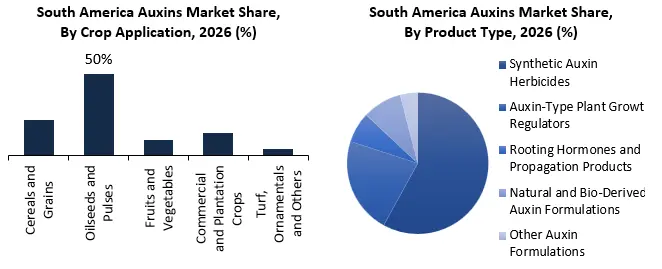
Synthetic Auxin Herbicides accounted for the largest share of South America Auxins Market value in 2026 at about 58%, while oilseeds and pulses represent about XX% of crop-application demand during the same year. South America Auxins Market growth is moving toward natural and bio-derived auxin formulations, rooting powders, gels and pastes, fruits and vegetables, e-commerce and digital channels and Peru, as herbicide-resistance management, horticulture expansion, regulatory change and demand for lower-residue inputs change what growers apply.
Stellar Market Research delivers a comprehensive South America Auxins Market Research Report covering value (USD Million) and volume (metric tons) by product type, product form, crop application, end user, distribution channel and country, together with a competitive landscape, strategic scenarios and growth opportunities.
South America Auxins Market Size and Growth: Industry Outlook, 2026–2034
The South America Auxins Market is sized at the auxin active-ingredient and finished-product level, so that the wider herbicide, plant growth regulator and biostimulant markets are not double counted. Brazil's Ministry of Agriculture and Livestock (MAPA) reported 912 pesticide and related-product registrations in 2025, including a record 162 bioinputs that cover plant growth regulators, and its Act No. 61 of 22 December 2025 suspended the registrations of 34 products as a precaution. This harvest and registration backdrop makes Brazil the anchor of the South America Auxins Market, with bio-derived products gaining share.
Key Findings: Insights Shaping the South America Auxins Market
Government statistics, company disclosures and SMR's market model point to the following key findings, highlighting South America Auxins Market demand, consumption, supply, revenue generation and market value creation through 2034.
- Synthetic Auxin Herbicides lead in value; Natural and Bio-Derived Auxin Formulations lead in growth. Synthetic Auxin Herbicides hold about 58% of 2026 value and grow at 5.0%, below the market's XX% CAGR, while Natural and Bio-Derived Auxin Formulations grow at XX% and Auxin-Type Plant Growth Regulators at 7.6%.
- Liquid and Emulsifiable Concentrates lead product forms; Rooting Powders, Gels and Pastes grow fastest. Liquid and Emulsifiable Concentrates hold about 60% of 2026 value and grow at 5.7%, while Rooting Powders, Gels and Pastes grow at 8.8%.
- Oilseeds and Pulses lead crops; Fruits and Vegetables grow fastest. Oilseeds and Pulses hold about XX% of 2026 value and grow at 6.7%, while Fruits and Vegetables grow at XX% and reach 13% of value by 2034.
- Harvests and registrations anchor demand. 2025/26 grain harvest at 361.7 million tonnes, and MAPA registered a record 162 bioinputs in 2025.
- Brazil is the largest market; Peru grows fastest. Brazil held about 58% of 2026 value and grows at XX%, while Peru grows at 9.4%, rising from XX% to XX% of value.
- E-Commerce and Digital Platforms gain share. They grow at 14.8% a year, against 4.6% for Agro-Input Distributors and Dealers, which held about XX% of 2026 value.
South America Auxins Market Trends
Record Brazilian Harvests Supporting Herbicide Demand: 2025/26 Brazilian grain harvest at 361.7 million tonnes and soybean at a record 180.4 million tonnes on 15 September 2026. Large soybean and corn area sustains demand for 2,4-D-based programs, and oilseeds and pulses hold about 50% of 2026 value, the largest crop share in this report.
Trait-Linked 2,4-D Choline Adoption: Corteva promotes the Enlist system in Brazil, where Enlist E3 soybean varieties tolerate the new 2,4-D choline herbicide Enlist Colex-D, glyphosate and glufosinate, according to the company's August 2026 distributor-congress statement. Trait-herbicide linkage underpins synthetic auxin demand in soybean.
Bioinput Registrations at a Record: MAPA recorded 162 bioinputs in its 2025 registrations, including plant growth regulators, and CropLife Brasil's CropData counted 139 new biological products by December 2025. Natural and bio-derived auxin formulations grow at 12.4% a year, the fastest-growing product type in this report.
Distributor-Led Market Access: Corteva described distributors as the key link between technology and growers at the Andav congress on 11–13 August 2026. Distributors and dealers held about XX% of 2026 value, while e-commerce and digital platforms grow fastest at 14.8% a year.
South America Auxins Market Drivers: Weed-Resistance Management, Horticulture Demand, Regulatory Support and Bio-Derived Products
Soybean, corn, cotton and sugarcane growers need dependable broadleaf weed control as resistance spreads. Conab's record 2025/26 harvest and planted-area growth of 1.7% keep treated area high, and synthetic auxin herbicides, which hold about 58% of 2026 value, are central to resistance-management programs in soybean and sugarcane.
Coffee, fruit and vegetable production in Brazil, Colombia, Chile and Peru uses auxin-type regulators and rooting hormones, and fruits and vegetables grow at 10.0% a year in this report. Bioinput registration growth in Brazil also widens the choice of natural-origin products.
South America Auxins Market Restraints and Challenges: Regulatory Risk, Generic Competition, Stewardship and Supply Costs
Regulatory tightening and public scrutiny are the most persistent restraints. MAPA suspended 34 product registrations as a precaution under Act No. 61 of 22 December 2025, and a national program to reduce pesticide use was reported to have been signed in 2025, which may slow growth in conventional herbicide volumes.
Price and product-differentiation pressure add to the strain. CropLife Brasil's data note that 2025 registrations advanced more in generic than in innovative products, which compresses margins on commodity actives such as 2,4-D. Drift risk to sensitive neighbouring crops also adds stewardship costs.
Brazil is the largest market at about 58% of 2026 value, while Peru is the fastest-growing at XX% a year from a small base. South America Auxins Market Value growth outside Brazil therefore depends on horticulture and specialty crops in Colombia, Chile and Peru.
South America Auxins Market Dynamics Analysis: Economic Factors, Demand and Supply, Competitive Rivalry and Regulation
Demand and Supply Gap Analysis: Demand is concentrated in soybean, corn, cotton and sugarcane weed control, with supply drawn from domestic formulators and imported actives. In SMR's analysis, the gap lies in registered bio-derived products and stewardship-ready formulations rather than in basic actives.
Farmer Behavior Trends and Preference Evolution: Large growers adopt stacked-trait programs and rotate modes of action, while fruit, coffee and vegetable growers adopt measured plant growth regulator programs and increasingly test bioinputs on-farm.
Technological Advancements and Innovation Impact: Choline-salt formulations, drift-reduction technologies and precision application improve performance and stewardship, and biological companies are scaling natural-origin plant hormone products locally.
Regulatory Influences and Regulatory Changes: Registration follows a three-agency process involving Anvisa, Ibama and MAPA, and 2025 registrations totalled 912. Precautionary suspensions show that compliance and post-registration monitoring are tightening.
In Brazil, pesticide registration is tripartite, involving Anvisa for health, Ibama for the environment and MAPA for agronomic efficacy, and biological products follow separate bioinput pathways. Argentina, Colombia, Chile and Peru operate national registration systems, and export crops must meet importing-market residue limits.
South America Auxins Market Opportunities: Trait-Linked Weed Control, Bio-Derived Plant Hormones and Horticulture Growth
Trait-Linked Weed Control Systems: Enlist E3 soybeans tolerate 2,4-D choline (Enlist Colex-D), glyphosate and glufosinate, linking seed and herbicide sales in Brazil, according to Corteva.
Growing Acceptance of Bio-Derived Plant Hormones: Natural and bio-derived auxin formulations grow at 12.4% a year, supported by MAPA's record 162 bioinput registrations in 2025.
Horticulture and Perennial-Crop Pull: Fruits and vegetables grow at 10.0% a year and rooting hormones and propagation products at 6.5%.
South America Auxins Market Innovations: Low-Volatility Formulations, Bio-Derived Auxins, Rooting Technologies and Precision Application
Choline-salt and low-volatility formulations, encapsulated premixes and drift-reduction technologies improve auxin herbicide stewardship in soybean and sugarcane. Plant growth regulator makers are tailoring IBA and NAA products for coffee, fruit and nursery use, and Brazilian biological companies are scaling plant-extract and microbial products with declared auxin activity.
Standardized auxin content, stable liquid formulations for tropical conditions and distributor-led technical programs help growers achieve repeatable results across large and varied production zones.
South America Auxins Market Segmentation
By Product Type: Synthetic Auxin Herbicides led with 58% of the 2026 market value, supported by low unit cost, broadleaf weed-control efficacy and compatibility with auxin-tolerant crop systems, and grow at 5.0% to reach 52% of 2034 value. Natural and Bio-Derived Auxin Formulations are the fastest-growing product type as buyers increasingly prefer natural-origin and lower-residue agricultural inputs. Auxin-Type Plant Growth Regulators and Rooting Hormones and Propagation Products benefit from orchard, nursery and protected-cultivation expansion, while Other Auxin Formulations support specialized agricultural applications.
By Crop Application: Oilseeds and Pulses dominated with 50% of the 2026 South America Auxins Market value and grow at 6.7%, supported by large treated area and the need for selective broadleaf control. Fruits and Vegetables are the fastest-growing application, driven by increasing orchard, vegetable and nursery demand for plant growth regulators and rooting products. Cereals and Grains, Commercial and Plantation Crops, and Turf and Ornamentals segments generate steady demand for synthetic auxin herbicides and specialized plant growth regulators.
By Product Form: Liquid and Emulsifiable Concentrates accounted for 60% of the 2026 South America Auxins Market value and are growing at 5.7%, because liquid herbicide and regulator concentrate suit spray application and tank mixing. Rooting Powders, Gels and Pastes are the fastest-growing product form, supported by expanding nursery operations and plant propagation activities. Water-Soluble and Dispersible Powders and Granules benefit from convenient handling, storage stability, formulation flexibility and compatibility with agricultural application systems.
By End User: Commercial Farms and Agricultural Enterprises are the core buyers of synthetic auxin herbicides, adopting stacked-trait programs and rotating modes of action to manage resistance, while Plantation, Orchard and Nursery Operators adopt measured plant growth regulator and rooting hormone programs and increasingly test bioinputs on-farm. Individual Farmers and Smallholders, Turf, Landscape and Ornamental Growers, and Government and Institutional Programs add steady demand.
South America Auxins Market Country-Level Outlook: Brazil, Argentina, Colombia, Chile, Peru, Venezuela and Rest of South America
Brazil held the largest share of the South America Auxins Market, about 58% of 2026 value, growing at about 6.2% CAGR on soybean, corn, cotton, sugarcane and coffee production. Extensive agricultural land, widespread adoption of herbicide-tolerant crops and increasing demand for selective broadleaf weed control support synthetic auxin herbicide consumption. Argentina represents another significant market, supported by extensive soybean, corn and wheat cultivation, mechanized farming practices and integrated weed management strategies.
Peru is expected to be the fastest-growing country at 9.4% CAGR over the forecast period, driven by expanding fruit, flower and horticulture production, export-oriented agriculture and increasing adoption of auxin-type plant growth regulators and rooting hormones. Colombia benefits from commercial flower cultivation, coffee plantations and growing demand for natural and bio-derived auxin formulations. Chile's Auxins Market is supported by vineyards, fruit orchards and advanced horticultural practices that encourage the adoption of specialized plant growth regulators. Venezuela, Ecuador, Paraguay, Uruguay and other South American countries contribute to regional demand through cereal cultivation, oilseed production, plantation agriculture and nursery operations. Increasing agricultural modernization, sustainable crop protection practices and demand for improved crop productivity support the long-term expansion of the South America Auxins Market penetration.
|
Country |
2026 share |
2026 (USD Mn) |
2034 (USD Mn) |
CAGR (2027–2034) |
Notes |
|
Brazil |
58.0% |
XX |
XX |
6.2% |
Soybean, corn, cotton, sugarcane and coffee; largest market |
|
Argentina |
XX% |
XX |
XX |
XX% |
Soybean, corn and wheat |
|
Colombia |
XX% |
XX |
XX |
XX% |
Flower, coffee and fruit production |
|
Chile |
XX% |
XX |
XX |
XX% |
Fruit export production |
|
Peru |
XX% |
XX |
XX |
XX% |
Fruit export production; fastest-growing market |
|
Venezuela |
XX% |
XX |
XX |
XX% |
Maize, rice, sugarcane and horticultural cultivation |
|
Rest of South America |
XX% |
XX |
XX |
XX% |
Remaining Andean, Southern Cone and Guianas markets |
Leading South America Auxins Manufacturers: Competitive Landscape and Auxin Product Portfolios
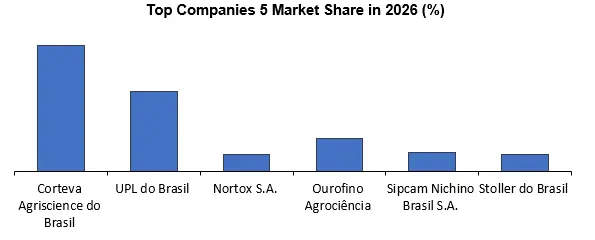
The South America Auxins Market competitive landscape includes several distinct groups: global crop-protection majors with trait-linked herbicide systems, generic and regional herbicide producers, plant growth regulator and horticultural specialists, and biostimulant and biological specialists.
Competition is shaped by registrations, trait linkage, distributor relationships and technical service. In August 2026, Corteva presented its Enlist system and biologicals at the Andav distributor congress, and in September 2026, Vylor outlined soybean plans for Latin America. Distributor partnerships and bolt-on biological acquisitions are likely to continue.
South America Auxins Market Recent Developments
|
Date |
Company |
Key Development |
Impact on South America Auxins Market |
|
Jan 2026 |
MAPA (Brazil) |
Reported 912 registrations granted in 2025, including a record 162 bioinputs that cover plant growth regulators. |
Confirms a growing registered base of natural-origin and growth-regulator products. |
|
Jun 2026 |
Conab (Brazil) |
Ninth grain (11 June 2026) 358.6 million tonnes for the 2025/26 harvest. |
Shows a record-level harvest supporting herbicide demand. |
|
Aug 2026 |
Corteva |
Presented the Enlist system, including Enlist Colex-D 2,4-D choline salt, and its biologicals brands at the Andav distributor congress (11–13 August 2026). |
Links 2,4-D choline demand to Enlist E3 soybean adoption and to distributor channels. |
|
Sep 2026 |
Corteva (Vylor) |
Outlined soybean technology plans for South America, including continued Conkesta E3 momentum through the end of the decade. |
Keeps trait-herbicide systems central to Brazilian soybean strategy. |
South America Auxins Competitive Landscape Analysis: Competitor Benchmarking, Rivalry Intensity and Market Strategies
- Competitor analysis and South America Auxins Market share: The report profiles key players, benchmarking company revenue, auxin-related revenue, growth rate, profit margin and R&D investment, and groups them by role rather than ranking them as identical producers.
- Competitive positioning and differentiation: Global majors differentiate on trait-linked herbicide systems and registrations; Brazilian generic producers on cost and local supply; plant growth regulator specialists on crop-specific know-how; and biological companies on natural-origin positioning.
- Rivalry intensity and competitive forces: Rivalry is shaped by generic competition in off-patent actives, regulatory tightening, resistance management, substitution by non-auxin modes of action and price sensitivity.
- Market player strategies and competitive maneuvers: Leading companies integrate trait and herbicide offers, expand distributor programs, add bioinputs and pursue bolt-on acquisitions.
South America Auxins Market Scope: Inquire before buying
|
South America Auxins Market |
|||
|
Report Coverage |
Details |
||
|
Base Year: |
2026 |
Forecast Period: |
2027–2034 |
|
Historical Data:
|
2021 to 2026
|
(Value) Market Size in 2026: |
USD 90.0 Million |
|
(Volume) Market Size in 2026: |
XX Metric Tons |
||
|
Forecast Period 2027 to 2034 CAGR (Value) |
6.4% |
Market Size in 2034: |
USD 148 Million |
|
Forecast Period 2027 to 2034 CAGR (Volume) |
XX% |
Market Size in 2034: |
XX Metric Tons |
|
South America Auxins Market Segments Covered: |
By Product Type |
Synthetic Auxin Herbicides Auxin-Type Plant Growth Regulators Rooting Hormones and Propagation Products Natural and Bio-Derived Auxin Formulations Other Auxin Formulations |
|
|
By Product Form |
Liquid and Emulsifiable Concentrates Water-Soluble and Dispersible Powders and Granules Rooting Powders, Gels and Pastes Tablets and Capsules Others |
||
|
By Crop Application |
Cereals and Grains Oilseeds and Pulses Fruits and Vegetables Commercial and Plantation Crops Turf and Ornamentals Others |
||
|
By End User |
Individual Farmers and Smallholders Commercial Farms and Agricultural Enterprises Plantation, Orchard and Nursery Operators Turf, Landscape and Ornamental Growers Government and Institutional Programs Others |
||
|
By Distribution Channel |
Agro-Input Distributors and Dealers Direct Sales and Key Accounts Retail, Garden and Horticulture Stores E-Commerce and Digital Platforms Others |
||
|
By Country |
Brazil Argentina Colombia Chile Peru Venezuela Rest of South America |
||
Key players/Competitors profiled in the South America Auxins Market report from a regional and global perspective:
South America
- Corteva Agriscience do Brasil (Brazil)
- UPL do Brasil (Brazil)
- Nortox S.A. (Brazil)
- Ourofino Agrociência (Brazil)
- Sipcam Nichino Brasil S.A. (Brazil)
- Stoller do Brasil (Brazil)
- Rizobacter Argentina S.A. (Argentina)
- Atanor S.A. (Argentina)
- Tecnomyl S.A. (Argentina)
- Biotrop (Brazil)
Global Participants with Regional Operations
- BASF S.A. (Brazil)
- Bayer S.A. (Brazil)
- Syngenta Proteção de Cultivos Ltda. (Brazil)
- FMC Química do Brasil Ltda. (Brazil)
- Nufarm Indústria Química e Farmacêutica S.A. (Brazil)
- ADAMA Brasil S.A. (Brazil)
- Albaugh LLC (Brazil and Argentina)
- Sumitomo Chemical do Brasil Representações Ltda. (Brazil)
- Koppert do Brasil Holding Ltda. (Brazil)
- Valent BioSciences LLC (Brazil)
Others
Frequently Asked Questions
Ans. Growth comes from record Brazilian soybean and grain harvests, trait-linked 2,4-D choline adoption, fruit, coffee and horticulture expansion, and the shift toward natural and bio-derived auxin formulations.
Ans. Brazil held the largest share in 2026, about 58% of value, driven by soybean, corn, cotton and sugarcane production.
Ans. Leading names include Corteva Agriscience do Brasil, UPL do Brasil, Nortox S.A., Ourofino Agrociência, Sipcam Nichino Brasil S.A., Stoller do Brasil, Rizobacter Argentina S.A., Atanor S.A., Tecnomyl S.A., Biotrop, BASF S.A., Bayer S.A., Syngenta Proteção de Cultivos Ltda., FMC Química do Brasil Ltda., Nufarm Indústria Química e Farmacêutica S.A., ADAMA Brasil S.A., Albaugh LLC, Sumitomo Chemical do Brasil Representações Ltda., Koppert do Brasil Holding Ltda. and Valent BioSciences LLC, along with regional formulators, plant growth regulator specialists and biological companies.
Ans. Synthetic auxin herbicides such as 2,4-D, dicamba and MCPA mimic the plant hormone auxin at high doses to control broadleaf weeds. Auxin-type plant growth regulators and rooting hormones, such as NAA and IBA, use low doses to improve rooting, fruit set and thinning. Natural and bio-derived auxin formulations draw on plant, seaweed or microbial sources of indole-3-acetic acid and related compounds and are positioned as lower-residue inputs.
Ans. Synthetic auxin herbicides lead with about 58% of 2026 value, supported by low unit cost, broadleaf weed-control efficacy and compatibility with auxin-tolerant crop systems, while natural and bio-derived auxin formulations grow fastest at 12.4% a year.
Ans. Peru is the fastest-growing country at a 9.4% CAGR in fruit, flower and horticulture production, followed by Colombia at XX% and Chile at 6.4%.
Ans. Oilseeds and pulses dominate with about 50% of the 2026 value and grow at XX%, while fruits and vegetables are the fastest-growing application at 10.0% a year.
1. South America Auxins Market: Executive Landscape and Industry Overview
1.1. South America Auxins Market Size (Value USD Million and Volume Metric Tons), 2026–2034
1.2. Evolution of Auxins in Crop Protection and Plant Growth Regulation
1.3. Market Definition, Scope, Boundaries and Product Classification
1.4. Role of Auxins in Weed Management, Propagation and Crop Quality
1.5. South America Auxins Market Industry Structure and Value Chain
1.6. Herbicide Resistance Management, Horticulture and Plant Growth Regulator Adoption
1.7. CAGR Analysis of South America Auxins Market During 2027–2034
2. South America Auxins Market Dynamics
2.1. South America Auxins Market Trends
2.2. South America Auxins Market Dynamics
2.2.1. Drivers
2.2.2. Restraints
2.2.3. Opportunities
2.2.4. Challenges
2.3. Porter's Five Forces Analysis
2.4. PESTLE Analysis
3. South America Auxins Market Macroeconomic Factors
3.1. Agricultural Production and Cultivated Land Area
3.2. Crop Protection and Agricultural Input Expenditure
3.3. Expansion of Horticulture, Nurseries and Protected Cultivation
3.4. Government Registration Decisions and Agricultural Support Programs
3.5. Food Security and Agricultural Productivity Requirements
3.6. Generic Active-Ingredient Prices and Agricultural Commodity Economics
3.7. International Pesticide Trade Policies and Residue Regulations
4. South America Auxins Industry Trends and Emerging Requirements
4.1. Increasing Adoption of Auxin-Tolerant Trait Systems
4.2. Growing Demand for Low-Volatility and Drift-Reduced Formulations
4.3. Expansion of Over-the-Top Auxin Herbicide Use
4.4. Increasing Demand for Rooting Hormones and Propagation Products
4.5. Development of Natural and Bio-Derived Auxin Formulations
4.6. Adoption of Precision Application and Digital Advisory
4.7. Growing Commercialization of Biostimulant-Auxin Combinations
5. South America Auxins Technology and Agronomic Ecosystem
5.1. Chemistry and Classes of Auxins (Phenoxy, Benzoic, Pyridine, Quinoline and Indole Auxins)
5.2. Mode of Action and Auxin Signaling in Plants
5.3. Selectivity, Crop Tolerance and Weed Spectrum
5.4. Interaction of Auxins with Soil, Weather and Spray Drift
5.5. Rooting, Fruit Set and Plant Growth Regulation Mechanisms
5.6. Formulation Stability, Salt Forms and Compatibility
5.7. Agronomic Performance and Crop Response Assessment
6. South America Auxins Raw Materials and Feedstock Landscape
6.1. Chlorophenol, Phenoxyacetic Acid and Pyridine Intermediates
6.2. Indole, Naphthalene and Other Aromatic Feedstocks
6.3. Plant, Seaweed and Microbial Sources of Natural Auxins
6.4. Solvents, Salts, Adjuvants and Safeners
6.5. Intermediate Supply and Regional Production Clusters
6.6. Raw Material Quality and Regulatory Impurity Limits
6.7. Procurement Economics and Supply Security
Part II: Product Landscape, Manufacturing and Technology Analysis
7. South America Synthetic Auxin Herbicide Market Landscape
7.1. Composition and Product Characteristics
7.2. 2,4-D and 2,4-D Choline Products
7.3. Dicamba and Low-Volatility Dicamba Products
7.4. MCPA, MCPB and Mecoprop-P Products
7.5. Fluroxypyr, Picloram, Aminopyralid and Arylpicolinate Auxins
7.6. Production Costs, Pricing and Commercial Viability
7.7. Demand and Growth Opportunities
8. South America Auxin-Type Plant Growth Regulator Market Landscape
8.1. Composition and Product Characteristics
8.2. NAA and Naphthaleneacetamide Products
8.3. Fruit Thinning, Fruit Set and Pre-Harvest Drop Control
8.4. Sprout Suppression and Flowering Control Uses
8.5. Application Rates and Agronomic Performance
8.6. Production Costs and Pricing
8.7. Demand and Growth Opportunities
9. South America Rooting Hormones and Propagation Products Market Landscape
9.1. Composition and Product Characteristics
9.2. IBA Based Rooting Products
9.3. IAA and NAA Based Rooting Products
9.4. Cuttings, Grafting and Tissue Culture Applications
9.5. Powder, Gel and Liquid Rooting Formats
9.6. Production Economics and Pricing
9.7. Demand and Adoption Trends
10. South America Natural and Bio-Derived Auxin Formulations Market Landscape
10.1. Composition and Classification
10.2. Seaweed-Derived Auxin Formulations
10.3. Microbial and Fermentation-Derived Indole-3-Acetic Acid
10.4. Plant-Extract Based Auxin Products
10.5. Standardization of Auxin Content
10.6. Production Economics and Pricing
10.7. Demand and Adoption Trends
11. South America Other Auxin Formulations and Emerging Products
11.1. Auxin Combinations with Safeners and Partner Herbicides
11.2. Biostimulant-Auxin Combination Products
11.3. Tissue Culture Media Auxins
11.4. Encapsulated and Controlled-Release Formulations
11.5. Product Stability, Storage and Shelf-Life Requirements
11.6. Specialty Product Pricing
11.7. Emerging Product Development and Opportunities
12. South America Auxins Product Forms and Delivery Technologies
12.1. Liquid and Emulsifiable Concentrates
12.2. Water-Soluble and Dispersible Powders and Granules
12.3. Rooting Powders, Gels and Pastes
12.4. Tablets, Capsules and Other Forms
12.5. Particle Size, Solubility and Application Compatibility
12.6. Product Handling, Storage and Transportation Requirements
12.7. Product Form Performance and Commercial Benchmarking
13. South America Auxins Manufacturing and Production Workflow
13.1. Intermediate Synthesis and Active Ingredient Production
13.2. Salt Formation, Purification and Technical Grade Control
13.3. Fermentation and Extraction of Natural Auxins
13.4. Formulation, Blending and Adjuvant Addition
13.5. Filling, Granulation and Tablet Production
13.6. Quality Inspection and Active Content Testing
13.7. Packaging, Storage and Production Optimization
14. South America Auxins Manufacturing Automation and Processing Technologies
14.1. Automated Synthesis and Reactor Control
14.2. Purification and Crystallization Technologies
14.3. Automated Formulation and Dosing Systems
14.4. Granulation and Tablet Equipment
14.5. Digital Production Monitoring and Process Optimization
14.6. Automated Packaging and Product Traceability Systems
14.7. Energy-Efficient Manufacturing and Waste Reduction Technologies
Part III: Crop Applications, Customer Requirements and Commercial Landscape
15. South America Auxin Applications in Cereals and Grains
15.1. Wheat and Barley Broadleaf Weed Control
15.2. Maize and Sorghum Weed Management
15.3. Rice and Millets Applications
15.4. Pasture and Grassland Applications
15.5. Application Rates and Crop Safety
15.6. Farm-Level Economics
15.7. Cereals and Grains Demand and Adoption Trends
16. South America Auxin Applications in Oilseeds and Pulses
16.1. Soybean Cultivation and Auxin-Tolerant Systems
16.2. Cotton and Rapeseed Applications
16.3. Sunflower and Other Oilseed Applications
16.4. Pulses and Legume Applications
16.5. Drift Management and Sensitive Crop Buffers
16.6. Application Economics and Crop Productivity
16.7. Oilseeds and Pulses Demand Opportunities
17. South America Auxin Applications in Fruits and Vegetables
17.1. Orchard Fruit Set, Thinning and Drop Control
17.2. Open-Field Vegetable Applications
17.3. Protected Cultivation and Greenhouse Applications
17.4. Nursery Propagation and Grafting
17.5. Crop Quality, Uniformity and Yield Improvement
17.6. Procurement and Application Economics
17.7. Fruits and Vegetables Demand and Adoption
18. South America Auxin Applications in Commercial and Plantation Crops
18.1. Sugarcane Weed Control and Ripening Uses
18.2. Coffee, Tea and Cocoa Plantations
18.3. Oil Palm, Rubber and Tree Crops
18.4. Spices, Medicinal and Aromatic Crops
18.5. Turf, Ornamentals and Landscape Applications
18.6. Commercial Crop Application Economics
18.7. Commercial and Specialty Crop Demand Opportunities
19. South America Auxins Buyers and Procurement Requirements
19.1. Individual Farmers and Smallholder Producers
19.2. Commercial Farms and Agricultural Enterprises
19.3. Plantation, Orchard and Nursery Operators
19.4. Turf, Landscape and Ornamental Growers
19.5. Government and Institutional Programs
19.6. Purchasing Criteria, Product Quality and Price Sensitivity
19.7. Seasonal Purchasing Patterns and Brand Loyalty
20. South America Auxins Customization and Product Development
20.1. Crop-Specific Formulation Development
20.2. Region and Climate-Based Product Customization
20.3. Active Ingredient Ratio and Salt Form Optimization
20.4. Safener, Adjuvant and Partner Active Selection
20.5. Concentration and Dose Optimization for Rooting Products
20.6. Compatibility with Tank-Mix and Fertigation Systems
20.7. Custom Formulation Costs and Commercialization Requirements
21. South America Auxins Testing, Validation and Quality Assurance
21.1. Raw Material Quality and Chemical Composition Testing
21.2. Active Ingredient Content and Impurity Analysis
21.3. Volatility and Drift Assessment
21.4. Physical Stability and Particle Size Testing
21.5. Residue, Toxicology and Environmental Safety Testing
21.6. Field Trials and Agronomic Performance Validation
21.7. Product Certification, Shelf-Life and Quality Compliance
22. South America Auxins Pricing, Business Models and Cost Economics
22.1. Pricing Analysis by Product Type
22.2. Pricing Analysis by Product Form
22.3. Intermediate and Technical Grade Costs
22.4. Labor, Energy, Processing and Manufacturing Overhead Costs
22.5. Packaging, Transportation and Distribution Costs
22.6. Branded versus Generic Pricing Models
22.7. Average Selling Price, Gross Margin and Profitability Analysis
22.8. Historical and Forecast Price Trends (2021–2034)
22.9. Auxin Products versus Alternative Modes of Action Cost Comparison
23. South America Auxins Sales, Distribution and Market Delivery Landscape
23.1. Direct Sales by Manufacturers
23.2. Agricultural Distributors and Agro-Input Dealers
23.3. Cooperatives and Government Distribution Networks
23.4. Retail, Garden and Horticulture Stores
23.5. E-Commerce and Digital Agricultural Input Platforms
23.6. Export Distribution and International Sales Networks
23.7. Distributor Margins, Trade Incentives and Channel Performance
24. South America Auxins Manufacturing Supply Chain and Operational Ecosystem
24.1. Intermediate Producers and Technical Grade Suppliers
24.2. Formulation and Toll Manufacturing Companies
24.3. Natural Auxin Extraction and Fermentation Companies
24.4. Manufacturing and Processing Clusters
24.5. Packaging, Warehousing and Agricultural Logistics Networks
24.6. Seasonal Demand and Supply Chain Disruptions
24.7. Manufacturing Capacity, Localization and Supply Chain Resilience
Part IV: Innovation, International Trade, Sustainability and Regulatory Landscape
25. South America Auxins Technology Innovation, R&D and Product Development
25.1. Novel Auxin Active Ingredients and Chemistries
25.2. Low-Volatility and Drift-Reduced Formulations
25.3. Safener and Adjuvant Technologies
25.4. Natural and Bio-Derived Auxin Research
25.5. Precision Application and Digital Advisory Integration
25.6. Improved Stability and Agronomic Performance
25.7. Technology Patents, R&D Investments and Research Collaborations
26. South America Auxins International Trade, Import-Export and Logistics
26.1. Intermediate and Technical Grade Trade Landscape for South America
26.2. Finished Herbicide Import and Export Analysis
26.3. Plant Growth Regulator and Rooting Product Trade
26.4. Major Exporting and Importing Countries
26.5. Tariffs, Customs Classification and Trade Restrictions
26.6. International Transportation, Packaging and Logistics Costs
26.7. Export Competitiveness and International Market Expansion Opportunities
27. South America Auxins Regulatory, Quality and Sustainability Landscape
27.1. South America Pesticide and Plant Growth Regulator Regulatory Framework
27.2. Argentina SENASA and Colombia ICA Registration Framework
27.3. Chile SAG and Peru SENASA Registration Framework
27.4. Brazil MAPA, Anvisa and Ibama Registration Framework
27.5. Residue Limits, Maximum Residue Levels and Export Compliance
27.6. Spray Drift, Environmental Impact and Stewardship Requirements
27.7. Circular Economy and Waste Reduction
27.8. Sustainable Sourcing, Biodiversity and Resource Conservation
27.9. International Product Registration and Certification Requirements
28. South America Auxins Country-Level Market Landscape
28.1. Brazil Soybean, Corn, Cotton, Sugarcane and Coffee Demand
28.2. Argentina Soybean, Corn and Wheat Demand
28.3. Colombia Flower, Coffee and Fruit Demand
28.4. Chile and Peru Fruit Export and Horticulture Demand
28.5. Venezuela and Rest of South America Demand
28.6. Country-Level Production, Consumption and Trade Analysis
28.7. Regional Manufacturing Investments and Adoption Trends
Part V: Market Size and Forecast by Segmentation
29. South America Auxins Market: Market Size and Forecast by Segmentation, Value (USD Million), Volume (Metric Tons), 2026–2034
29.1. By Product Type
29.1.1. Synthetic Auxin Herbicides
29.1.2. Auxin-Type Plant Growth Regulators
29.1.3. Rooting Hormones and Propagation Products
29.1.4. Natural and Bio-Derived Auxin Formulations
29.1.5. Other Auxin Formulations
29.2. By Product Form
29.2.1. Liquid and Emulsifiable Concentrates
29.2.2. Water-Soluble and Dispersible Powders and Granules
29.2.3. Rooting Powders, Gels and Pastes
29.2.4. Tablets and Capsules
29.2.5. Others
29.3. By Crop Application
29.3.1. Cereals and Grains
29.3.2. Oilseeds and Pulses
29.3.3. Fruits and Vegetables
29.3.4. Commercial and Plantation Crops
29.3.5. Turf and Ornamentals
29.3.6. Others
29.4. By End User
29.4.1. Individual Farmers and Smallholders
29.4.2. Commercial Farms and Agricultural Enterprises
29.4.3. Plantation, Orchard and Nursery Operators
29.4.4. Turf, Landscape and Ornamental Growers
29.4.5. Government and Institutional Programs
29.4.6. Others
29.5. By Distribution Channel
29.5.1. Agro-Input Distributors and Dealers
29.5.2. Direct Sales and Key Accounts
29.5.3. Retail, Garden and Horticulture Stores
29.5.4. E-Commerce and Digital Platforms
29.5.5. Others
29.6. By Country
29.6.1. Brazil
29.6.2. Argentina
29.6.3. Colombia
29.6.4. Chile
29.6.5. Peru
29.6.6. Venezuela
29.6.7. Rest of South America
Part VI: Competitive Landscape and Strategic Benchmarking
30. South America Auxins Market Competitive Landscape
30.1. SMR Competition Matrix
30.2. Competitive Positioning of Leading Key Players (Revenue and Market Share %)
30.3. Key Players Benchmarking
30.3.1. Company Name
30.3.2. Headquarters
30.3.3. Auxin Product Portfolio
30.3.4. Product Type and Formulation Coverage
30.3.5. Active Ingredient Portfolio and Formulation Technology
30.3.6. Manufacturing and Processing Technologies
30.3.7. Registrations, Certifications and Stewardship Programs
30.3.8. Raw Material and Intermediate Sourcing Capabilities
30.3.9. Total Company Revenue (2026)
30.3.10. Auxin-Related Revenue (2026)
30.3.11. Geographic Presence
30.3.12. Manufacturing Capacity and Production Capabilities
30.3.13. Distribution Network and Customer Portfolio
30.3.14. Product Pricing and Market Positioning
30.3.15. Strategic Partnerships and Technology Collaborations
30.4. Market Structure
30.4.1. Market Leaders
30.4.2. Market Followers
30.4.3. Emerging Players
30.4.4. Specialized Auxin Manufacturers
30.5. Growth Rate / Y-o-Y (%) of Companies
30.6. Profit Margin (%) of Companies
30.7. R&D and Technology Development Investments (%) of Companies
30.8. Revenue versus Net Earnings – Financial Health Benchmarking (2026)
30.9. Revenue Performance and Financial Analysis (2026)
30.10. Mergers and Acquisitions Details
30.11. Recent Key Developments
31. South America Auxins Market Manufacturers
31.1. Synthetic Auxin Herbicide Manufacturers
31.2. Auxin-Type Plant Growth Regulator Manufacturers
31.3. Rooting Hormone Manufacturers
31.4. Natural and Bio-Derived Auxin Manufacturers
31.5. Specialty Auxin Formulators
31.6. Product Portfolio and Production Capacity Benchmarking
31.7. Manufacturing Competitive Positioning
32. South America Auxin Technology and Formulation Providers
32.1. Active Ingredient Synthesis Technology Providers
32.2. Formulation and Adjuvant Technology Providers
32.3. Safener and Drift-Reduction Technology Providers
32.4. Fermentation and Extraction Technology Providers
32.5. Crop-Specific Formulation Developers
32.6. Technology Performance and Commercial Benchmarking
32.7. Emerging Auxin Technology Innovations
33. South America Auxin Raw Material and Agricultural Input Suppliers
33.1. Intermediate and Technical Grade Suppliers
33.2. Solvent, Salt and Adjuvant Suppliers
33.3. Seaweed and Plant Extract Suppliers
33.4. Fermentation Input Suppliers
33.5. Packaging Material Suppliers
33.6. Additive and Safener Suppliers
33.7. Supplier Quality, Production Capacity and Cost Benchmarking
34. South America Auxin Manufacturing Equipment and Automation Providers
34.1. Reactor and Synthesis Equipment Manufacturers
34.2. Purification and Drying Equipment Providers
34.3. Formulation and Granulation Equipment Providers
34.4. Filling, Tablet and Packaging Equipment Manufacturers
34.5. Automated Material Handling System Providers
34.6. Digital Production Monitoring and Quality Control Solutions
34.7. Manufacturing Equipment Performance and Technology Benchmarking
35. South America Auxin Dealers, Distributors and Sales Companies
35.1. Agricultural Input Dealers and Distributors
35.2. Horticulture and Nursery Supply Companies
35.3. Government and Cooperative Distribution Agencies
35.4. Rural Retail Networks
35.5. Online Agricultural Input Sales Platforms
35.6. International Importers and Exporters
35.7. Distribution Network Performance and Competitive Benchmarking
36. South America Auxin Agronomic and Technical Service Providers
36.1. Weed Management and Crop Advisory Consultants
36.2. Spray Application and Drift Management Service Providers
36.3. Propagation and Nursery Technical Service Providers
36.4. Residue Testing and Regulatory Laboratories
36.5. Agricultural Research Institutions and Field Trial Organizations
36.6. Grower Training and Product Demonstration Programs
36.7. Technical Service Performance and Customer Support Benchmarking
37. South America Auxin Manufacturers' Strategies and Expansion Plans
37.1. Expansion of Auxin Product Portfolios
37.2. Development of Low-Volatility and Stewardship-Ready Formulations
37.3. Backward Integration into Intermediate Supply
37.4. Expansion into Bio-Derived and Specialty Segments
37.5. Strategic Partnerships with Distributors and Cooperatives
37.6. Investment in Advanced Manufacturing and Formulation Technologies
37.7. Production Capacity Expansion and Supply Chain Development
37.8. Mergers, Acquisitions and Strategic Collaborations
38. South America Auxins Industry SWOT, Investments and Strategic Developments
38.1. Competitive Strengths of Established Auxin Manufacturers
38.2. Regulatory Risk, Production Costs and Stewardship Challenges
38.3. Opportunities in Horticulture and Bio-Derived Crop Inputs
38.4. Competitive Threats from Alternative Modes of Action
38.5. Strategic Investments in Formulation and Manufacturing
38.6. Government Registration Decisions and Agricultural Programs
38.7. Major Product Launches, Partnerships and Industry Developments
39. South America Auxins Competitive Outlook and Market Positioning
39.1. Competitive Dynamics Across Auxin Product Categories
39.2. Market Concentration Among Crop-Protection Manufacturers
39.3. Product Differentiation Through Efficacy, Stewardship and Pricing
39.4. Competitive Positioning of Established and Emerging Manufacturers
39.5. Regional Manufacturing Expansion and Localization
39.6. Future Developments in Low-Volatility and Bio-Derived Auxins
39.7. Long-Term Competitive Positioning of Leading Companies
40. Company Profile: Key South America Auxins Market Players
Detailed Profile Considering the Parameters:
1. Company Overview
2. Business Portfolio
3. Auxin Product Portfolio
4. Manufacturing and Technology Capabilities
5. Production Capacity and Raw Material Sourcing
6. Financial Overview
7. Geographic Presence and Distribution Network
8. SWOT Analysis
9. Strategic Analysis
10. Recent Developments
South America
Corteva Agriscience do Brasil (Brazil)
UPL do Brasil (Brazil)
Nortox S.A. (Brazil)
Ourofino Agrociência (Brazil)
Sipcam Nichino Brasil S.A. (Brazil)
Stoller do Brasil (Brazil)
Rizobacter Argentina S.A. (Argentina)
Atanor S.A. (Argentina)
Tecnomyl S.A. (Argentina)
Biotrop (Brazil)
Global Participants with Regional Operations
BASF S.A. (Brazil)
Bayer S.A. (Brazil)
Syngenta Proteção de Cultivos Ltda. (Brazil)
FMC Química do Brasil Ltda. (Brazil)
Nufarm Indústria Química e Farmacêutica S.A. (Brazil)
ADAMA Brasil S.A. (Brazil)
Albaugh LLC (Brazil and Argentina)
Sumitomo Chemical do Brasil Representações Ltda. (Brazil)
Koppert do Brasil Holding Ltda. (Brazil)
Valent BioSciences LLC (Brazil)
Others
Key Findings, Strategic Recommendations and Research Methodology
41. South America Auxins Market Key Findings
41.1. South America Auxins Market Size, Growth and Revenue Opportunities
41.2. Leading Product Types, Product Forms and Crop Applications
41.3. Regional or Country-Level Leadership and Growth Opportunities
41.4. Auxin Production, Sales and Consumption Trends
41.5. Competitive Positioning of Leading Manufacturers
41.6. Manufacturing, Pricing, Supply Chain and Distribution Insights
41.7. Strategic Implications for Manufacturers, Distributors and Investors
42. South America Auxins Market Strategic Moves and Industry Outlook
42.1. Strategic Opportunities in Weed Management and Horticulture
42.2. Expansion of Low-Volatility and Bio-Derived Auxin Products
42.3. Localization of Formulation and Manufacturing
42.4. Agricultural Distribution and Rural Retail Network Expansion
42.5. Emerging Market Entry and Geographic Expansion Opportunities
42.6. Strategic Partnerships, Acquisitions and Product Development
42.7. Long-Term South America Auxins Market Outlook, 2026–2034
43. Research Methodology
43.1. Research Objectives, Market Definition and Scope
43.2. Primary Research Methodology
43.2.1. Interviews with Auxin Manufacturers and Formulators
43.2.2. Interviews with Plant Growth Regulator and Biological Companies
43.2.3. Interviews with Agricultural Input Distributors and Dealers
43.2.4. Interviews with Growers, Nursery Operators and Agronomists
43.2.5. Procurement, Consumption and Application Assessment
43.3. Secondary Research Methodology
43.3.1. Company Annual Reports and Financial Statements
43.3.2. Government Agricultural and Pesticide Registration Statistics
43.3.3. FAO, USDA, Conab and Agricultural Industry Associations
43.3.4. International Pesticide Trade and Customs Databases
43.3.5. Scientific Publications and Agronomic Research Studies
43.4. Market Size Estimation Methodology
43.4.1. Bottom-Up Market Estimation
43.4.2. Top-Down Market Estimation
43.4.3. Active Ingredient Production and Conversion Ratio Analysis
43.4.4. Volume and Sales Analysis
43.4.5. Average Selling Price Analysis
43.4.6. Revenue-Based Market Size Validation
43.5. Market Forecasting Methodology
43.6. Data Triangulation and Validation
43.7. Assumptions, Limitations and Research Quality Control