ENG
 Japanese
 French
 German
 Korean

Middle East & Africa Boil-Off Gas (BOG) Compressor Market & Forecast 2026–2034
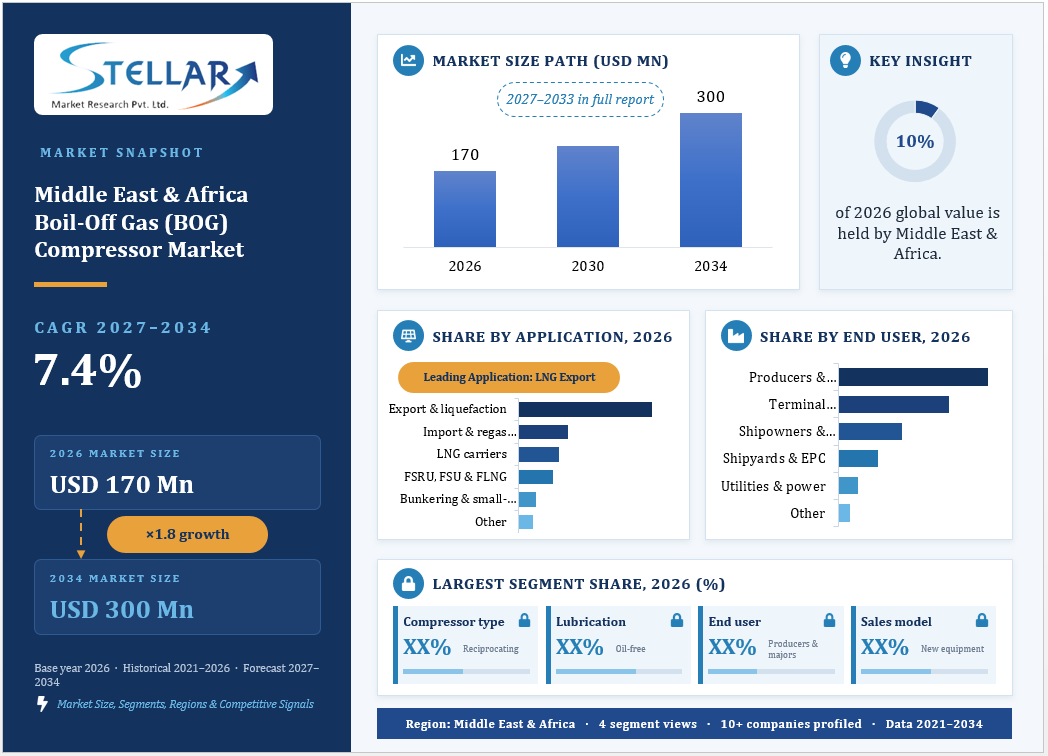
The Middle East & Africa Boil-Off Gas (BOG) Compressor Market is valued at USD 170 million in 2026 and is projected to reach USD 300 million by 2034, growing at a CAGR of 7.4% during 2027–2034.
The Middle East & Africa Boil-Off Gas (BOG) Compressor Market is valued at USD 170 million in 2026 and is projected to reach USD 300 million by 2034, growing at a CAGR of 7.4% during 2027–2034, according to Stellar Market Research (SMR). In volume terms, SMR estimates that the installed base handles 1.4 million metric tons of LNG boil-off gas in 2026, rising to 2.2 million metric tons by 2034. Boil-Off Gas (BOG) compressors in the Middle East & Africa handle the vapor generated in LNG storage tanks, ship-loading systems and liquefaction trains at export terminals, in FSRUs and regasification terminals, and on LNG carriers. The region is home to Qatar, the world's largest LNG exporter by capacity, and to new African supply, and this report tracks BOG compressors supplied to terminal operators, producers, EPC contractors and shipowners. This Boil-Off Gas (BOG) Compressor Market overview and Boil-Off Gas (BOG) Compressor Market synopsis summarizes the MEA BOG Compressor Market size, BOG Compressor revenue generated, BOG Compressor growth prospects and Boil-Off Gas (BOG) Compressor Market outlook, based on SMR's Boil-Off Gas (BOG) Compressor Market research findings.
This Boil-Off Gas (BOG) Compressor Market analysis answers both sides of the search: what the MEA Boil-Off Gas (BOG) Compressor Market size and Boil-Off Gas (BOG) Compressor Market forecast mean for compressor manufacturers, packagers, shipyards, terminal operators and investors, and what national oil companies, LNG producers, terminal operators, EPC contractors and shipowners want to know, from how a reciprocating compressor differs from a centrifugal one to pressure ratings, qualification, delivery slots and cost of ownership. The MEA Boil-Off Gas (BOG) Compressor Market insights also cover BOG compressor demand, the LNG compression systems market and market growth by segment, along with consumer behavior (how terminal operators, shipowners and EPC contractors buy and service compressors), industry trends and BOG compressor market trends.
LNG export and liquefaction terminals are the largest application at about 46% of 2026 value, and the region is the fastest growing at 7.4% CAGR, but 2026 conflict damage in Qatar and the Strait of Hormuz disruption add schedule risk to the expansion that drives compression demand. The industry landscape is shaped by growth drivers, market dynamics, challenges and opportunities that influence the Boil-Off Gas (BOG) Compressor Market industry outlook. LNG BOG compressor market buyers, LNG compression systems suppliers, reciprocating BOG compressors and centrifugal BOG compressors are the main product pools within the market.
Stellar Market Research provides comprehensive analysis of the MEA Boil-Off Gas (BOG) Compressor Market size, share, compressor type, lubrication type, stage configuration, discharge pressure, application, end user, sales and service model and regional segmentation, the BOG compressor competitive landscape, strategic scenarios and growth opportunities. The report helps BOG compressor manufacturers, packagers, shipyards, terminal operators, shipowners and investors decide which segments, projects and countries to prioritize through 2034. Market segmentation, key players and market strategies, including technology choices, support market entry decisions.
|
2026 | BASE YEAR |
2034 | FORECAST |
GROWTH RATE |
LEADING APPLICATION |
|
USD 170 Mn |
USD 300 Mn |
7.4% |
Export & liquefaction terminals |
Middle East & Africa Boil-Off Gas (BOG) Compressor Market Overview: Boil-Off Gas (BOG) Compressor Market Size, Share, Trends and Outlook to 2034
The market is measured at product-and-service level across reciprocating, centrifugal and screw BOG compressors supplied in the Middle East & Africa to LNG export and import terminals, FSRU, FSU and FLNG units, LNG carriers operated by regional owners and small-scale LNG facilities. Revenue covers new equipment sales, spare parts and aftermarket, maintenance, repair and overhaul (MRO) services and retrofit and upgrades. General-purpose industrial compressors with no BOG service are excluded. This market summary also reflects the economic factors, macroeconomic factors, technological advancements and regulatory influences that determine BOG compressor consumption across emerging markets.
Volume: SMR estimates the MEA market at 1.4 million metric tons in 2026 and 2.2 million metric tons by 2034, a 5.8% CAGR over 2027–2034, measured as LNG boil-off gas handled by installed BOG compressors (metric tons per year). This is about 12.5% of the 11.2 million metric tons global estimate for 2026. No source publishes a market-level volume, so this is an SMR estimate with a range of about plus or minus 25%, built with the same carrier and terminal boil-off method as the global estimate (about 0.10% of laden cargo per day on carriers and 0.25% of throughput at terminals), with carrier boil-off split equally between the loading and discharging regions.
Three shifts shape the market through 2034: demand is broadening from Qatar's export trains into UAE, African and floating projects; value is moving toward repair, spares and replacement of equipment affected by 2026 conflict damage; and growth is rotating toward new importers adding FSRUs. Suppliers are answering logistics disruption with pre-positioned spares and local service. These market shifts and emerging trends highlight industry evolution, growth catalysts and competitive forces across the industry. Market overview, industry landscape, market analysis, market insights, industry trends, market dynamics, market size, key players, competitive landscape, market segmentation, growth prospects, market opportunities, market challenges, LNG industry outlook, market entry, emerging markets, market outlook, market research findings, market summary, revenue generated, growth drivers, market synopsis and market strategies are all covered in this report.
To get more Insights: Request Free Sample Report
Key Findings: Eight Insights Shaping the Middle East & Africa Boil-Off Gas (BOG) Compressor Market
SMR's analysis of published market data, project announcements, manufacturer statements, regulatory filings and industry reports points to eight findings that explain where Boil-Off Gas (BOG) Compressor Market growth and value are created through 2034. This market trends analysis also identifies growth catalysts, the market gap and the competitive landscape shifts affecting key players.
|
Sr.No. |
Findings |
Evidence |
So what |
|
1 |
The market grows about 1.8× by 2034 |
USD 170 Mn (2026) to USD 300 Mn (2034) at 7.4% CAGR over 2027–2034 |
Suppliers must scale capacity, service coverage and cryogenic testing with demand |
|
2 |
LNG terminals are the anchor buyer |
LNG terminal operators 28% of 2026 value; shipowners and vessel operators 16% |
Terminal capacity and ship deliveries set the pace of orders |
|
3 |
The region is the fastest growing |
7.4% CAGR over 2027–2034 from about 10% of 2026 value; NFE Train 1 due 1H 2027 |
Qatar's schedule and repair needs set regional demand |
|
4 |
Reciprocating and centrifugal machines dominate |
Reciprocating 47% and centrifugal 47% of 2026 value |
Platform choice follows pressure, flow and duty cycle |
|
5 |
Oil-free machines are the larger lubrication class |
Oil-free 63% of 2026 value against 37% oil-lubricated |
Dry-running references win marine and terminal tenders |
|
6 |
Aftermarket adds recurring value |
Spare parts and aftermarket 24% and MRO 13% of 2026 value |
Installed base converts into recurring spares and service revenue |
|
7 |
Retrofit and upgrades grow fastest by service model |
Retrofit and upgrades 8.0% CAGR over 2027–2034 against 7.4% for the market |
Efficiency and methane-slip upgrades are a lever for suppliers |
|
8 |
Geopolitics and delivery timing set the pace |
Hormuz disruption and damage at Ras Laffan in 2026; 107 carriers due for delivery in 2026 (IGU) |
Schedule risk and slot availability decide who delivers before 2030 |
Middle East & Africa Boil-Off Gas (BOG) Compressor Market Dynamics: Growth Drivers, Restraints, Opportunities and Trends
Middle East & Africa Boil-Off Gas (BOG) Compressor Market Growth Drivers: Terminal Build-Out, LNG Supply, Fleet Growth and Technology
The Middle East & Africa Boil-Off Gas (BOG) Compressor Market is supported by the largest liquefaction expansion in the world. QatarEnergy's North Field programme, covering North Field East, North Field South and North Field West, is planned to lift Qatari capacity to 142 million tonnes per year by 2030 from 77 million tonnes per year. QatarEnergy's chief executive said in September 2026 that the first NFE train would start in the first half of 2027 and North Field South in 2028, and Baker Hughes secured a major North Field West contract in the first quarter of 2026. ADNOC Gas has also announced an expansion programme, and Greater Tortue Ahmeyim, the offshore project on the Senegal and Mauritania border, is ramping. Each train and storage tank needs BOG compression. These market drivers and market growth factors reflect market dynamics, industry fluctuations, economic factors, LNG demand and supply, demand and supply dynamics, competitive forces, market drivers, market challenges, technological advancements, regulatory influences and emerging trends.
Repairs and replacement create a second layer of demand. Iranian missile strikes on Ras Laffan in March 2026 damaged LNG trains 4 and 6, sidelining about 12.8 million tonnes per year, or about 17% of Qatar's capacity, for an estimated three to five years, and the repair programme will need compression and spares. Qatar's fleet of LNG carriers, regional owners' vessels and new FSRU deployments add marine demand. Technological advancements in dry-running and high-pressure machines and the energy efficiency goals of national oil companies accelerate compressor technology innovation. These economic factors, demand and supply dynamics, technology trends and innovation impact reflect market opportunities, compressor technology innovation, macroeconomic factors, market growth factors, market constraints, industry disruptors, market shifts, environmental factors, energy efficiency, market trends analysis and LNG infrastructure development.
Middle East & Africa Boil-Off Gas (BOG) Compressor Market Restraints: Cost, Lead Times, Regulation and Market Volatility
Geopolitical disruption is the main restraint. The conflict that began on 28 February 2026 and the near-closure of the Strait of Hormuz suspended work on the North Field expansion at times, and QatarEnergy's chief executive said critical equipment could not reach Qatar and that additional trains beyond NFE Train 1 depend on traffic resuming. QatarEnergy extended force majeure on deliveries into early December 2026. Market volatility, project delays and logistics risk delay compressor deliveries and acceptance. These market constraints and market challenges reflect market forces, economic indicators, industry evolution, competitive landscape shifts, LNG trade developments, regulatory changes, innovation impact, technology trends, market responsiveness, external market influences and market adaptability.
Concentration and import dependence add friction. Demand is concentrated in a few national oil company programmes with long procurement cycles, and almost all BOG compressors are imported, so suppliers face logistics, sanctions and currency exposure. Local content rules and the limited number of qualified service shops raise costs, and external market influences such as insurance and freight costs weigh on projects. These regulatory influences, environmental factors and external market influences reflect strategic market changes, market segmentation shifts, LNG infrastructure investments, industry resilience, market fluctuation analysis, growth catalysts, market volatility and market gap.
What Are the Biggest MEA Boil-Off Gas (BOG) Compressor Market Opportunities Through 2034?
Export expansion, FSRUs and aftermarket represent the most significant opportunities. LNG import and regasification terminals are projected to grow at 8.9% CAGR and FSRU, FSU and FLNG units at 9.1% as new importers use floating terminals, while retrofit and upgrades grow at 8.0%. The NFE first train that QatarEnergy expects ready to start in November 2026 and in production in 2027, and the three to five-year repair of Ras Laffan trains, create orders for spares and service that are not discretionary.
New supply and local service offer further routes. Africa adds export supply through projects such as Greater Tortue Ahmeyim, and Gulf states are building import and bunkering capacity. Suppliers with local service centers, dry-running high-reliability machines and rapid-response spares can win repeat business, and unexplored market niches in remote monitoring and in compression for LNG bunkering at Gulf and African ports add recurring revenue.
MEA Boil-Off Gas (BOG) Compressor Market Trends: Capacity Build-Out, Technology, Floating Units and Aftermarket
Four market trends stand out through 2034. First, North Field expansion: NFE, NFS and NFW trains add compression capacity. Second, repair and recovery: replacement of damaged Ras Laffan equipment adds spares and service demand. Third, floating terminals: FSRUs add compression at new import sites. Fourth, localization: national oil companies favor suppliers with local service and training. These trends reflect industry evolution, technology trends and strategic market changes.
Middle East & Africa Boil-Off Gas (BOG) Compressor Market Segmentation:
By Compressor Type, Lubrication Type, Stage Configuration, Discharge Pressure, Application, End User and Sales and Service Model
MEA Boil-Off Gas (BOG) Compressor Market by End User and Sales and Service Model: LNG Terminal Operators, Shipowners, Producers and Aftermarket
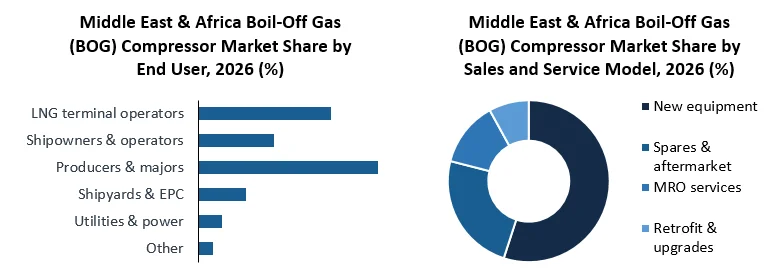
By end user, LNG terminal operators hold about 28% of 2026 value, shipowners and vessel operators 16%, LNG producers and oil and gas majors 38%, shipyards and EPC contractors 10%, utilities and power generators 5% and other end users 3%. By sales and service model, new equipment sales account for about 55%, spare parts and aftermarket 24%, maintenance, repair and overhaul (MRO) services 13% and retrofit and upgrades 8%; retrofit and upgrades are the fastest at 8.0% CAGR over 2027–2034. This market segment analysis and industry segmentation supports target market analysis, end-user analysis and customer profiling, including market segment analysis, industry segmentation, target market analysis, end-user analysis, product segmentation, geographic segmentation, market subsegments, niche markets, customer profiling, market share by segment and segment growth analysis. Geographic segmentation by country and project pipeline further refines the picture.
Compressor Type, Lubrication, Stage, Pressure and Capacity Analysis of the MEA Boil-Off Gas (BOG) Compressor Market
By compressor type, reciprocating BOG compressors hold about 47% of 2026 value, centrifugal BOG compressors 47%, screw compressors 4% and other types 2%. By lubrication, oil-free (dry-running) designs hold 63% against 37% for oil-lubricated machines. By stage configuration, multi-stage units (three or more stages) hold 47%, two-stage 30% and single-stage 23%. By discharge pressure, low-pressure units up to 10 bar hold 40%, medium-pressure units above 10 to 50 bar 24% and high-pressure units above 50 bar, including the 150 bar class used on high-pressure marine engines, 36%. This product segmentation and compressor type segmentation, covering technology-based segmentation, compressor capacity segmentation and specialized compressor segments, highlights competitive segment landscape, emerging market segments, segment attractiveness, application-based segmentation, LNG terminal applications, compressor type segmentation, technology-based segmentation, market niche exploration, segmentation strategies, market segment dynamics and end-use industry segmentation.
Middle East & Africa Boil-Off Gas (BOG) Compressor Market Applications: LNG Terminals, LNG Carriers, FSRU and FLNG Units and Small-Scale LNG
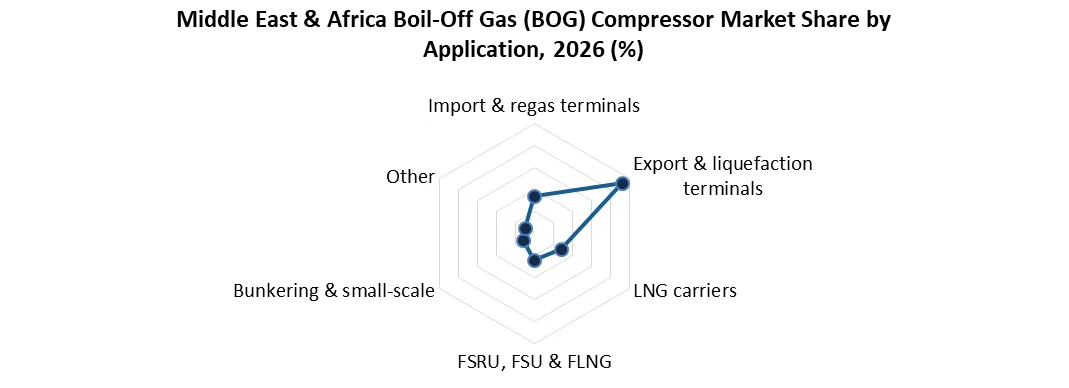
In 2026, LNG export and liquefaction terminals dominate the Middle East & Africa (MEA) BOG compressor market, accounting for approximately 46% of the total market value. LNG import and regasification terminals represent 17%, followed by LNG carriers at 14%, FSRU, FSU and FLNG units at 12%, LNG bunkering and small-scale LNG at 6%, and other applications at 5%. Looking ahead, FSRU, FSU and FLNG units are projected to be the fastest-growing application segment, registering a CAGR of 9.1% during 2027–2034, closely followed by LNG import and regasification terminals at 8.9%. These trends reflect the evolving requirements of the region's LNG infrastructure and the growing need for efficient boil-off gas management across different applications. Opportunities for compressor manufacturers lie in developing application-specific solutions, addressing varying compressor capacity requirements, and targeting emerging LNG infrastructure projects and underserved market segments across the region.
Middle East & Africa Boil-Off Gas (BOG) Compressor Market Regional Analysis
The Middle East represents the largest sub-region within the Middle East & Africa (MEA) BOG compressor market, with Qatar, the United Arab Emirates, Oman, Kuwait and Saudi Arabia accounting for the majority of regional market value. In 2026, the MEA region is estimated to represent approximately 10% of the global market, valued at USD 170 million, and is projected to register the fastest regional growth, with a CAGR of 7.4% during 2027–2034. Qatar remains a major LNG hub, with Ras Laffan hosting 14 liquefaction trains. However, trains 4 and 6 were damaged in March 2026, highlighting potential infrastructure and operational challenges. Additionally, the planned North Field East expansion, which includes four mega-trains, is expected to strengthen Qatar's LNG production capacity. Overall, regional market growth will be influenced by LNG infrastructure expansion, liquefaction capacity additions, investment in gas processing facilities, regional energy demand and LNG trade developments. These factors create opportunities for compressor manufacturers while shaping country-specific market dynamics, competitive positioning and long-term growth prospects across the Middle East and Africa.
Africa adds export supply from Nigeria, Algeria and Greater Tortue Ahmeyim and new import terminals in North and West Africa, though these are smaller markets. Regional values sum with other regions to the global total, and geopolitical influences, including the Iran conflict and sanctions, shape local demand. Regional insights also include territorial dynamics, locational market nuances, area-centric market shifts, geographic market analysis, regional LNG demand, local economic factors, regional market performance, territorial competitive landscape, LNG import and export trends, localized market challenges, regionally driven opportunities, locational market share, geostrategic influences, regional market entry strategies, area-centric growth factors, regional industry outlook, market trends in designated areas and geopolitical influences.
MEA Boil-Off Gas (BOG) Compressor Market Companies and Competitive Landscape: Who Are the Top BOG Compressor Manufacturers?
The regional competitive landscape is dominated by established global turbomachinery and compressor manufacturers that supply equipment through EPC contractors and national oil companies. Key players include Baker Hughes, Siemens Energy, Everllence, Ebara Elliott Energy and Atlas Copco, which provide centrifugal and integrally geared compressors for LNG liquefaction and terminal applications. Burckhardt Compression also serves the market with its reciprocating compressor solutions. The limited presence of regional compressor manufacturers makes the MEA market largely dependent on international suppliers. However, these companies differ in their product portfolios, technological capabilities and application expertise and should not be considered identical equipment producers. The competitive assessment examines key players' business profiles, revenue performance, market positioning, product offerings, technological capabilities and regional presence. It also evaluates competitive strategies, industry rivalry, market share dynamics and competitive advantages to understand the positioning and influence of major suppliers in the regional BOG compressor market.
Selection is shaped by national oil company approvals, EPC relationships, prior Qatar and UAE references and the ability to serve sites with limited access. Baker Hughes' North Field West award in the first quarter of 2026 shows large packages going to global turbomachinery groups. Competitive landscape trends favor suppliers with regional service bases and spares. Market rivalry assessment, market rivalry intensity and rivalry impact analysis suggest that competitive benchmark analysis, rival market share, competitive market evolution, competitor differentiation, market rival scrutiny, industry player assessment, competitive ecosystem analysis, rivalry landscape analysis, competitive matrix analysis, company portfolio analysis, industry competition dynamics, competitive positioning analysis, market competition assessment, rivalry intensity analysis, industry competitive strategies, market player developments and strategic analysis will shape who wins share.
Middle East & Africa Boil-Off Gas (BOG) Compressor Market Recent Developments and Industry News | 2026
|
Date |
Development |
Why it matters |
|
Feb 2026 |
The US-Iran conflict begins and QatarEnergy suspends North Field expansion work and LNG production at Ras Laffan and Mesaieed |
Sets a major schedule risk for Middle East compression demand |
|
Mar 2026 |
Strikes on Ras Laffan damage LNG trains 4 and 6, removing about 12.8 million tonnes per year (17%) for three to five years |
Creates repair, spares and replacement demand |
|
Apr 2026 |
Baker Hughes award reported as QatarEnergy pushes ahead with North Field West |
Shows expansion continuing despite disruption |
|
Sep 2026 |
QatarEnergy says NFE Train 1 (8 million tonnes per year) will start in the first half of 2027 and North Field South in 2028; further trains depend on Hormuz traffic |
Resets the timing of expansion compression demand |
|
Oct 2026 |
Sources say the first NFE train will be ready to start in November, with LNG production expected in the first quarter of 2027 |
Marks the first step toward replacing lost Qatari capacity |
|
Oct 2026 |
ADNOC Gas unveils an expansion programme of USD 8.2 billion |
Adds gas-handling investment in the UAE |
Middle East & Africa Boil-Off Gas (BOG) Compressor Market Scope: Inquire before buying
|
Middle East & Africa Boil-Off Gas (BOG) Compressor Market |
|||
|
Report Coverage |
Details |
||
|
Base Year: |
2026 |
Forecast Period: |
2027–2034 |
|
Historical Data: |
2021–2026 |
Market Size in 2026: |
USD 170 million |
|
Forecast Period 2027 to 2034 CAGR: |
7.4% |
Market Size in 2034: |
USD 300 million |
|
Segments Covered: |
By Compressor Type |
Reciprocating BOG Compressors; Centrifugal BOG Compressors; Screw BOG Compressors; Other Compressor Types |
|
|
By Lubrication Type |
Oil-Free (Dry-Running) BOG Compressors; Oil-Lubricated BOG Compressors |
||
|
By Stage Configuration |
Single-Stage; Two-Stage; Multi-Stage (Three or More Stages) |
||
|
By Discharge Pressure |
Low Pressure (Up to 10 bar); Medium Pressure (Above 10 to 50 bar); High Pressure (Above 50 bar) |
||
|
By Application |
LNG Import and Regasification Terminals; LNG Export and Liquefaction Terminals; LNG Carriers; FSRU, FSU and FLNG Units; LNG Bunkering and Small-Scale LNG; Other Applications |
||
|
By End User |
LNG Terminal Operators; Shipowners and Vessel Operators; LNG Producers and Oil and Gas Majors; Shipyards and EPC Contractors; Utilities and Power Generators; Other End Users |
||
|
By Sales and Service Model |
New Equipment Sales; Spare Parts and Aftermarket; Maintenance, Repair and Overhaul (MRO) Services; Retrofit and Upgrades |
||
Middle East & Africa Boil-Off Gas (BOG) Compressor Market, By Region
Middle East (Qatar, United Arab Emirates, Saudi Arabia, Oman, Kuwait, Rest of Middle East)
Africa (Nigeria, Algeria, Egypt, Senegal and Mauritania, South Africa, Rest of Africa)
Middle East & Africa Boil-Off Gas (BOG) Compressor Market, 20+ Key Players
Middle East
- Atlas Copco Gas and Process (Dubai aftermarket centre)
- Burckhardt Compression (Abu Dhabi entity)
- Ebara Elliott Energy (Middle East projects)
- Siemens Energy (Middle East)
- Baker Hughes (Middle East)
- Everllence (Middle East)
- AERZEN (Middle East, Türkiye and Africa)
- Wärtsilä (Middle East marine service)
- WoodServ (Bahrain)
- MEISCO Energy & Industrial Services Company LLC
- Technip Energies (Qatar projects)
- Consolidated Contractors Company
- Chiyoda Corporation (Qatar projects)
- Saipem S.p.A. (Middle East)
- National Petroleum Construction Company (NPCC)
- QatarEnergy
- Nakilat (Qatar Gas Transport Company)
- ADNOC Gas
- Saudi Aramco
- Oman LNG
- Kuwait National Petroleum Company
Others
Africa
- Fancraft (Pty) Ltd
- Nigeria LNG Limited
- Sonatrach
- Transnet National Ports Authority (Ukwanda LNG, Port of Ngqura)
Frequently Asked Questions
The Middle East & Africa holds about 10% of global value in 2026 (USD 170 million) and is projected to grow at a 7.4% CAGR over 2027–2034, the fastest of the five regions, anchored by Qatar's North Field expansion.
Reciprocating machines are the largest type at about 47% of 2026 value and LNG export and liquefaction terminals the largest application at about 46%, but LNG import and regasification terminals (8.9% CAGR), retrofit and upgrades (8.0%) and FSRU, FSU and FLNG units (9.1%) are growing faster than the 7.4% market average over 2027–2034.
SMR estimates 1.4 million metric tons in 2026 and 2.2 million metric tons by 2034, a 5.8% CAGR over 2027–2034, measured as LNG boil-off gas handled by installed BOG compressors. No source publishes a market-level volume, so this is an SMR estimate with a range of about plus or minus 25%.
Leading names include Atlas Copco, Burckhardt Compression, Ebara Elliott Energy, Siemens Energy, Baker Hughes, Everllence, Technip Energies, QatarEnergy, ADNOC Gas and Sonatrach, among the 20+ key players profiled in this report. Competitive positioning depends on cryogenic references, pressure rating, delivery slots, shipyard and EPC relationships, and service coverage.
Reciprocating compressors use pistons and cylinders to reach high pressures at modest flows and are widely used on LNG carriers and for terminal vapor return, including 150 bar duties on high-pressure marine engines. Centrifugal compressors use impellers and suit high flows at lower pressure ratios, as at large export and import terminals, and need less maintenance but a narrower operating range.
1. Executive Market Landscape and Industry Overview
1.1. Boil-Off Gas (BOG) Compressor Market Size (Value USD Million), 2026–2034
1.2. Evolution of LNG Boil-Off Gas Handling and Compression
1.3. Definition, Scope and Classification of BOG Compressors
1.4. BOG Compressor Design, Cryogenic Duty and Operating Principles
1.5. Role of BOG Compressors in LNG Storage, Transport and Regasification
1.6. Demand for BOG Compressors Across Terminals, Carriers and Floating Units
1.7. CAGR Analysis of the BOG Compressor Market During 2027–2034
2. BOG Compressor Market Dynamics
2.1. BOG Compressor Market Trends
2.2. BOG Compressor Market Dynamics
2.3. Drivers
2.4. Restraints
2.5. Opportunities
2.6. Challenges
2.7. PORTER's Five Forces Analysis
2.8. PESTLE Analysis
3. BOG Compressor Market Macroeconomic Factors
3.1. LNG Production, Trade and Liquefaction Capacity Trends Shaping Demand
3.2. LNG Import and Regasification Capacity Trends Across Importing Markets
3.3. LNG Carrier Fleet, Orderbook and Delivery Trends Driving Orders
3.4. Gas Prices, Energy Security and Geopolitical Developments Affecting Investment
3.5. Capital Expenditure on LNG Infrastructure and Compressor Procurement Effects
3.6. Trade Policy, Tariffs and Import Duties Affecting Equipment Supply
3.7. Currency Movements and Cryogenic Supply Chain Developments Influencing Equipment Costs
4. BOG Compressor Industry Trends and Emerging Technology Requirements
4.1. Growth of LNG Export and Import Infrastructure Creating Compression Demand
4.2. Adoption of High-Pressure Marine BOG Compressors for Dual-Fuel Engines
4.3. Shift to Oil-Free Dry-Running Compression to Avoid Contamination
4.4. Floating Regasification and Storage Deployment Expanding Installation Opportunities
4.5. Methane-Slip Reduction and Emission Compliance Shaping Equipment Selection
4.6. Digital Monitoring and Predictive Maintenance Improving Compressor Uptime
4.7. Ammonia, Hydrogen and Small-Scale LNG Compression as Emerging Applications
5. BOG Compressor Technology Architecture and Ecosystem Landscape
5.1. Cryogenic Gas Handling Fundamentals Behind Boil-Off Gas Compression Duties
5.2. Cylinders, Impellers and Rotating Assemblies Used in Cryogenic Service
5.3. Seals, Valves and Cryogenic Materials Supporting Low-Temperature Operation
5.4. Drives, Motors and Variable-Speed Systems Powering Boil-Off Compressors
5.5. Control, Anti-Surge and Safety Systems Protecting Cryogenic Compressor Operations
5.6. Reliquefaction and Vapor Recovery Integration With Compression Systems
5.7. Skid Integration and Packaging of Complete Compression Systems
6. BOG Compressor Types, Configurations and Design Landscape
6.1. Reciprocating BOG Compressors for High-Pressure, Low-Flow Cryogenic Duties
6.2. Centrifugal BOG Compressors for High-Flow Terminal Applications
6.3. Screw BOG Compressors Offering Oil-Free Operation for Marine Fuel Gas
6.4. Oil-Free and Oil-Lubricated Designs for Cryogenic Service Suitability
6.5. Single-Stage and Multi-Stage Configurations for Different Compression Ratios
6.6. Low-, Medium- and High-Pressure Designs Matched to End-Use Requirements
6.7. Specialized Compressor Configurations for Bunkering, Small-Scale and Floating Applications
7. BOG Compressor Performance, Capacity and Efficiency Characteristics
7.1. Flow Capacity and Suction Conditions Defining Compressor Sizing and Selection
7.2. Discharge Pressure and Compression Ratio Requirements Across Terminals and Vessels
7.3. Power Consumption and Energy Efficiency Influencing Operating Costs
7.4. Cryogenic Reliability and Availability Expected From Critical LNG Equipment
7.5. Noise, Vibration and Footprint Constraints in Marine and Onshore Installations
7.6. Maintenance Intervals and Lifecycle Costs Affecting Ownership Economics
7.7. Performance Testing and Acceptance Criteria Applied Before Delivery
8. BOG Compressor Manufacturing Processes and Production Technologies
8.1. Design, Engineering and Prototype Development of Cryogenic Compressor Platforms
8.2. Machining and Casting of Cryogenic Components Requiring Specialized Alloys
8.3. Assembly, Balancing and Packaging Steps Before Shipment to Customers
8.4. Factory Acceptance and Cryogenic Testing Verifying Performance Under Duty
8.5. Quality Assurance and Certification Procedures Required by Classification Societies
8.6. Manufacturing Capacity and Lead Times Affecting Delivery Slots
8.7. Production Localization Strategies Supporting Regional Content and Supply Security
9. BOG Compressor Components, Systems and Equipment Ecosystem
9.1. Cylinders, Pistons and Piston Rings Determining Reciprocating Compressor Performance
9.2. Impellers, Diaphragms and Gearboxes Used in Centrifugal and Screw Machines
9.3. Valves, Seals and Bearings as High-Wear Components Driving Aftermarket
9.4. Coolers, Separators and Piping Supporting Complete Compressor Packages
9.5. Drives and Motors Selected for Power, Speed and Hazardous Areas
9.6. Instrumentation and Control Systems Enabling Monitoring, Protection and Automation
9.7. Compressor Skids and Packages Integrating Equipment for Delivery and Installation
10. BOG Compressor Maintenance, Repair, Overhaul and Upgrades
10.1. Aftermarket and Spare Parts Demand Generated by Installed Compressors
10.2. Routine Maintenance and Inspection Programs Keeping Compressors Operating Reliably
10.3. Overhaul and Rebuild Services Extending Compressor Life During Dry-Dock
10.4. Condition Monitoring and Remote Services Reducing Unplanned Downtime and Costs
10.5. Retrofit for Efficiency and Methane Reduction on Ageing Compressors
10.6. Service Agreements and Uptime Guarantees Offered by Manufacturers
10.7. Lifecycle Management Balancing Reliability, Cost and Replacement Timing Decisions
11. BOG Compressor Testing, Certification and Technical Standards
11.1. API 618 and 617 Requirements for Reciprocating and Centrifugal Compressors
11.2. Classification Society Approvals Required for Compressors Installed on LNG Carriers
11.3. Hazardous-Area and Cryogenic Safety Standards Governing Design and Installation
11.4. IGC Code and IMO Requirements for Marine Compressor Units
11.5. Emission and Methane Regulations Affecting Compressor Sealing and Vent Design
11.6. Factory and Site Acceptance Testing Verifying Compliance Before Commissioning
11.7. Quality and Reliability Assessment Methods Used to Qualify Suppliers
12. BOG Compressor Applications at LNG Import and Regasification Terminals
12.1. Tank Vapor Handling at Import Terminals Managing Storage Pressure
12.2. Send-Out and Recondenser Systems Relying on Compressed Boil-Off Gas
12.3. Ship Unloading Vapor Return Balancing Tank Pressure During Transfer
12.4. Terminal Flash Gas Recovery Reducing Losses and Flaring During Operations
12.5. Peak-Shaving Operations Requiring Flexible Compression Across Variable Send-Out
12.6. Terminal Expansion Projects Adding Tanks, Berths and Compression Capacity
12.7. Terminal Operating Economics Linking Compressor Efficiency, Availability and Energy Costs
13. BOG Compressor Applications at LNG Export and Liquefaction Terminals
13.1. Storage Tank BOG Recovery Maximizing Saleable LNG at Export Terminals
13.2. Ship Loading Vapor Return Managing Tank Pressure During Cargo Loading
13.3. End-Flash Gas Compression Recovering Gas From Liquefaction Train Streams
13.4. Return to Liquefaction Feed Routing Compressed Gas Back Into Production
13.5. Fuel Gas Supply From Boil-Off Gas Supporting Plant Power Needs
13.6. Train Ramp-Up and Commissioning Periods Creating Temporary High Compression Demand
13.7. Liquefaction Project Pipeline Supporting Long-Term Export Terminal Compressor Orders
14. BOG Compressor Applications on LNG Carriers
14.1. Cargo Tank Pressure Management Using Compressors to Control Voyage Boil-Off
14.2. Reliquefaction and Partial Reliquefaction Systems Returning Gas to Cargo Tanks
14.3. Fuel Gas Supply to Propulsion Engines Using Compressed Boil-Off Gas
14.4. High-Pressure Engine Compression for Two-Stroke Dual-Fuel Marine Engine Requirements
14.5. Low-Pressure Engine Compression for Four-Stroke and Low-Pressure Dual-Fuel Engines
14.6. Newbuild Deliveries and Retrofits Sustaining Marine Compressor Orders and Service
14.7. Carrier Operating Economics Linking Boil-Off Management, Cargo Value and Fuel
15. BOG Compressor Applications in FSRU, FSU, FLNG and Small-Scale LNG
15.1. FSRU Operations Depending on Boil-Off Compression During Regasification and Storage
15.2. FSU and FLNG Applications Requiring Compact Offshore Compression Systems
15.3. FSRU Conversions Creating Compressor Demand Through Retrofit and Upgrades
15.4. LNG Bunkering Vessels and Stations Requiring Compact Boil-Off Recovery
15.5. Small-Scale LNG Plants Using Compact Compressors for Distributed Liquefaction
15.6. LNG Fueling Stations Handling Vapor Return and Tank Pressure
15.7. Emerging Hydrogen and Ammonia Uses Extending Cryogenic Compression Further
16. BOG Compressor Procurement, Contracting and Project Ecosystem
16.1. EPC Contracting and Package Awards Determining Supplier Selection on Projects
16.2. Direct Orders From Shipyards Supplying Compressors for LNG Carrier Newbuildings
16.3. Terminal Operator Procurement Practices for Replacement and Expansion Projects
16.4. Long-Term Service Agreements Bundled With Compressor Supply for Lifecycle Support
16.5. Tendering and Delivery Timelines Affecting Project Scheduling and Supplier Competitiveness
16.6. Financing and Contract Structures Supporting Large Compressor and Package Orders
16.7. Local Content Requirements Influencing Supplier Selection and Manufacturing Localization
17. BOG Compressor Production, Manufacturing Capacity and Industrial Infrastructure
17.1. Global Manufacturing Facilities Producing Cryogenic Compressors Across Key Regions
17.2. Reciprocating Compressor Production Capacity and Supplier Concentration Across Regions
17.3. Centrifugal Compressor Production Capacity and Technology Leadership Among Suppliers
17.4. Marine Compressor Production Linked to Shipyard Schedules and Newbuild Cycles
17.5. Service Center Network Supporting Aftermarket Coverage Near Terminals and Shipyards
17.6. Capacity Expansion and Investments Announced by Leading Compressor Manufacturers
17.7. Production Efficiency Benchmarking Across Manufacturers, Facilities and Technology Platforms
18. BOG Compressor Pricing, Business Models and Cost Economics
18.1. Pricing by Compressor Type Across Reciprocating, Centrifugal and Screw Machines
18.2. Pricing by Pressure and Capacity Reflecting Duty and Materials
18.3. Package and Skid Cost Structure Covering Equipment, Controls and Integration
18.4. Aftermarket and Service Pricing for Spares, Overhauls and Contracts
18.5. Lifecycle Cost Economics Comparing Purchase Price, Service and Replacement
18.6. Energy and Maintenance Costs Shaping Operating Expenses Over Service Life
18.7. Total Cost of Ownership Guiding Buyer Decisions and Supplier Selection
19. BOG Compressor Distribution, Sales and Service Landscape
19.1. Direct Sales by Manufacturers to Terminal Operators, Shipyards and Owners
19.2. Sales Through EPC Contractors Embedding Compressors Within Larger Terminal Scopes
19.3. Shipyard Supply Relationships Linking Compressor Makers to LNG Carrier Builders
19.4. Regional Representatives and Distributors Extending Manufacturer Reach Into Local Markets
19.5. Authorized Service Providers Delivering Installation, Maintenance and Overhaul Support Locally
19.6. Spare Parts Logistics Ensuring Availability Near Terminals, Ports and Shipyards
19.7. After-Sales Support Programs Strengthening Customer Retention and Recurring Service Revenue
20. BOG Compressor Supply Chain and Operational Ecosystem
20.1. Raw Material and Cryogenic Alloy Sourcing Affecting Component Cost
20.2. Component Supplier Networks Providing Cylinders, Valves, Seals and Precision Parts
20.3. Drive and Motor Supply Supporting Package Assembly and Delivery Schedules
20.4. Control System Supply Providing Instrumentation, Automation and Safety Hardware
20.5. Assembly and Integration Networks Combining Components Into Tested Packages
20.6. International Delivery Logistics for Heavy Cryogenic Equipment and Marine Packages
20.7. Supply Chain Resilience and Risk Management Under Geopolitical Disruptions
21. BOG Compressor Technology Innovation, R&D and Product Development
21.1. Next-Generation High-Pressure Marine Compressors Developed for Dual-Fuel LNG Carriers
21.2. Dry-Running Cylinder Technology Reducing Oil Contamination and Maintenance Requirements
21.3. Methane-Slip Reduction Technologies Improving Sealing, Venting and Emission Performance
21.4. Energy-Efficient Centrifugal Designs Lowering Power Consumption at Large Terminals
21.5. Digital Twins and Predictive Maintenance Supporting Condition-Based Servicing
21.6. Ammonia and Hydrogen-Ready Compression Extending Cryogenic Platforms Into New Markets
21.7. R&D Investment, Intellectual Property and Collaboration Among Manufacturers and Shipyards
22. BOG Compressor Market Adoption, Utilization and Customer Economics
22.1. Installed Base and Fleet Deployment Trends Behind Compressor Demand
22.2. Terminal and Carrier Acquisition Patterns Shaping Compression Equipment Purchases
22.3. Compressor Utilization and Load Profiles Across Terminals and Carriers
22.4. Seasonal and Spot-Market Demand Effects on Boil-Off Volumes
22.5. Replacement and Upgrade Demand Created by Ageing Fleets
22.6. Customer Purchasing Preferences Covering Reliability, Delivery Slots and Service Coverage
22.7. Reliability, Uptime and Customer Satisfaction Measures Used to Evaluate Suppliers
23. BOG Compressor Market Regulatory, Safety and Technical Standards
23.1. International Maritime Organization (IMO) Framework Governing Gas-Fuelled and Gas-Carrying Vessels
23.2. International Gas Carrier (IGC) Code Requirements for Cargo Handling Equipment
23.3. Classification Society Rules Applied to Compressor Design, Testing and Installation
23.4. Regional Gas and Pipeline Safety Regulations Affecting Onshore Terminals
23.5. Methane Emission and Flaring Rules Encouraging Boil-Off Gas Recovery Investments
23.6. EU ETS and FuelEU Maritime Influencing Carrier Fuel Strategies
23.7. Environmental Compliance and Permitting Requirements for Terminals and Compression Projects
24. Middle East & Africa BOG Compressor Regional and Country-Level Market Landscape
24.1. Middle East & Africa LNG Infrastructure Development Across Key Projects
24.2. LNG Import and Export Trends Shaping Regional Compressor Demand
24.3. Terminal and Project Pipeline Supporting Future Compressor Orders and Services
24.4. Regional Economic and Policy Factors Influencing LNG Investment and Procurement
24.5. Country-Level Market Assessment Covering Leading Countries and Sub-Regions
24.6. Local Market Entry Strategies for New Suppliers and Service Providers
24.7. Regional Installed Base and Investment Trends Supporting Compressor Demand
25. BOG Compressor Market: Market Size and Forecast by Segmentation (Value USD Million and Volume in Metric Tons) (2026–2034)
25.1. BOG Compressor Market Size and Forecast, By Compressor Type
25.1.1. Reciprocating BOG Compressors
25.1.2. Centrifugal BOG Compressors
25.1.3. Screw BOG Compressors
25.1.4. Other Compressor Types
25.2. BOG Compressor Market Size and Forecast, By Lubrication Type
25.2.1. Oil-Free (Dry-Running)
25.2.2. Oil-Lubricated
25.3. BOG Compressor Market Size and Forecast, By Stage Configuration
25.3.1. Single-Stage
25.3.2. Two-Stage
25.3.3. Multi-Stage (Three or More Stages)
25.4. BOG Compressor Market Size and Forecast, By Discharge Pressure
25.4.1. Low Pressure (Up to 10 bar)
25.4.2. Medium Pressure (Above 10 to 50 bar)
25.4.3. High Pressure (Above 50 bar)
25.5. BOG Compressor Market Size and Forecast, By Application
25.5.1. LNG Import and Regasification Terminals
25.5.2. LNG Export and Liquefaction Terminals
25.5.3. LNG Carriers
25.5.4. FSRU, FSU and FLNG Units
25.5.5. LNG Bunkering and Small-Scale LNG
25.5.6. Other Applications
25.6. BOG Compressor Market Size and Forecast, By End User
25.6.1. LNG Terminal Operators
25.6.2. Shipowners and Vessel Operators
25.6.3. LNG Producers and Oil and Gas Majors
25.6.4. Shipyards and EPC Contractors
25.6.5. Utilities and Power Generators
25.6.6. Other End Users
25.7. BOG Compressor Market Size and Forecast, By Sales and Service Model
25.7.1. New Equipment Sales
25.7.2. Spare Parts and Aftermarket
25.7.3. Maintenance, Repair and Overhaul (MRO) Services
25.7.4. Retrofit and Upgrades
25.8. BOG Compressor Market Size and Forecast, By Region
25.8.1. Qatar
25.8.2. United Arab Emirates
25.8.3. Saudi Arabia
25.8.4. Oman
25.8.5. Kuwait
25.8.6. Nigeria
25.8.7. Algeria
25.8.8. Egypt
25.8.9. South Africa
25.8.10. Rest of Middle East & Africa
26. BOG Compressor Market Competitive Landscape
26.1. SMR Competition Matrix
26.2. Competitive Positioning of Leading Key Players
26.3. Key Players Benchmarking
26.4. Company Name
26.5. Headquarters
26.6. BOG Compressor Product Portfolio
26.7. Compressor Types, Pressure Ratings and Technical Specifications
26.8. Manufacturing and Assembly Capabilities
26.9. Marine and Terminal References
26.10. Total Company Revenue (2026)
26.11. BOG Compressor-Related Revenue (2026), Where Available
26.12. Geographic Presence
26.13. Customer Base
26.14. Strategic Partnerships and Collaborations
26.15. Market Structure
26.16. Market Share Analysis of Leading Companies
26.17. Revenue Growth Rate / Y-o-Y (%) of Companies
26.18. Profit Margin (%) of Companies, Where Available
26.19. Revenue vs. Net Earnings – Financial Health Benchmarking
26.20. Mergers, Acquisitions and Strategic Partnerships
26.21. Recent Key Developments
27. BOG Compressor Manufacturers and Original Equipment Manufacturers Landscape
27.1. Reciprocating Compressor Manufacturers Serving High-Pressure Marine and Terminal Applications
27.2. Centrifugal Compressor Manufacturers Serving Large Terminal and Liquefaction Applications
27.3. Marine BOG Compressor Manufacturers Supplying Shipyards and LNG Carrier Owners
27.4. Integrated LNG Equipment Suppliers Offering Compression Within Broader Cryogenic Portfolios
27.5. Regional and Local Manufacturers Supporting Domestic Projects and Shipyard Programs
27.6. Manufacturing Capacity and Product Portfolio Benchmarking Across Leading Manufacturers
28. BOG Compressor Packagers, EPC Contractors and Shipyard Integrators
28.1. Compressor Package Integrators Combining Equipment, Controls and Skids for Customers
28.2. EPC Contractors for LNG Terminals Specifying and Procuring Compression Systems
28.3. Shipyards and Marine Integrators Installing Compressors Aboard LNG Carriers
28.4. FSRU and FLNG Converters Retrofitting Floating Units With Compression Equipment
28.5. Small-Scale LNG Plant Builders Integrating Compact Boil-Off Compression Systems
28.6. Capability Benchmarking of Packagers, EPC Contractors and Shipyard Integrators
29. BOG Compressor Components, Drives and Technology Suppliers
29.1. Valve and Seal Suppliers Providing Critical Wear Components for Compressors
29.2. Motor and Drive Suppliers Powering Compressors in Hazardous Marine Environments
29.3. Control and Instrumentation Providers Supplying Monitoring, Protection and Automation Systems
29.4. Cryogenic Material Suppliers Providing Alloys and Components for Low-Temperature Service
29.5. Condition Monitoring Technology Providers Enabling Predictive Maintenance and Diagnostics
29.6. Supplier Capability Benchmarking Across Components, Drives and Technology Providers
30. BOG Compressor Maintenance, Repair and Technical Support Providers
30.1. OEM Service Organizations Supporting Installed Compressors Through Authorized Service Networks
30.2. Independent Service Providers Competing on Cost, Responsiveness and Local Presence
30.3. Spare Parts Suppliers Serving Terminals, Shipowners and Dry-Dock Requirements
30.4. Overhaul and Rebuild Facilities Restoring Compressors Close to Major Shipyards
30.5. Remote Monitoring Service Providers Offering Diagnostics, Analytics and Performance Support
30.6. Service Coverage Benchmarking Across Regions, Response Times and Compressor Types
31. BOG Compressor Manufacturers' Strategies and Expansion Plans
31.1. Capacity and Service Center Expansion Planned by Leading Manufacturers
31.2. Development of High-Pressure Marine Compressors for Next-Generation Dual-Fuel Carriers
31.3. Oil-Free and Low-Emission Product Development Responding to Regulatory Requirements
31.4. Digital and Aftermarket Services Expansion Increasing Recurring Installed-Base Revenue
31.5. Partnerships With Shipyards and EPC Contractors Securing Early Specification Positions
31.6. Mergers, Acquisitions and Strategic Collaborations Reshaping the Competitive Landscape
32. BOG Compressor Industry SWOT, Investments and Strategic Developments
32.1. Strengths of Established Manufacturers Including Cryogenic References and Service Networks
32.2. Cost and Supply-Chain Constraints Affecting Delivery Schedules and Margins
32.3. Investment Opportunities in LNG Infrastructure Supporting Long-Term Compressor Demand
32.4. Fleet and Terminal Ageing Creating Replacement, Retrofit and Upgrade Opportunities
32.5. Geopolitical and Trade Risks Affecting LNG Projects and Equipment Supply
32.6. Strategic Recommendations Derived From Strengths, Constraints, Opportunities and Risks
33. BOG Compressor Market Opportunity Assessment and Strategic Recommendations
33.1. Segment and Region Opportunity Mapping Highlighting Where Demand Is Growing
33.2. Fast-Growing Segments Offering Above-Average Growth Through the 2027–2034 Forecast
33.3. Aftermarket and Retrofit Opportunities Created by Ageing Terminals and Fleets
33.4. Market Entry Strategies for New Suppliers and Regional Service Providers
33.5. Partnership Opportunities With Shipyards, EPC Contractors, Operators and Technology Providers
33.6. Investment Priorities for Manufacturers, Operators, Shipowners and Financial Investors
33.7. Key Takeaways Summarizing Opportunities, Risks and Recommended Actions for Participants
34. BOG Compressor Market Scenario Analysis
34.1. Base Case Assumptions Behind SMR's Central Value and Volume Forecast
34.2. High-Growth Case Assuming Faster LNG Project Delivery and Carrier Orders
34.3. Low-Growth Case Assuming Project Delays and Slower Fleet Growth
34.4. Impact of LNG Supply Disruptions on Demand, Repairs and Spares
34.5. Impact of Trade Policy and Tariffs on Equipment Costs
34.6. Impact of Carrier Delivery Timing on Marine Compressor Orders
34.7. Scenario Summary Comparing Base, High-Growth and Low-Growth Outcomes Through 2034
35. Company Profiles – Middle East & Africa BOG Compressor Market
35.1. Company Overview
35.2. Product Portfolio
35.3. Key Financials
35.4. Geographic Presence
35.5. Strategic Moves
35.6. Recent Developments
35.7. SWOT Analysis
Middle East & Africa Boil-Off Gas (BOG) Compressor Market, 20+ Key Players
Middle East
- Atlas Copco Gas and Process (Dubai aftermarket centre)
- Burckhardt Compression (Abu Dhabi entity)
- Ebara Elliott Energy (Middle East projects)
- Siemens Energy (Middle East)
- Baker Hughes (Middle East)
- Everllence (Middle East)
- AERZEN (Middle East, Türkiye and Africa)
- Wärtsilä (Middle East marine service)
- WoodServ (Bahrain)
- MEISCO Energy & Industrial Services Company LLC
- Technip Energies (Qatar projects)
- Consolidated Contractors Company
- Chiyoda Corporation (Qatar projects)
- Saipem S.p.A. (Middle East)
- National Petroleum Construction Company (NPCC)
- QatarEnergy
- Nakilat (Qatar Gas Transport Company)
- ADNOC Gas
- Saudi Aramco
- Oman LNG
- Kuwait National Petroleum Company
Others
Africa
- Fancraft (Pty) Ltd
- Nigeria LNG Limited
- Sonatrach
- Transnet National Ports Authority (Ukwanda LNG, Port of Ngqura)
Others
36. Key Findings
37. Strategic Moves and Recommendations
38. Research Methodology