ENG
 Japanese
 French
 German
 Korean

Europe Neem Based Fertilizer Market: Industry Analysis, Market Size, Share, Trends and Forecast (2026–2034)
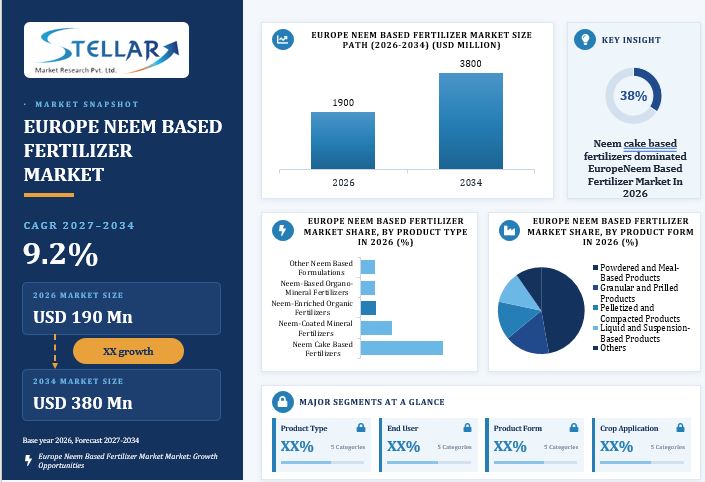
Europe Neem Based Fertilizer Market was valued at USD 190 Million in 2026 and is projected to reach USD 380 Million by 2034, growing at a CAGR of 9.2% during 2026–2034
The Europe Neem Based Fertilizer Market was valued at USD 190 Million in 2026 and is projected to reach USD 380 Million by 2034, growing at a CAGR of 9.2% during 2026–2034. In terms of volume, the Europe Neem Based Fertilizer Market was estimated at XX Metric Tons in 2026 and is expected to reach XX Metric Tons by 2034, growing at a CAGR of XX% during 2026–2034.
Market definition and scope: The Europe Neem Based Fertilizer Market covers fertilizers and soil amendments sold in Europe whose nutrient value comes from neem seed, kernel, cake or meal. Included are neem cake and neem seed meal fertilizers, neem-enriched organic fertilizers, neem-based organo-mineral fertilizers, neem-coated mineral fertilizers and other neem-based formulations.
Stellar Market Research Study scope and coverage: The study period is 2021–2034, with 2026 as the base year, 2021–2026 as historical data and 2026–2034 as the forecast period. Market size is reported in USD Million (value) and metric tons (volume). The analysis segments the market by product type, product form, crop application, end user, distribution channel and country across Germany, France, Italy, Spain, United Kingdom, Netherlands, Poland and Rest of Europe.
To get more Insights: Request Free Sample Report
The report is for neem fertilizer importers and processors, organic fertilizer brand owners, blenders, distributors, cooperatives and agro-dealers, garden and farm retailers, growers, public agencies and investors who need a view of Europe demand, supply and competition through 2034. Regulation (EU) 2019/1009 harmonises organic fertilising products, the Green Deal sets a 25% organic area target for 2030, and actual shares of 10.5% to 11.0% leave a large conversion gap. Neem based fertilizers remain a niche inside a large organic fertilizer base, sold mainly through garden retail, online shops and specialty fertilizer groups.
Key Findings: Insights Shaping the Europe Neem Based Fertilizer Market
The Europe Neem Based Fertilizer Market demand is driven by expanding organic farming, sustainable agriculture, soil health awareness and increasing adoption of plant-based fertilizers. Europe Neem Based Fertilizer Market consumption is expected to increase across horticulture, cereals, vineyards, orchards and protected cultivation through 2034. Supply dynamics remain influenced by imported neem cake, raw material availability, transportation costs and regional manufacturing capabilities. Revenue generation is supported by premium organic fertilizer formulations, specialty crop nutrition products and expanding distribution channels. Value creation opportunities emerge through product innovation, strategic sourcing partnerships, private-label manufacturing, sustainable fertilizer development and increasing penetration of neem-enriched organic fertilizers.
1. Organic farming covered about 10.5% of EU farmland in 2022. Eurostat reports 16.9 million hectares of organic area, or 10.5% of the EU utilised agricultural area, against a European Green Deal target of 25% by 2030, which sets the demand reference for neem based fertilizer.
2. Country gaps are wide. Austria reached about 27% in 2023, while the Netherlands, at a share well below the EU average, targets 15% by 2030 and Ireland stood at 2.2% in 2022.
3. Europe holds 19.5 million organic hectares. FiBL counts 19.5 million hectares in Europe in 2023, the second-largest region after Oceania, which anchors input demand for organic fertilizers.
4. One EU rulebook now covers organic fertilizers. Regulation (EU) 2019/1009 sets CE-marking rules for fertilising products, and its organic fertiliser category requires organic carbon and nutrients of solely biological origin, which suits neem cake based products.
Europe Neem Based Fertilizer Market Trends
1. Organic Area Expansion Under the Green Deal: Organic farmland has grown steadily since 2012, and the EU aims to bring 25% of agricultural land under organic farming by 2030. Each additional hectare needs fertility inputs that comply with organic rules, and neem cake qualifies as a plant-based nitrogen source in many markets, subject to applicable requirements. Increasing organic cultivation of cereals, fruits, vegetables and commercial crops supports demand for natural soil amendments. Farmers are increasingly incorporating organic fertilizers into nutrient management programmes to improve soil fertility, microbial activity and long-term agricultural productivity, boosts Europe Neem Based Fertilizer Market growth.
2. Harmonised Rules for Organic Fertilising Products: Regulation (EU) 2019/1009 allows compliant CE-marked organic fertilisers to move across EU Member States. Importers and blenders can design one neem-enriched product for several Member States, which lowers registration efforts compared with country-by-country approvals. Harmonised requirements concerning product quality, contaminant limits, nutrient composition and labelling support greater transparency across the supply chain. This trend encourages manufacturers to develop standardised neem-based formulations suitable for multiple European markets while strengthening distribution partnerships and cross-border commercial opportunities.
3. Blends and Biostimulant Convergence: Italian and Spanish specialty fertilizer groups sell organic fertilizers, biostimulants and trace elements together. Neem cake fits naturally within these product bundles as a slow-release nitrogen and soil-health ingredient. Europe Neem Based Fertilizer Manufacturers are increasingly combining neem cake with organic matter, micronutrients, humic substances and microbial ingredients to develop differentiated agricultural inputs. These formulations address multiple crop nutrition requirements while supporting root development, nutrient availability and soil biological activity. Integrated product portfolios also enable manufacturers to target high-value horticulture and specialty crop applications.
4. Online and Marketplace Sales of Imported Neem: Neem cake reaches German, Italian and Spanish consumers through web shops and cross-border marketplaces, often in packs of 250 grams to 1 kilogram, which supports premium pricing per kilogram. Digital distribution channels allow smaller importers and specialty fertilizer brands to reach home gardeners, hobby farmers and urban agricultural consumers without extensive physical retail networks. Product descriptions, application instructions, organic credentials and customer reviews influence purchasing decisions. Growing interest in sustainable gardening further supports demand for conveniently packaged neem-based fertilizers.
5. Label Boundaries Between Fertilizer and Plant Protection: Products that claim pest effects alongside nutrition can fall under plant-protection rules. Suppliers increasingly keep nutrient claims on fertilizer labels and sell neem pesticides separately. This distinction influences product development, packaging, marketing communication and regulatory compliance strategies across Europe. Manufacturers are focusing on substantiated claims concerning nutrient supply, organic matter enrichment and soil fertility improvement. Clear product positioning helps distributors reduce regulatory uncertainty while strengthening customer confidence and maintaining compliance with applicable European agricultural input regulations.
Europe Neem Based Fertilizer Market Drivers
1. Organic Area Growth and Policy Targets: The 25% EU target for 2030 and Common Agricultural Policy (CAP) support schemes keep organic conversion on the policy agenda, even though actual organic farmland shares remain near 11% based on earlier reported figures. Financial incentives, environmental programmes and sustainable farming initiatives encourage agricultural producers to reduce dependence on conventional synthetic inputs. Neem-based fertilizers benefit from increasing demand for plant-derived nutrient sources that support organic farming practices. Expansion in certified organic crop production creates additional commercial opportunities for importers, manufacturers and specialty fertilizer distributors.
2. Nitrogen-Loss Rules and Soil Health Priorities: Tighter nitrogen-loss rules encourage improved nutrient management and interest in slow-release nutrient sources. Neem cake releases nitrogen gradually, which fits fertilization plans for vegetables, fruit and vineyards. Its organic matter content also supports soil conditioning and biological activity. European farmers are increasingly adopting integrated nutrient management practices to improve fertilizer-use efficiency and maintain soil productivity. Environmental concerns regarding nutrient leaching, groundwater contamination and soil degradation further encourage the adoption of organic fertilizers within balanced crop nutrition programmes.
3. Horticulture and Protected Cultivation: Greenhouse and orchard operations in Spain, Italy and the Netherlands purchase premium agricultural inputs and value production practices that support stringent residue requirements. Neem-based fertilizers offer opportunities in high-value fruit, vegetable, ornamental and specialty crop production, where soil quality and consistent nutrient availability are important. Granular, pelletized and suitably formulated liquid neem-based products can address different cultivation requirements. Increasing investment in protected agriculture, precision nutrient management and sustainable horticultural practices supports demand for specialised organic fertilizer formulations.
4. Retail Demand for Organic Garden Products: Home gardeners in Germany, France and the United Kingdom purchase neem cake as an organic fertilizer and soil conditioner through garden retail outlets and web shops. Growing consumer awareness regarding environmentally responsible gardening, chemical input reduction and home-grown food production supports demand for plant-based fertilizers. Retailers are expanding their organic gardening portfolios through smaller packaging formats and easy-to-use formulations. Urban gardening, balcony cultivation, kitchen gardens and ornamental plant maintenance create additional revenue opportunities for neem-based fertilizer suppliers.
Europe Neem Based Fertilizer Market Restraints and Challenges
1. Import Dependence and Freight: Neem trees grow mainly in India, other South Asian countries and parts of Africa, making European buyers dependent on imported neem seed cake. This exposes manufacturers and distributors to international freight costs, seasonal seed harvest fluctuations, exchange rate volatility and supply chain disruptions. Variations in raw material quality, moisture content and nutrient composition can also affect finished fertilizer consistency. Importers must maintain reliable sourcing relationships, inventory planning and quality inspection procedures, increasing overall procurement and operational expenditure.
2. Competition From Local Organic Inputs: Manure, compost, digestate and animal-based organic fertilizers are available locally and can offer lower costs per unit of nitrogen than imported neem cake. Established European organic fertilizer manufacturers benefit from regional raw material availability, developed distribution networks and lower transportation requirements. Price-sensitive agricultural producers may prefer locally sourced alternatives, particularly for large-scale field crop applications. Neem-based fertilizer suppliers must therefore demonstrate differentiated agronomic benefits, consistent product quality and suitability for specialised crop applications to justify premium pricing.
3. Compliance Burden for Small Importers: CE marking, contaminant limits and applicable organic certification requirements add costs for small importers, while pest-control claims trigger a separate regulatory track. Laboratory testing, technical documentation, product traceability and conformity assessment can increase the financial burden associated with market entry. Differences between EU and non-EU European regulatory frameworks create additional challenges for companies operating across multiple countries. Smaller suppliers may struggle to maintain competitive pricing while meeting quality, packaging, labelling and regulatory requirements.
Europe Neem Based Fertilizer Market Opportunities
1. CE-Marked Neem Enriched Blends: A compliant CE-marked blend of neem cake with other organic materials can be sold across the EU single market, which suits private-label and specialty fertilizer groups. Manufacturers can develop crop-specific formulations by combining neem cake with composted plant materials, organic nutrient sources and permitted mineral ingredients. Product differentiation through nutrient composition, application convenience and soil-conditioning properties creates opportunities in professional agriculture. Standardised formulations also support scalable manufacturing, cross-border distribution and long-term supply agreements with agricultural input retailers.
2. Biostimulant and Specialty Partnerships: Specialty fertilizer groups in Italy, Spain and Germany can add neem cake to organic fertilizer and soil-health portfolios through supply agreements. Strategic partnerships between European fertilizer manufacturers and neem raw material processors can improve supply reliability, formulation development and product consistency. Collaborative research and field trials can help establish crop-specific application recommendations and demonstrate agronomic performance under European climatic conditions. Such partnerships enable companies to expand their sustainable agricultural input portfolios while accessing established professional farming and horticultural distribution networks.
3. Premium Retail and Online Channels: Packs for gardeners, hobby farmers and urban growers can earn higher prices per kilogram than bulk farm sales. Manufacturers can introduce consumer-friendly packaging, clear application guidelines and formulations designed for vegetables, flowering plants, lawns and ornamental gardens. Online marketplaces provide opportunities for direct-to-consumer sales, private-label distribution and cross-border market expansion. Growing demand for environmentally responsible gardening products enables suppliers to strengthen brand differentiation, improve customer engagement and access higher-margin specialty retail segments.
Europe Neem Based Fertilizer Market Segmentation
By Product Type: Neem cake-based fertilizers lead the European market in 2026 with an 38% share of market value, supported by their established application as plant-based organic nutrient sources and soil conditioners. Their gradual nutrient release and organic matter content make them suitable for horticulture, organic farming and residential gardening. Neem-enriched organic fertilizers are expected to register the fastest growth as specialty fertilizer groups increasingly blend neem with other organic materials to improve nutrient composition and application flexibility. Neem-coated mineral fertilizers, neem-based organo-mineral fertilizers and other neem-based formulations address specialised agricultural requirements, supporting product diversification across conventional and organic cultivation systems, subject to applicable input eligibility requirements.
By Product Form: Powdered and meal products lead the European market owing to their established availability, relatively simple processing requirements and suitability for direct soil incorporation. These products are widely used in organic farming, garden cultivation and basal fertilizer applications. Granular and pelletized products are gaining importance in professional horticulture because of their improved handling, storage, transportation and mechanical application characteristics. Liquid and suspension products offer growth opportunities in greenhouse cultivation and fertigation when appropriately formulated for irrigation systems. Manufacturers are increasingly focusing on product forms that improve application efficiency, nutrient distribution and compatibility with modern agricultural equipment.
Europe Neem Based Fertilizer Market Country-Level Analysis
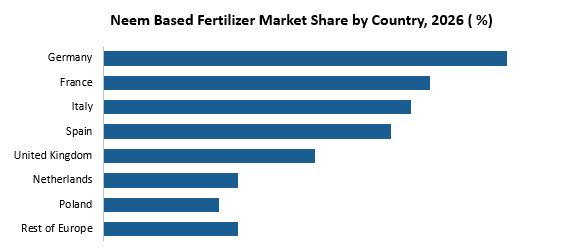
Germany: Germany dominated for Europe Neem Based Fertilizer Market in 2026, supported by established organic farming practices, environmental awareness and developed garden retail infrastructure. Demand originates from organic agricultural producers, home gardeners, specialty horticultural businesses and sustainable farming programmes. Online marketplaces and specialised organic input distributors provide access to imported neem cake products. Consumer preference for plant-based fertilizers and environmentally responsible gardening solutions creates opportunities for premium packaged products and neem-enriched organic formulations.
France: France offers significant opportunities for neem-based fertilizers through its extensive agricultural sector, organic farmland and diversified crop production. Demand is supported by vineyards, fruit orchards, vegetable cultivation and sustainable soil management practices. Agricultural cooperatives and specialty fertilizer distributors provide potential channels for introducing neem-enriched organic products. Increasing emphasis on soil fertility preservation, nutrient management and environmentally responsible agricultural production supports the adoption of alternative organic nutrient sources.
Italy: Italy's neem-based fertilizer demand is supported by its established organic agricultural sector, specialty fertilizer manufacturing industry and high-value horticultural production. Vineyards, olive plantations, fruit orchards and vegetable cultivation provide potential applications for neem cake-based and neem-enriched organic fertilizers. Italian specialty fertilizer manufacturers can incorporate neem-derived ingredients into integrated crop nutrition portfolios. Opportunities are particularly evident in differentiated organic formulations, granular products and premium soil-conditioning solutions.
Leading Europe Neem Based Fertilizer Manufacturers: Competitive Landscape and Key Players
The Europe Neem Based Fertilizer Market features a competitive landscape comprising organic fertilizer manufacturers, specialty crop nutrition companies, neem cake importers and regional agricultural input distributors. Key companies within the broader competitive ecosystem include Italpollina (Hello Nature), ILSA S.p.A., COMPO EXPERT, DCM, and Tradecorp (Rovensa Next), alongside specialised neem-based fertilizer suppliers. Market participants focus on product innovation, organic nutrient formulations, sustainable soil management and distribution network expansion to strengthen their competitive positioning.
Increasing demand for neem cake-based fertilizers, neem-enriched organic fertilizers and plant-based soil conditioners encourages manufacturers to diversify their product portfolios. Companies compete through pricing, product quality, organic certification, nutrient-release efficiency and crop-specific formulations. Expanding organic farming, sustainable agriculture, biofertilizer adoption and premium horticultural applications create opportunities for emerging players. Digital distribution channels and private-label manufacturing further influence competitive dynamics across European agricultural markets.
Europe Neem Based Fertilizer Market Recent Developments
|
Company |
Date |
Recent Development |
Strategic Impact |
|
Rovensa Next |
July 2026 |
Joined the USD 6.4 million BIO² Horizon Europe project to develop circular biofertilizers and microbial solutions. |
Strengthens biological fertilizer innovation and sustainable agricultural practices across Europe. |
|
Yara International |
May 2026 |
Introduced YaraBela NITROMAG Z, combining nitrogen, calcium, magnesium and zinc in a single granule. |
Expands specialty fertilizer offerings and improves nutrient delivery efficiency. |
|
Timac Agro |
March 2026 |
Established a strategic partnership with the Confederation of Independent Winegrowers of France, covering nearly 7,000 winegrowers. |
Strengthens access to European horticultural customers and sustainable crop nutrition markets. |
Europe Neem Based Fertilizer Market Scope
|
Report Coverage |
Details |
|
Base Year |
2026 |
|
Historical Data |
2021 to 2026 |
|
Forecast Period |
2027–2034 |
|
Market Size in 2026 |
USD 190 Million |
|
CAGR 2027 to 2034 |
9.2% |
|
Market Size in 2034 |
USD 380 Million |
|
By Product Type |
Neem Cake Based Fertilizers Neem-Enriched Organic Fertilizers Neem-Based Organo-Mineral Fertilizers Neem-Coated Mineral Fertilizers Other Neem Based Formulations |
|
By Product Form |
Powdered and Meal-Based Products Granular and Prilled Products Liquid and Suspension-Based Products Pelletized and Compacted Products Others |
|
By Crop Application |
Fruits and vegetables Cereals and grains Ornamentals, nursery, turf Oilseeds and pulses Others |
|
By End User |
Residential Gardeners and Landscape Professionals Greenhouse, Nursery and Horticulture Operations Farms and Commercial Growers Research, Institutional and Other Users |
|
By Distribution Channel |
Specialty Retail, Farm-Supply Stores and Cooperatives Online and Wholesale Marketplaces Mass Retail and Home Centers Direct and Distributor Sales to Growers |
|
By Country |
Germany France Italy Spain United Kingdom Netherlands Poland Rest of Europe |
Key players covered in the Europe Neem Based Fertilizer Market report from a strategic perspective
- Yara International
- ICL Group
- K+S
- COMPO EXPERT
- Biolchim
- Rovensa Next
- Fertiberia
- FertiGlobal International
- Dr. Stähler
- Femundus GmbH
- Provita
- TrustBasket (Multiplex Urban Green)
- NIEM-HANDEL GmbH
- Hello Nature (Italpollina)
- Timac Agro (Groupe Roullier)
- Haifa Group
- EuroChem Group
- ILSA S.p.A.
- Fertikal N.V.
- Humintech GmbH
- W. Neudorff GmbH KG
- Van Iperen International B.V.
- Fertinagro Biotech
- Frayssinet SAS
- DCM – De Ceuster Meststoffen
- Plantin SARL
- FKL Fertilizers
- Agribios Italiana
- Organazoto Fertilizzanti S.p.A.
- Bioiberica S.A.U.
- Uniflor Poland Sp. z o.o.
- Coromandel International Limited
- UPL Limited
- Fortune Biotech Limited
- Ozone Biotech
- P.J. Margo Pvt. Ltd.
- T. Stanes and Company Limited
- Multiplex Group of Companies
- Suståne Natural Fertilizer Inc.
- PUR VER
Others
Frequently Asked Questions
Expanding organic farming, increasing demand for sustainable agricultural inputs, soil health awareness, stringent environmental regulations, growing horticultural activities, and rising adoption of plant-based fertilizers are the major market growth drivers.
Neem cake-based fertilizers dominate the market with an estimated 38% market share in 2026, supported by their gradual nutrient release, organic matter content, soil-conditioning properties, and widespread applications in organic farming and horticulture.
Germany leads the Europe Neem Based Fertilizer Market in 2026, supported by established organic farming practices, growing environmental awareness, developed agricultural distribution networks, and increasing demand for sustainable gardening products.
Emerging opportunities include neem-enriched organic fertilizer development, CE-marked fertilizer formulations, controlled-release technologies, premium horticultural applications, private-label manufacturing, strategic sourcing partnerships, and expanding online distribution channels.
Europe Neem Based Fertilizer Market Table of Contents
Part I: Market Overview, Dynamics and Technology
1. Executive Market Landscape and Industry Overview
1.1. Europe Neem Based Fertilizer Market Size (Value USD Million and Volume Metric Tons), 2027–2034
1.2. Evolution of Neem Based Fertilizers and Sustainable Crop Nutrition
1.3. Market Definition, Scope, Boundaries and Product Classification
1.4. Role of Neem Based Fertilizers in Sustainable Agriculture and Soil Fertility
1.5. Europe Neem Based Fertilizer Industry Structure and Value Chain
1.6. Organic Farming Expansion, Soil Health Management and Fertilizer Adoption
1.7. CAGR Analysis of Europe Neem Based Fertilizer Market During 2027–2034
2. Neem Based Fertilizer Market Dynamics
2.1. Neem Based Fertilizer Market Trends
2.2. Neem Based Fertilizer Market Dynamics
2.2.1. Drivers
2.2.2. Restraints
2.2.3. Opportunities
2.2.4. Challenges
2.3. PORTER's Five Forces Analysis
2.4. PESTLE Analysis
3. Neem Based Fertilizer Market Macroeconomic Factors
3.1. European Agricultural Investment and Organic Farming Expenditure
3.2. Government Agricultural Subsidies and Soil Health Programs
3.3. European Agricultural Land Utilization and Organic Cultivation Area
3.4. Conventional Fertilizer Consumption and Price Fluctuations
3.5. Sustainable Agriculture Investment and Environmental Regulations
3.6. Agricultural Productivity, Farm Income and Fertilizer Affordability
3.7. Organic Fertilizer Imports, Exports and International Trade Policies
4. Neem Based Fertilizer Industry Trends and Emerging Requirements
4.1. Increasing Adoption of Plant-Based Organic Fertilizers
4.2. Growing Demand for Sustainable Soil Nutrient Management
4.3. Expansion of Certified Organic Farming and Horticulture
4.4. Increasing Adoption of Enhanced Efficiency Neem Based Fertilizers
4.5. Development of Nutrient-Enriched Neem Based Formulations
4.6. Growing Preference for Standardized and Certified Agricultural Inputs
4.7. Integration of Neem Based Fertilizers into Regenerative Agriculture Practices
4.8. Emerging Demand for Neem-Coated and Controlled-Release Fertilizers
5. Neem Based Fertilizer Composition and Technology Ecosystem
5.1. Neem Based Fertilizer Composition and Nutrient Characteristics
5.2. Nitrogen, Phosphorus, Potassium and Micronutrient Content
5.3. Organic Carbon, Organic Matter and Soil Conditioning Properties
5.4. Nutrient Mineralization and Controlled-Release Mechanisms
5.5. Neem Oil, Neem Extracts, Azadirachtin and Bioactive Compounds
5.6. Soil Microbial Activity and Nutrient Availability
5.7. Nitrification Inhibition and Nitrogen Retention Mechanisms
5.8. Product Stability, Agronomic Performance and Application Efficiency
6. Neem Based Fertilizer Raw Materials and Formulation Components
6.1. Neem Seeds and Neem Kernels
6.2. Neem Cake and Neem Seed Meal
6.3. Neem Oil and Neem Oil Derivatives
6.4. Neem Leaf and Seed Extracts
6.5. Organic Nutrient Enrichment Materials
6.6. Mineral Fertilizer and Micronutrient Ingredients
6.7. Binding Agents, Coating Materials and Formulation Components
6.8. Raw Material Quality, Availability and Procurement Economics
Part II: Product Landscape, Manufacturing and Processing Technologies
7. Neem Cake Based Fertilizer Market Landscape
7.1. Product Composition and Nutrient Specifications
7.2. Cold-Pressed and Mechanically Extracted Neem Cake Characteristics
7.3. Residual Oil Content and Agronomic Performance
7.4. Soil Application Methods and Recommended Dosage
7.5. Organic Certification and Product Quality Requirements
7.6. Product Pricing and Production Economics
7.7. Neem Cake Based Fertilizer Demand and Opportunities
8. Neem-Enriched Organic Fertilizer Market Landscape
8.1. Neem-Enriched Organic Fertilizer Composition and Product Specifications
8.2. Integration of Neem Ingredients with Compost and Plant-Based Nutrients
8.3. Nutrient-Enriched Organic Fertilizer Formulations
8.4. Microbial Enrichment and Biofertilizer Compatibility
8.5. Crop-Specific Organic Fertilizer Formulations
8.6. Manufacturing Costs and Average Selling Prices
8.7. Neem-Enriched Organic Fertilizer Demand and Adoption Trends
9. Neem-Coated Mineral Fertilizer Market Landscape
9.1. Neem-Coated Mineral Fertilizer Composition and Product Specifications
9.2. Neem-Coated Urea and Other Mineral Fertilizer Products
9.3. Neem Oil and Neem Extract-Based Coating Technologies
9.4. Nitrogen Retention and Nutrient Release Characteristics
9.5. Nutrient Use Efficiency and Agronomic Performance
9.6. Manufacturing Economics and Commercial Viability
9.7. Neem-Coated Mineral Fertilizer Demand and Growth Opportunities
10. Neem Based Organo-Mineral Fertilizer Market Landscape
10.1. Organo-Mineral Fertilizer Composition and Formulation Principles
10.2. Integration of Neem-Derived Ingredients with Mineral Nutrients
10.3. Organic Matter Enrichment and Nutrient Availability
10.4. Crop-Specific Nutrient Formulation Requirements
10.5. Agronomic Performance and Nutrient Use Efficiency
10.6. Manufacturing Economics and Product Pricing
10.7. Neem Based Organo-Mineral Fertilizer Demand and Growth Opportunities
11. Other Neem Based Fertilizer Formulations
11.1. Neem Extract-Based Nutrient Formulations
11.2. Neem Leaf-Derived Fertilizer Products
11.3. Specialty Neem-Based Crop Nutrition Products
11.4. Neem-Based Multi-Nutrient Fertilizer Formulations
11.5. Advanced Neem-Based Nutrient Delivery Systems
11.6. Product Development and Commercialization Economics
11.7. Emerging Neem Based Fertilizer Demand and Market Opportunities
12. Neem Based Fertilizer Product Forms and Processing Technologies
12.1. Powdered and Meal-Based Neem Fertilizers
12.2. Granular and Prilled Neem Based Fertilizers
12.3. Pelletized and Compacted Neem Based Fertilizers
12.4. Liquid and Suspension-Based Neem Fertilizers
12.5. Grinding, Milling, Granulation and Pelletization Technologies
12.6. Extraction, Filtration and Liquid Formulation Technologies
12.7. Product Stability, Handling and Application Compatibility
12.8. Product Form-Wise Production Economics and Pricing
12.9. Emerging Product Forms and Commercial Opportunities
13. Neem Based Fertilizer Manufacturing and Production Workflow
13.1. Neem Seed Collection and Raw Material Procurement
13.2. Seed Cleaning, Drying and Kernel Separation
13.3. Neem Oil Extraction and Neem Cake Recovery
13.4. Neem Extract Processing and Bioactive Compound Recovery
13.5. Nutrient Enrichment, Blending and Formulation
13.6. Mineral Fertilizer Coating and Controlled-Release Processing
13.7. Granulation, Pelletization and Product Quality Inspection
13.8. Final Packaging, Warehousing and Production Optimization
14. Neem Based Fertilizer Manufacturing Automation and Processing Technologies
14.1. Automated Neem Seed Cleaning and Sorting Systems
14.2. Mechanical Oil Extraction and Cold-Press Technologies
14.3. Automated Grinding, Milling and Blending Equipment
14.4. Fertilizer Coating and Controlled-Release Manufacturing Technologies
14.5. Granulation, Pelletization and Drying Technologies
14.6. Automated Nutrient Analysis and Quality Control
14.7. Digital Manufacturing, Batch Traceability and Production Monitoring
14.8. Energy-Efficient Manufacturing and Waste Reduction Technologies
Part III: Crop Applications, Customers and Commercial Landscape
15. Neem Based Fertilizer Applications in Cereals and Grains
15.1. Nutrient Requirements of Wheat, Barley, Maize and Other Cereals
15.2. Neem Based Fertilizer Application Rates and Nutrient Management
15.3. Soil Fertility and Nitrogen Retention Considerations
15.4. Integration with Conventional and Organic Fertilization Programs
15.5. Cereal Crop Productivity and Agronomic Performance
15.6. Fertilizer Procurement and Application Economics
15.7. Cereals and Grains Fertilizer Demand and Adoption Trends
16. Neem Based Fertilizer Applications in Fruits and Vegetables
16.1. Nutrient Requirements of Fruit and Vegetable Crops
16.2. Neem Based Fertilizer Applications in Orchards and Vineyards
16.3. Greenhouse and Protected Cultivation Applications
16.4. Soil Conditioning and Root Zone Nutrient Management
16.5. Organic Horticulture and Premium Crop Production
16.6. Fertigation and Foliar Nutrient Application
16.7. Fertilizer Application Costs and Crop Yield Economics
16.8. Fruits and Vegetables Fertilizer Demand and Growth Opportunities
17. Neem Based Fertilizer Applications in Oilseeds and Pulses
17.1. Nutrient Requirements of Oilseeds and Pulse Crops
17.2. Neem Based Fertilizer Applications in Rapeseed and Sunflower
17.3. Fertilizer Applications in Soybean, Peas and Other Pulses
17.4. Soil Organic Matter and Nutrient Availability
17.5. Integration with Crop Rotation and Sustainable Farming Practices
17.6. Fertilizer Consumption and Application Economics
17.7. Oilseeds and Pulses Fertilizer Demand and Market Opportunities
18. Neem Based Fertilizer Applications in Commercial Crops, Ornamentals and Other Crops
18.1. Ornamental Plant and Floriculture Nutrient Requirements
18.2. Neem Based Fertilizer Applications in Commercial Nurseries
18.3. Turfgrass, Landscaping and Garden Management Applications
18.4. Applications in Medicinal and Aromatic Plants
18.5. Applications in Commercial and Industrial Crops
18.6. Specialty Crop Fertilizer Pricing and Application Economics
18.7. Specialty Crop Fertilizer Demand and Adoption Trends
19. Neem Based Fertilizer Buyers and Procurement Requirements
19.1. Agricultural Enterprises and Commercial Growers
19.2. Greenhouse, Nursery and Commercial Horticulture Operators
19.3. Residential Gardeners and Household Consumers
19.4. Landscaping and Turf Management Companies
19.5. Government, Academic and Research Institutions
19.6. Customer Procurement Criteria, Certification and Supplier Selection
19.7. Customer Purchasing Behaviour, Brand Preferences and Price Sensitivity
20. Neem Based Fertilizer Customization and Product Configuration
20.1. Crop-Specific Nutrient Formulation Requirements
20.2. Soil Type-Specific Fertilizer Customization
20.3. Nutrient Enrichment and Organic Blend Development
20.4. Integration with Microbial and Biological Agricultural Inputs
20.5. Neem Coating and Controlled Nutrient Release Customization
20.6. Product Form, Particle Size and Application Method Configuration
20.7. Private Label Manufacturing and Customized Packaging
20.8. Customization Costs, Minimum Order Quantities and Manufacturing Lead Times
21. Neem Based Fertilizer Testing, Validation and Quality Assurance
21.1. Fertilizer Testing and Quality Validation Infrastructure
21.2. Nitrogen, Phosphorus, Potassium and Micronutrient Analysis
21.3. Organic Carbon, Moisture and Residual Oil Content Testing
21.4. Azadirachtin and Bioactive Compound Analysis
21.5. Nutrient Release, Coating Uniformity and Product Stability Testing
21.6. Heavy Metal, Pathogen and Contaminant Testing
21.7. Field Trials, Crop Response and Agronomic Performance Validation
21.8. Product Quality Certification, Batch Consistency and Regulatory Compliance
22. Neem Based Fertilizer Pricing, Business Models and Cost Economics
22.1. Neem Based Fertilizer Pricing by Product Type
22.2. Fertilizer Pricing by Product Form and Nutrient Composition
22.3. Neem Seed, Neem Oil, Neem Cake and Extract Procurement Costs
22.4. Organic and Mineral Fertilizer Ingredient Costs
22.5. Labour, Energy, Processing and Manufacturing Overhead Costs
22.6. Packaging, Transportation, Import Duties and Landed Costs
22.7. Direct Sales, Distribution, Contract Manufacturing and Private Label Models
22.8. Average Selling Price, Gross Margin and Profitability Analysis
22.9. Country-Level Neem Based Fertilizer Pricing Analysis
23. Neem Based Fertilizer Sales, Distribution and Market Delivery Landscape
23.1. Direct Sales by Fertilizer Manufacturers
23.2. Agricultural Input Distributors and Wholesalers
23.3. Specialty Retailers, Farm Supply Stores and Agricultural Cooperatives
23.4. Online Fertilizer Sales Platforms and E-Commerce Channels
23.5. Garden Centers, Home Improvement Stores and Mass Retailers
23.6. Importer Partnerships and International Distribution Networks
23.7. Distributor Margins, Trade Schemes and Customer Support Networks
24. Neem Based Fertilizer Supply Chain and Operational Ecosystem
24.1. Global Neem Seed, Neem Oil, Neem Cake and Extract Supply Chains
24.2. Major Neem-Based Raw Material Producing and Exporting Countries
24.3. European Neem Based Fertilizer Importers and Processing Companies
24.4. Organic and Mineral Fertilizer Formulation Material Suppliers
24.5. European Fertilizer Manufacturing, Coating and Blending Clusters
24.6. International Trade, Import-Export and Logistics Networks
24.7. Manufacturing Capacity, Localization and Supply Chain Resilience
Part IV: Innovation, Sustainability, Regulatory and Country-Level Landscape
25. Neem Based Fertilizer Technology Innovation, R&D and Product Development
25.1. Advanced Neem Processing and Nutrient Extraction Technologies
25.2. Controlled Nutrient Release and Enhanced Efficiency Formulations
25.3. Microbial-Enriched Neem Based Fertilizer Development
25.4. Advanced Granulation, Coating and Pelletization Technologies
25.5. Neem-Based Liquid Fertilizer Innovation
25.6. Nanotechnology and Emerging Nutrient Delivery Systems
25.7. Precision Agriculture and Crop-Specific Nutrient Management
25.8. Technology Patents, R&D Investments and Research Collaborations
26. Neem Based Fertilizer Consumption, Utilization and Sustainability Economics
26.1. Europe Neem Based Fertilizer Market Production and Consumption Analysis
26.2. Europe Neem Based Fertilizer Market Demand and Supply Gap Analysis
26.3. Annual Fertilizer Application Rates and Consumption Intensity
26.4. Nutrient Use Efficiency and Crop Productivity Assessment
26.5. Cost per Hectare and Cost per Unit of Nutrient
26.6. Soil Organic Carbon, Soil Health and Environmental Impact
26.7. Nitrogen Loss Reduction and Sustainable Nutrient Management
26.8. Circular Economy, Neem Industry By-Product Utilization and Waste Reduction
26.9. Return on Investment and Comparative Economics Against Alternative Fertilizers
26.10. Europe Neem Based Fertilizer Market Revenue Generation and Value Creation Through 2034
27. Neem Based Fertilizer Regulatory, Quality and Technical Standards
27.1. EU Fertilising Products Regulation (EU 2019/1009)
27.2. EU Organic Production Regulation (EU 2018/848) and Permitted Input Requirements
27.3. Fertilizer Product Registration, Labelling and CE Marking Requirements
27.4. Country-Specific Fertilizer Regulations and Certification Standards
27.5. Nutrient Content, Contaminant Limits and Product Safety Requirements
27.6. Organic Input Certification and Supply Chain Traceability
27.7. Regulatory Distinction Between Neem Based Fertilizers and Plant Protection Products
27.8. Fertilizer Import-Export Compliance and Customs Classification
27.9. European Green Deal, Common Agricultural Policy and Soil Health Initiatives
28. Europe Neem Based Fertilizer Country-Level Market Landscape
28.1. Germany Neem Based Fertilizer Market Development
28.2. France Neem Based Fertilizer Demand and Organic Farming Expansion
28.3. Italy Neem Based Fertilizer Consumption and Horticultural Applications
28.4. Spain Neem Based Fertilizer Demand and Sustainable Agriculture
28.5. United Kingdom Neem Based Fertilizer Market Development
28.6. Netherlands Neem Based Fertilizer Demand and Greenhouse Applications
28.7. Poland Neem Based Fertilizer Market and Agricultural Development
28.8. Rest of Europe Neem Based Fertilizer Market
28.9. Country-Level Fertilizer Production, Consumption and Import-Export Analysis
28.10. Country-Level Manufacturing Investments and Fertilizer Adoption Trends
Part V: Market Size and Forecast by Segmentation
29. Europe Neem Based Fertilizer Market: Market Size and Forecast by Segmentation, Value (USD Million), Volume (Metric Tons), 2027–2034
29.1. By Product Type
29.1.1. Neem Cake Based Fertilizers
29.1.2. Neem-Enriched Organic Fertilizers
29.1.3. Neem-Coated Mineral Fertilizers
29.1.4. Neem Based Organo-Mineral Fertilizers
29.1.5. Other Neem Based Fertilizer Formulations
29.2. By Product Form
29.2.1. Powdered and Meal-Based Products
29.2.2. Granular and Prilled Products
29.2.3. Pelletized and Compacted Products
29.2.4. Liquid and Suspension-Based Products
29.2.5. Others
29.3. By Crop Application
29.3.1. Cereals and Grains
29.3.2. Fruits and Vegetables
29.3.3. Oilseeds and Pulses
29.3.4. Commercial and Other Crops
29.4. By End User
29.4.1. Agricultural Enterprises and Commercial Field Crop Growers
29.4.2. Commercial Horticulture, Greenhouse and Nursery Operators
29.4.3. Residential Gardeners and Household Consumers
29.4.4. Landscaping and Turf Management Companies
29.4.5. Government and Research Institutions
29.4.6. Others
29.5. By Sales Channel
29.5.1. Manufacturer Direct Sales (Offline)
29.5.2. Agricultural Input Distributors and Wholesalers
29.5.3. Specialty Retailers, Farm Supply Stores and Cooperatives
29.5.4. Mass Retailers and Home Improvement Stores
29.5.5. Online Sales Channels
29.5.6. Others
29.6. By Country
29.6.1. Germany
29.6.2. France
29.6.3. Italy
29.6.4. Spain
29.6.5. United Kingdom
29.6.6. Netherlands
29.6.7. Poland
29.6.8. Rest of Europe
Part VI: Competitive Landscape and Company Profiles
30. Europe Neem Based Fertilizer Market Competitive Landscape
30.1. SMR Competition Matrix
30.2. Competitive Positioning of Leading Key Players (Neem Based Fertilizer Revenue and Market Share %)
30.3. Key Players Benchmarking
30.3.1. Company Name
30.3.2. Headquarters
30.3.3. Neem Based Fertilizer Product Portfolio
30.3.4. Product Type and Product Form Coverage
30.3.5. Nutrient Composition and Formulation Capabilities
30.3.6. Product Quality and Organic Certifications
30.3.7. Customer Portfolio and Distribution Partnerships
30.3.8. Total Company Revenue (2026)
30.3.9. Neem Based Fertilizer-Related Revenue (2026)
30.3.10. Geographic Presence
30.3.11. Manufacturing Capacity and Production Capabilities
30.3.12. Raw Material Sourcing Capabilities
30.3.13. Product Pricing and Market Positioning
30.3.14. Strategic Partnerships and Technology Collaborations
30.3.15. Research and Development Capabilities
30.4. Market Structure
30.4.1. Market Leaders
30.4.2. Market Followers
30.4.3. Emerging Players
30.4.4. Specialized Neem Based Fertilizer Manufacturers
30.5. Growth Rate / Y-o-Y (%) of Companies
30.6. Profit Margin (%) of Companies
30.7. R&D and Technology Development Investments (%) of Companies
30.8. Revenue versus Net Earnings – Financial Health Benchmarking (2026)
30.9. Revenue Performance and Financial Analysis (2026)
30.10. Mergers and Acquisitions Details
30.11. Recent Key Developments
31. Europe Neem Based Fertilizer Manufacturers
31.1. Neem Cake Based Fertilizer Manufacturers
31.2. Neem-Enriched Organic Fertilizer Manufacturers
31.3. Neem-Coated Mineral Fertilizer Manufacturers
31.4. Neem Based Organo-Mineral Fertilizer Manufacturers
31.5. Specialty Neem Based Fertilizer Formulation Manufacturers
31.6. Product, Formulation and Manufacturing Technology Benchmarking
31.7. European Manufacturing Competitive Positioning
32. Advanced Neem Based Fertilizer Technology and Formulation Providers
32.1. Neem Seed Processing and Oil Extraction Technology Providers
32.2. Organic Fertilizer Blending and Enrichment Technology Providers
32.3. Fertilizer Coating, Granulation and Pelletization Technology Providers
32.4. Controlled Nutrient Release Technology Providers
32.5. Microbial Enrichment and Biological Formulation Technology Providers
32.6. Nutrient Release and Agronomic Performance Benchmarking
32.7. Emerging Neem Based Fertilizer Technology Innovations
33. Neem Based Fertilizer Raw Material and Ingredient Suppliers
33.1. Neem Seed and Neem Kernel Suppliers
33.2. Neem Cake and Neem Seed Meal Suppliers
33.3. Neem Oil, Neem Extract and Derivative Suppliers
33.4. Organic Nutrient Enrichment Material Suppliers
33.5. Mineral Nutrient and Microbial Ingredient Suppliers
33.6. Fertilizer Coating, Binding Agent and Packaging Material Suppliers
33.7. Supplier Quality, Production Capacity and Cost Benchmarking
34. Neem Based Fertilizer Manufacturing Automation and Processing Equipment Providers
34.1. Neem Seed Cleaning and Oil Extraction Equipment Providers
34.2. Grinding, Milling and Particle Classification Equipment Suppliers
34.3. Automated Fertilizer Blending and Formulation Equipment Providers
34.4. Fertilizer Coating, Granulation, Pelletization and Drying Equipment Suppliers
34.5. Automated Packaging and Quality Inspection Technology Providers
34.6. Digital Manufacturing and Batch Traceability System Providers
34.7. Manufacturing Automation Performance and Technology Benchmarking
35. Neem Based Fertilizer Dealers, Distributors and Sales Companies
35.1. Organic Fertilizer Dealers and Distributors
35.2. Agricultural Input Wholesalers and Cooperatives
35.3. Neem Based Fertilizer Importers and Exporters
35.4. Garden Centers and Specialty Retail Networks
35.5. Online Neem Based Fertilizer Sales Platforms
35.6. Distribution Partnerships and Dealer Network Expansion
35.7. Distribution Network Performance and Competitive Benchmarking
36. Neem Based Fertilizer Contract Manufacturing and Support Service Providers
36.1. Contract Fertilizer Processing and Blending Companies
36.2. Private Label Fertilizer Manufacturing Providers
36.3. Fertilizer Testing and Quality Certification Laboratories
36.4. Organic Input Certification and Regulatory Consulting Providers
36.5. Agricultural Advisory and Nutrient Management Service Providers
36.6. Warehousing, Packaging and Fertilizer Logistics Providers
36.7. Contract Manufacturing and Support Service Pricing Benchmarking
37. Neem Based Fertilizer Manufacturers' Strategies and Expansion Plans
37.1. Expansion of Neem Based Fertilizer Product Portfolios
37.2. Development of Advanced Organic and Organo-Mineral Formulations
37.3. Development of Neem-Coated Mineral and Enhanced Efficiency Fertilizers
37.4. Localization of Fertilizer Processing and Manufacturing
37.5. Expansion into Emerging European Agricultural Markets
37.6. Strategic Partnerships with Agricultural Distributors and Cooperatives
37.7. Investment in Advanced Fertilizer Processing Technologies
37.8. Manufacturing Capacity Expansion and Supply Chain Development
37.9. Mergers, Acquisitions and Strategic Collaborations
38. Neem Based Fertilizer Industry SWOT, Investments and Strategic Developments
38.1. Competitive Strengths of Established Fertilizer Manufacturers
38.2. Raw Material Availability, Import Dependence and Production Cost Challenges
38.3. Opportunities in Organic Farming and Sustainable Crop Nutrition
38.4. Competitive Threats from Alternative Organic and Conventional Fertilizers
38.5. Strategic Investments in Neem Based Fertilizer Manufacturing
38.6. Government Organic Agriculture and Soil Health Funding
38.7. Major Product Launches, Partnerships and Industry Developments
39. Neem Based Fertilizer Competitive Outlook and Market Positioning
39.1. Competitive Dynamics Across Neem Based Fertilizer Product Categories
39.2. Market Concentration Among European Neem Based Fertilizer Suppliers
39.3. Product Differentiation Through Nutrient Content, Certification and Pricing
39.4. Competitive Positioning of Established and Emerging Manufacturers
39.5. European Manufacturing Expansion and Raw Material Sourcing Strategies
39.6. Future Developments in Sustainable and Enhanced Efficiency Fertilizers
39.7. Long-Term Competitive Positioning of Leading Companies
40. Company Profile: Key Europe Neem Based Fertilizer Market Players
Detailed Profile Considering the Parameters:
- Company Overview
- Business Portfolio
- Neem Based Fertilizer Product Portfolio
- Manufacturing and Formulation Capabilities
- Production Capacity and Distribution Network
- Financial Overview
- Geographic Presence
- SWOT Analysis
- Strategic Analysis
- Recent Developments
European Companies and Strategic Industry Participants
40.1. Yara International
40.2. ICL Group
40.3. K+S
40.4. COMPO EXPERT
40.5. Biolchim
40.6. Rovensa Next
40.7. Fertiberia
40.8. FertiGlobal International
40.9. Dr. Stähler
40.10. Femundus GmbH
40.11. Provita
40.12. NIEM-HANDEL GmbH
40.13. Hello Nature (Italpollina)
40.14. Timac Agro (Groupe Roullier)
40.15. Haifa Group
40.16. EuroChem Group
40.17. ILSA S.p.A.
40.18. Fertikal N.V.
40.19. Humintech GmbH
40.20. W. Neudorff GmbH KG
40.21. Van Iperen International B.V.
40.22. Fertinagro Biotech
40.23. Frayssinet SAS
40.24. DCM – De Ceuster Meststoffen
40.25. Plantin SARL
40.26. FKL Fertilizers
40.27. Agribios Italiana
40.28. Organazoto Fertilizzanti S.p.A.
40.29. Bioiberica S.A.U.
40.30. Uniflor Poland Sp. z o.o.
40.31. PUR VER
International Suppliers and Strategic Industry Participants
40.32. Coromandel International Limited
40.33. UPL Limited
40.34. Fortune Biotech Limited
40.35. Ozone Biotech
40.36. P.J. Margo Pvt. Ltd.
40.37. T. Stanes and Company Limited
40.38. Multiplex Group of Companies
40.39. TrustBasket (Multiplex Urban Green)
40.40. Suståne Natural Fertilizer Inc.
40.41. Others
Part VII: Key Findings, Strategic Outlook and Research Methodology
41. Key Findings
41.1. Europe Neem Based Fertilizer Market Size, Growth and Revenue Opportunities
41.2. Leading Product Types, Product Forms and Crop Applications
41.3. Country-Level Market Leadership and Growth Opportunities
41.4. Neem Based Fertilizer Production, Consumption and Technology Adoption Trends
41.5. Competitive Positioning of Leading Manufacturers and Suppliers
41.6. Manufacturing, Raw Material Sourcing, Supply Chain and Distribution Insights
41.7. Europe Neem Based Fertilizer Market Demand, Consumption, Supply, Revenue Generation and Value Creation Through 2034
41.8. Strategic Implications for Manufacturers, Importers, Distributors and Investors
42. Strategic Moves and Industry Outlook
42.1. Strategic Opportunities in Organic Farming and Sustainable Crop Nutrition
42.2. Expansion of Advanced Neem Based Fertilizer Formulations
42.3. Development of Neem-Coated and Enhanced Efficiency Fertilizers
42.4. Localization of Neem Based Fertilizer Processing and Manufacturing
42.5. Agricultural Fertilizer Distribution and Dealer Network Expansion
42.6. Emerging European Market Entry and Geographic Expansion Opportunities
42.7. Strategic Partnerships, Acquisitions and Product Development
42.8. Long-Term Europe Neem Based Fertilizer Market Outlook Through 2034
43. Research Methodology
43.1. Research Objectives, Market Definition and Scope
43.2. Primary Research Methodology
43.2.1. Interviews with Neem Based Fertilizer Manufacturers
43.2.2. Interviews with Fertilizer Importers, Distributors and Retailers
43.2.3. Interviews with Agricultural Enterprises, Organic Farmers and Horticultural Growers
43.2.4. Interviews with Raw Material Suppliers, Agronomists and Fertilizer Industry Experts
43.2.5. Fertilizer Procurement, Consumption and Application Assessment
43.3. Secondary Research Methodology
43.3.1. Company Annual Reports and Financial Statements
43.3.2. Eurostat, FAOSTAT and European Agricultural Statistics
43.3.3. Fertilizers Europe, IFOAM Organics Europe and Agricultural Industry Associations
43.3.4. UN Comtrade, ITC Trade Map and European Customs Databases
43.3.5. Scientific Publications, Agronomic Studies and Organic Fertilizer Technology Reports
43.4. Market Size Estimation Methodology
43.4.1. Bottom-Up Market Estimation
43.4.2. Top-Down Market Estimation
43.4.3. Fertilizer Production, Consumption and Sales Volume Analysis
43.4.4. Average Selling Price Analysis
43.4.5. Revenue-Based Market Size Validation
43.5. Market Forecasting Methodology
43.6. Data Triangulation and Validation
43.7. Assumptions, Limitations and Research Quality Control